Happiness

Choosing Happiness

June 02, 2014

I think and write a lot about the things that contribute to a happy life in general, as well as what makes me, specifically happy. Lately, I’ve been thinking about one particular factor: choosing happiness.

I know I have a good life. And as I become more mindful of that life, while doing the everyday, ordinary things that make it up—driving to the grocery store, browsing the library shelves, cooking dinner—more often I’m choosing to feel happy. Happy instead of rushed, instead of frustrated, resentful, worried, etc. Happy.

I’m not talking about pasting on a happy face when life is truly hard, or denying pain and negative feelings. I’m talking about recognizing how happy ordinary life can be. Instead of feeling neutral or hurried, instead of zoning out and not feeling anything, I choose to feel happy.

How about you?


Happiness

Oh, No--It's Summer!

May 30, 2014

I feel like I’m the opposite of most people because I dread summer, and my summer plans mostly involve figuring out how to stay inside as much as possible. If I could hibernate during summer, I would! But since I can’t, I’m going to make the best of the new season by finding ways to make summer fun instead of a time to be endured. I’m going to work less, have more fun, shake up the routine, and just generally be more relaxed. Here are some of the things I want to do this summer when Florida’s temperatures and humidity make hibernating look appealing:

  • Institute Friday movie nights—my husband and I plan to pop some popcorn and rewatch some old favorites—like My Cousin Vinny and The Princess Bride. (I’m going to slip in Mama Mia! and My Life in Ruins, but I doubt I’ll get him to watch those with me! He can watch something more manly while I’m reveling in Greek scenery and romance.)
  • Spend time with friends. I have two friends coming in from out of town this summer, and I’m going to make the time to be with them, even if I have to—gasp!—let my normal work slide. I’m also going to make more time for getting together with local friends—I’ve been missing our long breakfasts/lunches/coffee dates
  • Reinstate “Summer Reruns” on the blog—once a month I’ll rerun a favorite post from a previous year.
  • Read at whim, regardless of bookish challenges. I want to read Mary Stewart’s The Crystal Cave, but that’s about as far as I’ve gotten in making summer reading plans. Fear not, though—I’ll be reading plenty, hopefully while relaxing on a chaise lounge and sipping some cold iced tea. (Note to self: make iced tea.)
If you ask nicely, I might move.
You’ll notice that not one of those things would fit on a traditional to-do list. I’ve got more than enough of those floating around—in fact, I should add “discard projects and goals” to the above list so I can indulge in my summer plans with no guilt feelings. Too often when I find life a little uncomfortable, I mope around feeling sorry for myself or helpless to make things better instead of looking for ways to add simple pleasures to my days. You can see from the above list that it doesn’t take much to make me feel happier—and you’re probably the same. So this summer I’m going to actively pursue my favorite simple pleasures—and maybe a few everyday adventures—instead of letting the hot, humid weather get me down.

What are some of your summer plans?

Pretty but HOT

Amy Fleury

Everything Rising

May 28, 2014

Photo courtesy Peter Rossing

Let’s celebrate the first warm days of spring with a poem for mushroom hunters, this one by Amy Fleury, who lives in Louisiana. [Introduction by Ted Kooser.]

First Morel

Up from wood rot,
wrinkling up from duff
and homely damps,
spore-born and cauled
like a meager seer,
it pushes aside earth
to make a small place
from decay. Bashful,
it brings honeycombed
news from below
of the coming plenty
and everything rising.

American Life in Poetry is made possible by The Poetry Foundation (www.poetryfoundation.org), publisher of Poetry magazine. It is also supported by the Department of English at the University of Nebraska, Lincoln. Poem copyright ©2013 by Amy Fleury from her most recent book of poems, Sympathetic Magic, Southern Illinois University Press, 2013. Poem reprinted by permission of Amy Fleury and the publisher. Introduction copyright 2014 by The Poetry Foundation. The introduction’s author, Ted Kooser, served as United States Poet Laureate Consultant in Poetry to the Library of Congress from 2004-2006.

Everyday adventures

Happiness is a Bigger Bed

May 23, 2014

The discussion starts like this:


“Could you move your elbow?”

“No, there’s no place for me to put it.”

“You’re on my side.”

“No, I’m not. I’m right on the edge of the bed. Look—you’re taking up more than your half!”

“No, I’m not—I’m hanging off my side…”

And on it goes as my husband and I bicker about space while we read in bed before we go to sleep. He’s bigger than I am, but does that mean I should give up my comfort so he can have more room? And in turn, why do I insist on a strict 50-50 division, even though we are not equal in size?

Don't forget room for me...
It occurs to me this little argument is a sort of parallel for marriage, or any close relationship for that matter: Each person struggling for territory of his or her own while trying to stay together in a finite space.

Is there a solution? Yes, and it’s simple:

Buy a bigger bed.

Or, create a relationship that gives both parties more room. Look for the win-win.

Too often we get caught up in our own points of view, in believing we’re right and our partner is wrong, when really, we’re both right. Working this out takes awareness and flexibility. We need to be aware of our true needs, our partner’s needs and what the situation calls for. One person shouldn’t have to make all the sacrifices, and both should feel free to make their needs known. We shouldn’t always cling to our “rights” OR always be the one who bends and accommodates. We lose flexibility when we establish arbitrary rules. This means we must also feel that we’re worthy of our space, needs and wants and that they matter as much as our partner’s. As much as, not more than.

Of course, balance in relationships is a constantly moving target. That’s one of the great things about a relationship—being aware of the other person’s needs and supporting him, and having your own needs supported in turn. Learning how to perform this balancing act is a challenge, but one worth mastering if we want to live happily with another. After 26 years of marriage, I’m still working on it.

How do you create win-win situations in your life?

Books

Death of a Storyteller

May 19, 2014

I just learned that one of my all-time favorite writers, Mary Stewart, passed away May 9 at age 97. My copies of her books are practically falling apart, mostly because I’ve had them since I was a teenager, but also because I’ve reread them many times. My mom introduced me to her books, and she is still one of my favorite writers. I often turn to her when I need a comfort read.

Mary Florence Elinor Rainbow (!) was born Sept. 17, 1916 in the town of Sunderland, England. She attended Durham University and received a First Class Honours B.A. in English. In 1941, she accepted a post at Durham where she lectured on English Language and Literature. It was here she later met the man who would become her husband, Frederick Henry Stewart (later Sir Frederick). They married in 1945, and eventually moved to Edinburgh, Scotland in 1956, where he became the chairman of the geology department at Edinburgh University.

According to her obituary in The Guardian, Mary Stewart began writing novels “in the mid-1950s [because of] an ectopic pregnancy and consequent operation which meant she could not have children.” Her first book, Madam, Will You Talk?, was published in 1954. She was most popular in the late 60s, 70s and 80s, and one of her books, The Moon-Spinners, was made into a Disney movie (the movie is quite different from the book).

In addition to her novels, she also wrote several children’s books and one book of poetry.  My favorites have always been her “superior romantic thrillers,” especially This Rough Magic, My Brother Michael, and The Moon-Spinners, but she is also well-known for her Merlin/Arthur books, The Crystal Cave, The Hollow Hills and The Last Enchantment. I’ve never read any of these, because I’ve never been much interested in the King Arthur legend, but I think I’ll pick up at least The Crystal Cave to see what these are like. (She later wrote two more books in the series, The Wicked Day and The Prince and the Pilgrim.)

I love her books for the writing itself, but also because of her heroines. They’re ordinary young women, often traveling alone in places I’d love to visit, who prove themselves when they’re thrown into adventure. They leave their comfort zones, and through their courage and fortitude solve the mystery and win the heart of the hero. The stories are just plain fun.

One of the biggest thrills of my life was visiting Delphi in Greece, with my copy of My Brother Michael as company. I even saw the statue of the Charioteer mentioned in the book in the museum there. Here he is:


If you’re a Mary Stewart fan, I’m sure you don’t need any urging to read or re-read one of her books. If you’ve never read her, I hope you’ll give her a try. To learn more about Mary Stewart and her books, check out marystewartnovels.com.

Happiness

Advice from One of the World's Happiest Countries

May 16, 2014

For years, Iceland has been high on the list of countries I’d like to visit. I want to soak in the Blue Lagoon  meet an Icelandic horse, and I’d love to explore a place that is consistently ranked as one of the happiest countries in the world. Despite a devastating financial crash in 2008, erupting volcanoes, and dark winters, Iceland currently ranks 9th in the World Happiness Report (the U.S. ranks 17th). There are certainly many factors involved, but one has got to be an emphasis on the factors that strengthen mental health.

The Blue Lagoon (photo courtesy briongloid)
More than 10 years ago, Reykjavik psychologist Dora Gudrun Gudmundsdottir knew that Iceland was consistently ranked as one of the world’s happiest nations, but she could find no studies on happiness in her country. She was curious about what factors predicted happiness. She found that the best predictor for happiness was not money, as many people believed, but social relationships (living with and/or spending time with a partner, friends or family). A second important predictor was health, especially mental health. This prompted her and her colleagues at the Public Health Institute to launch a public campaign to encourage better mental health and greater happiness among Iceland’s citizens. After studying research literature for common strategies and characteristics of people generally considered happy and successful, the result was the “Ten Commandments of Mental Health,” phrases that remind people what they can do every day to strengthen their mental health, and thus increase their happiness. The Public Health Institute of Iceland sponsored lectures and a media campaign, and sent a refrigerator magnet displaying “The Ten Commandments of Mental Health” to every household in the country. (Magnets were available in English for foreigners who couldn’t read Icelandic). Curious about the ten? Here they are:
  1. Think positively; it’s easier
  2. Cherish the ones you love
  3. Continue learning as long as you live
  4. Learn from your mistakes
  5. Exercise daily; it enhances your well-being
  6. Do not complicate your life unnecessarily
  7. Try to understand and encourage those around you
  8. Do not give up; success in life is a marathon
  9. Discover and nurture your talents
  10. Set goals for yourself and pursue your dreams 
So much that contributes to happiness is within our own power—we just need the occasional reminder. (And if I ever get to Iceland, I’d love to snag one of those magnets!)

Do you have any “commandments” regarding mental health and happiness?


Icelandic horse (photo courtesy Ida Lindell)

Cherry Trees

Gifts from a Cherry Tree

May 14, 2014

My grandmother Moser made wonderful cherry pies from fruit from a tree just across the road from her house, and I have loved fruit trees ever since. A cherry tree is all about giving. Here’s a poem by Nathaniel Perry, who lives in Virginia, giving us an orchard made of words. [Introduction by Ted Kooser.]


Remaking a Neglected Orchard 

It was a good idea, cutting away
the vines and ivy, trimming back
the chest-high thicket lazy years
had let grow here. Though it wasn’t for lack

of love for the trees, I’d like to point out.
Years love trees in a way we can’t
imagine. They just don’t use the fruit
like us; they want instead the slant

of sun through narrow branches, the buckshot
of rain on these old cherries. And we,
now that I think on it, want those
things too, we just always and desperately

want the sugar of the fruit, the best
we’ll get from this irascible land:
sweetness we can gather for years,
new stains staining the stains on our hands.

American Life in Poetry is made possible by The Poetry Foundation (www.poetryfoundation.org), publisher of Poetry magazine. It is also supported by the Department of English at the University of Nebraska-Lincoln. Poem copyright ©2010 by Nathaniel Perry, and reprinted fromGettysburg Review, Vol. 23, no. 1, Spring 2010, by permission of Nathaniel Perry and the publisher. Introduction copyright © 2014 by The Poetry Foundation. The introduction's author, Ted Kooser, served as United States Poet Laureate Consultant in Poetry to the Library of Congress from 2004-2006.

Being vs. doing

What's the Rush?

May 12, 2014

“Slowness is an option for everyone on the planet, not just a privilege reserved for the very wise or very young or very rich. All of us can decide (and the phrase is a potent one)
to take our time.”
—Christian McEwen, World Enough and Time

For the past few weeks, I’ve been experimenting with deliberately slowing down my actions. I’ve been surprised by how many times I catch myself rushing, as opposed to simply moving efficiently and deliberately. When I take the dog’s medications out of the cupboard, when I get out of the car to go inside, when I unload the dishwasher—I feel an internal push to hurry. (Gretchen Rubin describes this feeling perfectly in Happier at Home: “I always have the feeling that I should be working. I always feel pressed for time, as if someone were shoving a pistol in my back and muttering ‘Move, move, move!’”) I’m already aware that when I hurry I break things and hurt myself, and I really don’t need to hurry every minute of every day, so what gives?

It’s at least partly the familiar and eternal battle between doing and being. No matter how hard I try, it seems that I can’t shake the feeling that if I’m not doing something (or hurrying on to the next something) then I’m not worthy. No matter how much I streamline my do-do list, there’s always more to do than I’ll ever be able to accomplish. Hurry has become a habit. One I’m determined to break.

Even with my new focus on not hurrying, and even though I’ve written several blog posts about the concepts of doing less and slowing down (see “Do Less in More Time” and “One Less Thing,” for example), I still struggle to follow my own advice. Take last Thursday. First, while driving home from the grocery store, I stopped too quickly at a stop sign, spilling my coffee into the cup holder and down the center console. After I cleaned that up and got the groceries unloaded, instead of just chilling for a few minutes, I got caught up on the computer and was late leaving for yoga class. I barely had time to take off my shoes, drop my keys and roll out my mat before it started. I felt flustered, distracted and off balance for at least half the class and the quality of my poses suffered. After lunch, while on the way to run an errand with no timetable, I realized I had a death grip on the steering wheel as I tried to hit every traffic light just right.

Slow down there, girl.

After that, I started reminding myself of a principle Natural Horsemanship practitioner Pat Parelli often refers to: Go slower to go faster. Here’s an example in action: that five seconds I saved by hurrying to go in the house is more than eaten up by the time it takes me to retrieve the mail from beneath the car where I just dropped it. If I’d taken my time in the first place, I’d already be inside (in the air conditioning) rather than crawling on the floor of the garage.  

When I remember to slow down, time does seem to lengthen. I’m able to move more smoothly from one thing to another without feeling internal pressure goading me on. So I’ll continue to pay attention to the speed at which I move. Keep saying no to busy work and rushing. Value the time and space between activities as much as the activities themselves. Seek out activities with a slower pace. And I’ll keep working on taking my time.

What makes you feel rushed? How do you slow down?

No rushing allowed

Emotions

To Successfully Pursue Happiness

May 07, 2014

“To successfully pursue happiness, one must also work up the nerve to feel it, knowing full well that to finally open the heart is to encounter the other outlawed emotions in all their terrible glory.”
—Linda Kohanov, Riding Between the Worlds

Pursuing happiness: My son at age 4 with a litter of puppies. Scout is
the one licking his face.

Everyday adventures

I Love a Good Putter*

May 05, 2014

Already out of sync because of last week’s computer fiasco, this weekend I threw aside my usual routines for two days of puttering. Instead of riding Tank, working out, doing laundry and other household things, I:
  • Took a nap in the recliner (because Scout doesn’t understand the concept of sleeping in on the weekend, I had to walk her early Saturday morning since it was too early to just let her out in the backyard—she can be a noisy dog, and I want to remain friends with my neighbors).
  • Repotted a few orchids that were looking peaky. 
  • Puttered about town with my husband while he looked for tomato cages and a few other gardening items. We stopped at a place we’ve driven by for years—it turned out to be full of winding paths, ironwork, garden statuary, interesting plants, and…baby peacocks! And I did not have my camera! I will be going back.
  • Ate lunch with my husband at a favorite local restaurant. We both work at home so it feels like we’re always together, but really we don’t spend much time actually interacting. It was fun chatting and eating food someone else cooked.
  • Took off the winter slipcovers and replaced them with the summer ones. I’ll do the bed linens today.
  • Finished off the weekend by drinking a glass of wine and reading out on the lanai.

Prudy supervises the puttering

Though I felt a bit guilty about skipping some of my normal weekend activities, I think it’s good to change things up now and then, to wander through town with no real agenda, to blow off formal exercise for puttering around the house and yard. The laundry and elliptical machine will still be there. (Unfortunately.) And I finally trust myself to return to my healthy and organized habits after a brief break—I’m not going to throw all my systems to the wind and never return to my responsibilities. A weekend spent puttering refreshed me, helping me to look forward to what I hope will be a busy and productive week.

What would you do if you had a free weekend? What simple pleasures and everyday adventures would you like to indulge in?

*and I am not referring to the golf club.

Computers

When Good Computers Go Bad

May 02, 2014


Life took an unexpected detour last weekend when my computer began “acting funny” (my tech-savvy description). My husband spent a good portion of two days helping me tinker with the computer and doing online searches for things like “log on process has failed to create the security options dialog” and other, more ominous messages. After running various diagnostics and “fixes” (haha), which resulted in the computer doing nothing but blink at us, we finally determined the hard drive was failing and needed replacement.

My husband was confident he could replace the hard drive himself and we ordered a new one. We read a step-by-step description of the process, and watched a tutorial on YouTube. After the new drive arrived, he was able to put it in in just a few minutes. The most time-consuming thing has been reloading my operating system and all my programs. Fortunately, I had all my documents backed up. I thought I had my photos backed up but didn’t, not all of them—I’m still working on that. And figuring out how I can plug in my iPod without iTunes erasing all my music! (That’s happened to me before…) I figure by the end of today I’ll be finished getting things back to normal.

New hard drive
I’m deeply grateful to my husband, Larry, who worked patiently for hours while we tried to figure out the problem, and finally fix it. He put into words the moral of this story when he said, “You can fix anything if someone will show you how.” A good takeaway when life hands you unexpected adventure.

I would also add, if you have anything you value on your computer, back it up, Back It Up, BACK IT UP!

So endeth the lesson.

And how was your week?

Asana

A Happy Little Thing, and Announcing an Upcoming (Not-so) Everyday Adventure

April 25, 2014


When it comes to happy little things, I’m pretty easy to please—fun food, pretty notebooks, and, of course, books, all make me happy. Today I’m going to share one of my happy little things that’s just a bit bigger: yoga asana practice. Asana is what many people think of when they hear the word yoga: the physical postures.  (There’s much more to yoga, and you can read about it here if you’re interested.)

I’ve included a gentle and basic yoga practice in my exercise routine for more than 15 years, since I first discovered a class at my gym. After class I drove home feeling as if my shoulders were about six inches lower than before class. I was hooked. Since then, I’ve sampled yoga DVDs from my library and bought a few to have at home. I usually do Rodney Yee’s AM Yoga before I go to ride Tank, and I also love Suzanne Deason’s Stress Relief Yoga on the same DVD (All Day Yoga for Beginners). Other favorites include Yoga for the Rest of Us and Yoga for Weight Loss. And just recently my subdivision has started a yoga club, with a weekly meeting/class taught by a resident. A group of us meets in our clubhouse to breathe and stretch our way through an hour-long routine and learn a bit about the benefits of yoga.

Nothing I do makes me feel as good afterward as yoga does. It’s definitely a simple pleasure—and sometimes an adventure, since I’m not terribly flexible, and some poses are quite challenging. But with this new weekly class, I feel myself getting stronger and more flexible, and I always walk out relaxed and serene when I’m done.

What little thing is making you happy right now?

And now...

Looking for an Adventure?

My friend Laure Ferlita has just announced the next location for Imaginary Trips Made Real.  Winter Interrupted will take place in January of 2015 in St. Petersburg, FL. I will be her “first mate” (assistant)—and that will be an adventure for all. If you enjoy sketching on location (or want to learn how), I highly recommend both Laure’s online classes and live workshops. See Laure’s blog for complete details. We’d love to see you there!

Literature

Happy Birthday, Mr. Shakespeare

April 23, 2014

By In Helmolt, H.F., ed. History of the World. New York: Dodd, Mead and Company, 1902. Author unknown, but the portrait has several centuries [Public domain or Public domain], via Wikimedia Commons

Though no one knows for sure, it seems likely that April 23 marks the day William Shakespeare was born in 1564, 450 years ago. Shakespeare, one of the most influential writers of all time, wrote poetry and plays that have influenced the English language in many ways. According to Poets.org, “In his poems and plays, Shakespeare invented thousands of words, often combining or contorting Latin, French and native roots. His impressive expansion of the English language, according to the Oxford English Dictionary, includes such words as: arch-villain, birthplace, bloodsucking, courtship, dewdrop, downstairs, fanged, heartsore, hunchbacked, leapfrog, misquote, pageantry, radiance, schoolboy, stillborn, watchdog, and zany.”

As I was looking for an appropriate Shakespeare quote for today, I was surprised at how many quotes and phrases I’m familiar with but didn’t always realize came from his writing, such as:

To thine own self be true (the line continues: And it must follow, as the night the day, Thou canst not then be false to any man.) 

There is nothing either good or bad but thinking makes it so.

I would challenge you to a battle of wits, but I see you are unarmed.

What’s past is prologue.

Be not afraid of greatness. Some are born great, some achieve greatness, and others have greatness thrust upon them.

The course of true love never did run smooth.

Brevity is the soul of wit.

I’ve read very little Shakespeare, unfortunately, but perhaps now is the time to do a little exploring. I have a copy of The Sonnets of William Shakespeare I bought when I was a romantic teenager which I plan to dip into it in the next few weeks, and perhaps I’ll start watching movie versions of Shakespeare’s plays. I love a man who plays with language.

Do you have a favorite poem, quotation or play by Shakespeare? If so, please share.

Challenges

Paying the Price

April 21, 2014

Fannin Hill, 2012. Photo courtesy Holly Bryan
We did get to go to Fannin Hill on Friday, and it was awesome. Unfortunately, I have no photos to show for it…just some sore muscles and good memories. And , of course, a whole lot of things to clean: my bridle bag, Tank’s shipping boots, my saddle bag and even Tank’s bridle (at one of the water troughs, he immersed his face up to the eyes and shook his head side to side, sending water cascading onto the ground and turning the leather of his bridle into a mucky mess). An outing like this means extra work before and after, as well as stepping outside my comfort zone during. Tank gets excited when we ride off site, and sometimes I feel like I’m on top of a rocket ready to explode. I have to work at communicating what I want in a way that makes sense to him and doesn’t frustrate him:

Tank: “If all the other horses are cantering and jumping over there, why are we over here jumping over this little log?”

Me: “Because those jumps are beyond my abilities and confidence right now—I know you could do it, but would I still be on your back on the other side?”

 Tank: “OK. I guess I don’t want you to hurt yourself. Who would bring me carrots?”

Every time we go to Fannin Hill, we try new things and come home inspired. This time, we practiced going up and down a small bank, which required him to jump up to a higher level while going up, and to step down (into the scary unknown) when going down. He did just fine going up, but was pretty skeptical of going down. We tried several different approaches until he hopped down like it was a non-issue.

Sometimes the best things require effort. In the past, I tended to give up too easily when faced with challenges. Tank is teaching me to think things through, break them down into smaller steps, and to keep trying slightly different approaches. I still find myself avoiding things because I either don’t know what to do, or I think it’s too hard, but I’m becoming more willing and able to pay the price for what I want. And that’s a lesson worth learning.

What dream are you willing to pay the price for?

Happiness

Lucky Link Love

April 18, 2014

Welcome to the Lucky Number Seven edition of Link Love. If the weather holds, today Tank and I are enjoying a Field Trip Friday at Fannin Hill. Enjoy the following links that have been making me happy lately:

Are you at the crossroads of Should and Must? This is an interesting article about choosing between the two. An excerpt:
“Should is how others want us to show up in the world — how we’re supposed to think, what we ought to say, what we should or shouldn’t do. It’s the vast array of expectations that others layer upon us….
“Must is different—there aren’t options and we don’t have a choice.
 “Must is who we are, what we believe, and what we do when we are alone with our truest, most authentic self. It’s our instincts, our cravings and longings, the things and places and ideas we burn for, the intuition that swells up from somewhere deep inside of us. Must is what happens when we stop conforming to other people’s ideals and start connecting to our own. Because when we choose Must, we are no longer looking for inspiration out there. Instead, we are listening to our calling from within, from some luminous, mysterious place.”
How to stop being an emotional sponge.

Introverts unite! Susan Cain, author of Quiet: The Power of Introverts in a World That Can’t Stop Talking, gives an inspiring TED talk about why introverts should be encouraged and valued. 

As a person who struggles with feeling overwhelmed, I found “25 Bold Ways to Avoid the Trap of Overwhelm” to be helpful. “Overwhelm is a story we tell ourselves. It offers us an excuse to get out of what we don’t want to do or don’t feel we can do. Overwhelm is an illusion.” Ouch.

I learned of this new quarterly online magazine through Danielle at A Work in Progress. Even though I do not need any more suggestions for what to read (I already have FAR too many books piled on my shelves or noted on lists), I’m still going to have some fun with this.

Looking for some help in achieving your goals? Check out the four-step “Commitment Contract” process at stickK. Sign up is free.

Four minutes of happy:


I love, love, love this song! Clap along! 

What’s making you happy this week?

Cherry Trees

Early Blooming

April 16, 2014


From your school days you may remember A. E. Housman’s poem that begins, “Loveliest of trees, the cherry now/ Is hung with bloom along the bough.” Here’s a look at a blossoming cherry, done 120 years later, on site among the famous cherry trees of Washington, by D.C. poet Judith Harris. [Introduction by Ted Kooser.]

In Your Absence

Not yet summer,   
but unseasonable heat   
pries open the cherry tree.   

It stands there stupefied,   
in its sham, pink frills,   
dense with early blooming.   

Then, as afternoon cools   
into more furtive winds,   
I look up to see   
a blizzard of petals   
rushing the sky.   

It is only April.   
I can’t stop my own life   
from hurrying by.   
The moon, already pacing.


American Life in Poetry is made possible by The Poetry Foundation (www.poetryfoundation.org), publisher of Poetry magazine. It is also supported by the Department of English at the University of Nebraska-Lincoln. Poem copyright ©2007 by Judith Harris, whose most recent collection of poems is The Bad Secret, Louisiana State University Press, 2006. Reprinted by permission of Judith Harris. Introduction copyright © 2014 by The Poetry Foundation. The introduction's author, Ted Kooser, served as United States Poet Laureate Consultant in Poetry to the Library of Congress from 2004-2006.

Belle

Playing With Words: An Introduction to Haiku

April 14, 2014


Since it’s National Poetry Month, I thought I’d share a brief look at one of my favorite forms of poetry: the haiku.

For many people, haiku is a more approachable form of poetry. Poems are short, usually three lines of 17 syllables or less—perfect for a hurried world. (And, dare I say, even Twitter-sized?) I was taught in school that they should be broken into 5-7-5 form, but it’s increasingly popular and acceptable to break the lines in a different pattern and/or use fewer than 17 syllables. Line breaks should be at natural pauses, and are used to punctuate the poem.

Haiku are deceptively simple—a lot is packed into a few syllables. They focus on what’s happening in the moment, often involve nature and frequently indicate a specific season. They should evoke some type of emotion. According to Creative Writing Now, “Instead of saying how a scene makes him or her feel, the poet shows the details that caused that emotion. If the sight of an empty winter sky made the poet feel lonely, describing that sky can give the same feeling to the reader.”

Even for a novice, haiku are fun to write and read. I’ve gotten away from this practice lately, but for a while I was writing haiku several times a week. This is my most recent one:

huddled like mourners
black vultures crowd together
warm April rain

Two more of my haiku appear in this post found at Belle, Book and Candle where she shares reader haiku. She also has two more posts on haiku here and here. And one of my favorite spots for a dose of haiku is Susan Tweit’s Pinterest page where she writes and posts a haiku and photo every day.

If you’re interested in a more in-depth exploration of haiku, I recommend The Haiku Handbook. For more information on writing your own haiku, click here.

Playing with words makes me happy—and haiku are a fun way to do that. Why not try your hand at haiku, and come back here to share them with us?

Happiness

Happily Human

April 11, 2014

Beautifully imperfect
“It’s great to be great, but it’s greater to be human.”
—Will Rogers

I have a confession to make. I’m not perfect. No, really, I know you all thought I was and you’re probably very disappointed to learn otherwise. Oh, wait. You didn’t think I was perfect. I did. Or, more accurately, I hoped you thought I was, if not perfect, then very, very close to it. It gives me great pain—and also great relief—to finally admit, publicly, that I’m flawed. I can be messy, selfish, stubborn, controlling, I hate to admit I’m wrong… I could go on, but my ego is begging me to quit. I’d really prefer to list “faults” that are really virtues in disguise (as we’ve been told to do on job interviews), but I’m finally becoming too old wise not to accept all parts of myself.

I’m tired of being afraid of mistakes and missteps, of being paralyzed by fear of looking foolish or hypocritical. I’m tired of unreasonable expectations (my own and society’s). I’m tired of perfectionism when it comes to appearance or character or accomplishment. I’m tired of trying to force myself into even attempting to look perfect when—newsflash!—NO ONE is perfect. No, not even me.

Why am I so afraid of showing my imperfections, of looking foolish and admitting mistakes? One reason—I feel a certain shame in admitting imperfection. I should always be kind, warm, giving, an excellent writer, wife and mother, and, on top of that, perfectly fit and healthy. (Shouldn’t I?) My people-pleasing, perfectionist little heart doesn’t want to do anything “wrong” and risk rejection. At bottom, I’m truly afraid if I don’t present myself as darn near perfect, I am not “enough”—and I won’t be liked, let alone loved.

I’m not sure exactly where this comes from. Perhaps because I’ve been given so much in my life—in teaching, examples to follow, health, good fortune and opportunity. I feel I have no excuse for not being, at the very least, really, really close to perfection. I don’t want to waste what I’ve been given. However, just because I know better doesn’t mean I can always do better. I’m still human, and to be human is to make mistakes. I’m still working on feeling OK with that.

The funny thing is, pretending to be perfect actually keeps me from receiving the love I want. Sharing mistakes and weaknesses—imperfections—deepens intimacy between people. And keeping up an appearance of perfection means I can’t share my weaknesses with others, and perhaps receive the help and encouragement I need. It also may keep others from sharing their imperfections with me and allowing me to help them.

Life isn’t about being perfect. It’s about growing, learning from mistakes when we make them. My faults don’t define me. They are just threads woven into the cloth of my personality. I also have many good qualities, and it’s the unique combination of faults and virtues that makes me me. I am human, and learning to be happily so. I want to be loved in spite of and because of my faults. I can’t hide them, from myself or from others. I’m taking to heart Edward G. Bulwer-Lytton’s words: “If you wish to be loved, show more of your faults than your virtues.”

What have you learned from imperfection? How do you overcome your own perfectionism?

Benjamin Zander

The Joyful Question

April 09, 2014


“Unlike success and failure, contribution has no other side. It is not arrived at by comparison. All at once I found that the fearful question, ‘Is it enough?’ and the even more fearful question, ‘Am I loved for who I am or for what I have accomplished?’ could both be replaced by the joyful question, ‘How will I be a contributor today?’
—Rosamund Stone Zander and Benjamin Zander, The Art of Possibility 

Beauty

Beauty and the Soul: The Power of Everyday Beauty to Heal

April 04, 2014


As I write this, I look out my office window at the greenness of spring in Florida—our oak trees have mostly leafed out, my crepe myrtle has the tiniest bronze leaflets clinging to its bare limbs and I know in time it will bear ruffley lavender flowers. A cardinal is visiting the bird feeder, his red feathers bright against the greens and browns of the front yard. I’m listening to acoustic guitar music on Pandora, and I have my window open to smell all that green leafiness and hear the birds’ songs more clearly. Not only do I enjoy looking and listening to the beauty around me, I find that it has a calming and uplifting effect on my mood.

While most people would not argue that beauty is nice, is it something we all need? Best-selling author Piero Ferrucci thinks it is, and explores that topic in his book Beauty and the Soul: The Extraordinary Power of Everyday Beauty to Heal Your Life.

Ferrucci believes that beauty is an essential ingredient in a happy, healthy life. He writes, “Beauty plays a central role in our decision to be here. The more we can perceive beauty in our surroundings, and also inside us, the more we will feel at home and glad to exist. Some perceive beauty in the sound of rain and shape of clouds, in people’s faces and voices, in birdsong and the rustling of leaves. Some see it in modern design or ancient embroidered silk, in a cathedral’s stained glass or an advertising poster, in the flowering of intelligence or in altruism, in musical phrasing or the melodic rhythm of poetry, in the dynamism of a statue or the lightness of a dance. For such people the world is a place of great interest, of continuing amazement. Their relation with life is erotic: They are in love with life.”

Ferrucci also notes that contact with beauty makes us less angry and anxious, and that Swedish studies indicate that those who attended theater, movies, concerts and exhibitions have a greater chance of longevity. One explanation is that beauty stimulates the immune system.

Of course, beauty doesn’t just exist in cultural events and experiences. Beauty is everywhere—we just need to notice it. To improve our ability to seek and find beauty, Ferrucci suggests keeping a diary of what we find beautiful, slowing down and paying more attention to what is all around us (“Hurry usually obliterates all forms of beauty”), and removing the attitudes that hamper beauty (“I don’t deserve it, it’s a waste of time, there are better things to think about…”).  As he notes, “Attention is nourishing. Anything we give our interest to grows and develops. Anything we neglect or ignore atrophies. Attention is like a spotlight on a theater stage. It gives emphasis. The world is what it is, but we provide the accent. We look for beauty, give it our vital interest, create space for it. Then beauty will proliferate for us.”

Beauty lifts up the soul, lightens burdens, gives hope and inspiration—all things we so desperately need in this world. If we seek beauty in our lives, we will add to our happiness.

What do you find beautiful? How can you add beauty to your days?

Kim Dower

Brilliantly Hydrated

April 02, 2014

Photo courtesy Liz West

My parents didn’t live long enough to be confronted with the notion of paying for a bottle of water. They’d be horrified. Pay for water? Who ever heard of such a thing? Well . . . Here’s a good poem by Kim Dower, who lives in Los Angeles, about what we go through to quench our thirst today. [Introduction by Ted Kooser.]

Bottled Water

I go to the corner liquor store
for a bottle of water, middle
of a hectic day, must get out
of the office, stop making decisions,
quit obsessing does my blue skirt clash
with my hot pink flats; should I get
my mother a caregiver or just put her
in a home, and I pull open the glass
refrigerator door, am confronted
by brands—Arrowhead, Glitter Geyser,
Deer Park, spring, summer, winter water,
and clearly the bosses of bottled water:
Real Water and Smart Water—how different
will they taste? If I drink Smart Water
will I raise my IQ but be less authentic?
If I choose Real Water will I no longer
deny the truth, but will I attract confused,
needy people who’ll take advantage
of my realness by dumping their problems
on me, and will I be too stupid to help them
sort through their murky dilemmas?
I take no chances, buy them both,
sparkling smart, purified real, drain both bottles,
look around to see is anyone watching?
I’m now brilliantly hydrated.

American Life in Poetry is made possible by The Poetry Foundation (www.poetryfoundation.org), publisher of Poetry magazine. It is also supported by the Department of English at the University of Nebraska-Lincoln. Poem copyright ©2012 by Kim Dower, whose most recent book of poems is Slice of Moon, Red Hen Press, 2013. Poem reprinted from Barrow Street, Winter 2012/13, by permission of Kim Dower and the publisher. Introduction copyright © 2014 by The Poetry Foundation. The introduction's author, Ted Kooser, served as United States Poet Laureate Consultant in Poetry to the Library of Congress from 2004-2006.

An Imaginary Visit to a Past Vacation

As in Art, So in Life

March 31, 2014


As I mentioned in “Hello Sketchbook, My Old Friend,” I’ve been taking Laure Ferlita’s An Imaginary Visit to a Past Vacation class. Not for the first time, I noticed I’m learning more in art class than simply how to sketch—I’m learning lessons that easily expand beyond the art studio. As in art, so in life:

Preparation makes everything easier… Laure encouraged us to do thumbnails (quick sketches in a junk journal to figure out placement of images and lettering).  Before starting a sketch, I made sure I had my palette, full waterbrushes, paper towels and tissues, my color chart, my reference photos, and a scrap piece of watercolor paper if I needed a quick color check. Once I started, I didn’t want to have to stop to hunt something down. This is also a good way to approach new projects and experiences: figure out what resources you need to have before you get started so that you can proceed smoothly.

…but sooner or later, I have to start. I sometimes let myself get stuck in preparation mode, forever putting off action. Facing a blank page in my sketchbook feels remarkably like facing decisions or starting major projects. Once that first mark hits the page—or I take that first action—I usually relax and can continue without too much fuss and bother.

I’m often my harshest critic. I was pretty happy with my sketches in this class, but in previous classes, I have been frankly embarrassed to share my work. I could see only the flaws in it, how it wasn’t what I wanted it to be, and how (I felt) it wasn’t as good as everyone else’s. My fellow classmates always found something good to say, and ways to encourage me not to give up. When I comment on my classmates’ art, I always look for something specific that I like about it, and I can always find it. I should be so generous with myself! I have a feeling my art isn’t the only area where I’m much harder on myself than is necessary.

As always, I had a great time in Laure’s class, and was able to take away more than just the beginnings of a new sketchbook. I still have one more assignment to complete, so excuse me while I get ready, get started, and ease up on myself. 

So what have you been up to lately?

Animals

The Accomplished Cat

March 28, 2014

It’s been a long time since I’ve had a cat, and I had forgotten some of the added services cats provide over and above being pets. Each cat has his or her own specialties, and here are a few of Prudy’s:

Alarm Clock. My cat alarm clock is set for 6:30 a.m. This is fine for the rare days that I need to get up that early—which, unfortunately for Prudy, are not that often. Many nights I must shut Prudy in my office/her bedroom so that I can get a full night’s sleep. My office is directly next door to our bedroom, so when her snooze alarm goes off at 7:15, I’m sure to hear it.

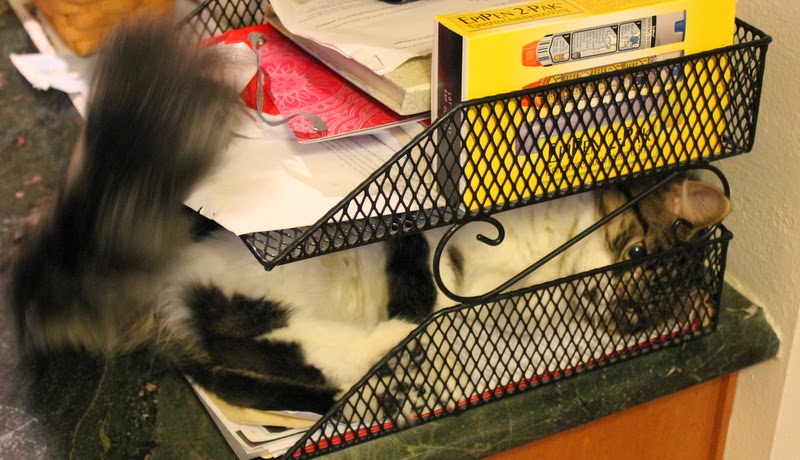
Declutterer. Some areas of our house now look a little, shall we say, minimalistic. For example, the dining room table, which used to have a lovely silk flower arrangement, is now a bare sheet of wood. Cats love to knock things off any surface they manage to get on, whether or not they are allowed on these surfaces. As Prudy’s ability to jump or climb has increased, so has the spareness of my décor—the sofa table, the aforementioned dining table, my dresser. Practically every horizontal surface in the house has been simplified if not stripped bare.  No, I suppose I didn’t really need that ceramic candle holder. But I’m still sad about the folk art cow she knocked off the kitchen sideboard.

Are you sure you need all these papers?

Natural Antidepressant. Prudy is super soft to pet and very purry—she purrs when she eats, she purrs when she plays, she purrs when she’s in the mood for affection. She’ll climb on my lap, lie down, and sometimes go to sleep. She’ll even lie on her back and allow me to play with her paws and stroke her pouffy tail. It’s kind of hard to remain down when faced with all that cuteness.

Asleep on my lap

It's exhausting work being this accomplished

Personal Trainer. Monday morning (a day I had to get up at 6:30—thank you, Prudy), as I exited the bathroom back into our dark bedroom where my husband still slept, my bare feet met something soft and furry. In an effort not to flatten her, I performed some of the most intricate dance moves I’ve done in a long time.

Artist. I’ve been taking Laure Ferlita’s Imaginary Visit to a Past Vacation class, and the first time I worked on an assignment, Prudy lay down on my open palette. I suspect all future sketches will have a little cat hair accent in them somewhere. A new way to incorporate texture!

I consider myself lucky to live with such an accomplished cat, and look forward to seeing what other services she will bring to our lives. Not a bad return on the minimal adoption fee at the shelter!

What are your pets’ specialties?

Being present

Being Present

March 26, 2014


“Being present to the way things are is not the same as accepting things as they are in the resigned way of the cow. It doesn’t mean you should drown out your negative feelings or pretend you like what you really can’t stand…It simply means, being present without resistance: being present to what is happening and present to your reactions, no matter how intense.”
—Rosamund Stone Zander and Benjamin Zander, The Art of Possibility 

Being present

This Morning...

March 21, 2014

I hear:   leaves rustling as they drop from the oak trees; a muted radio and the sound of a nail gun popping from a renovation going on nearby; Scout barking; the roar of a leaf blower; a far-off train whistle; the pool filter clicking on; various birds chirping and singing.


I see: sunlight and shadows making patterns on the ground and the surface of the pool; orchid buds opening, Spanish moss lazily blowing; ripples on the pool from the cycling filter; foliage trembling in the breeze.

I feel: mild, damp air; achy back (I’ve been sitting too long); cool metal of the chair arm.

I smell: Cold coffee in my mug; dirt; green and growing things.

I taste: Coffee and biscotti.

The weather has been perfect for sitting outside this week, and I spent some time reading and writing on the lanai this morning. I’m amazed by all the sensory input even when I’m sitting quietly in my back yard!

What did you hear, see, smell, feel and taste today?

Happiness

March 20 Is International Day of Happiness—How Will You Celebrate?

March 19, 2014


Morning happiness

What: International Day of Happiness
When: March 20
Who: 193 member nations of the United Nations
Where: All over the world
Why: Because the happiness and well-being are recognized as universal goals and aspirations in the lives of people all over the world.
How: Up to you! Find or take a picture of something that makes you happy and post it to social media (use #happinessday to be part of the official celebration) or on the “Wall of Happiness.” Learn more about International Day of Happiness here.)

What makes you happy? Share your thoughts in the comments!

Happy!

Achievement

What Comes After?

March 17, 2014

I recently celebrated another milestone anniversary: 10 years of having my horse, Tank. I find this as mind blowing as knowing I’ve been married for 26 years and that I have a (nearly) adult child.

When I was looking for a horse of my own, and even when I bought him, I was totally focused on the goal of finding a horse. I wasn’t thinking about all the years we had ahead of us, the time we would share getting to know each other, learning to work together. Just like when I was dating and falling in love, or preparing to become a mother—I didn’t think so much about what would happen once I reached that milestone or achieved that goal. The “after” was a blank space in my mind.

What do we do after we get what we want—after we achieve something we’ve longed for? What happens after we fall in love, lose 20 pounds, have a child, get that coveted job, even buy that horse?

Reality sets in. The goal we once desired with all of our hearts is in our hands, and often we find it’s not all romantic dinners under the stars, buying new clothes in a smaller size, cuddling a sleeping baby, kudos from the boss, or galloping like the wind. There’s manure to shovel, diapers to change, compromises to be made and maintenance of all kinds to be done. In many cases, “after” lasts longer than “before.” How can we make the most of what comes after we reach a milestone or major goal?

  1. Appreciate what we have. Stop and look at what we’ve just achieved or received. Take it in. Isn’t it wonderful that we have this thing we have longed for for so long? Bask in the feeling and say a little thank you to the universe. It’s very easy to get caught up in the details, both good and bad, adjust to the new reality, and forget the work and sacrifices it took to get what we wanted.
  1. Don’t make comparisons with others. Since I came to horses as an adult—and a none-too-athletic one—my skills have grown more slowly than the young girls I often ride with. If I compared myself to them, I’d become dissatisfied with my experience, when what I have is all I ever wanted. If I compare my marriage, my relationship with my son, or my career with others’, I can become discouraged that what I have isn’t as outwardly “good.” Every person has his or her own abilities, challenges, lucky (or unlucky) breaks, and so on. And what we see from the outside is rarely the whole story. As Theodore Roosevelt said, “Comparison is the thief of joy.”
  1. Keep growing and learning. So we have this new thing/relationship. Now what? Is that the ultimate? How can we enhance and improve whatever-it-is? Growing and learning are what life’s all about. To return to my relationship with Tank, over the past 10 years I’ve spent most of my time learning, from the simple things (how to groom a horse or post a trot) to the more complex (how to “speak horse” or use tiny movements of my body to control where he goes and how fast).
If we appreciate what we have, don’t compare it with what others have, and keep learning so we can make it better, what comes after will better than we can even imagine.

What have you discovered about what comes after a big goal or milestone?

Since it's an anniversary, will there be (carrot) cake?