Joe Paddock

Joy in Each Breath

November 12, 2014

Photo courtesy Heri West

Introduction by Ted Kooser: Joe Paddock is a Minnesota poet and he and I are, as we say in the Midwest, “of an age.” Here is a fine poem about arriving at a stage when there can be great joy in accepting life as it comes to us.

One’s Ship Comes In

I swear
my way now will be
to continue without
plan or hope, to accept
the drift of things, to shift
from endless effort
to joy in, say,
that robin, plunging
into the mossy shallows
of my bird bath and
splashing madly till
the air shines with spray.
Joy it will be, say,
in Nancy, pretty in pink
and rumpled T-shirt,
rubbing sleep from her eyes, or
joy even in
just this breathing, free
of fright and clutch, knowing
how one’s ship comes in
with each such breath.

American Life in Poetry is made possible by The Poetry Foundation  www.poetryfoundation.org), publisher of Poetry magazine. It is also supported by the Department of English at the University of Nebraska, Lincoln. Poem copyright ©2009 by Joe Paddock from his most recent book of poetry, “Dark Dreaming, Global Dimming,” Red Dragonfly Press, 2009. Reprinted by permission of Joe Paddock and the publisher. Introduction copyright ©2011 by The Poetry Foundation. The introduction’s author, Ted Kooser, served as United States Poet Laureate Consultant in Poetry to the Library of Congress from 2004-2006.

30-Day Gratitude Photo Challenge: 2014 Edition

10 Ways to Spread Kindness

November 10, 2014

It’s easy to see unkindness in the world: in wars, the rhetoric of politicians, and more personally in the nasty comments we so often see online, on Twitter, and other places where people can anonymously let loose their hatefulness. Kindness is much quieter. It doesn’t demand attention, it doesn’t get in your face, and even though it’s sometimes anonymous, the feeling it leaves behind is happiness, not misery (or at least the desire to take a very hot shower).

Kindness is today’s 30-Day Gratitude Photo Challenge prompt, and this Thursday, Nov. 13, is World Kindness Day so kindness is on my mind. Even though I really value kindness and aspire to be kind, I’m not always aware of what I can do to spread kindness. After a little thought and some quick internet research, I found quite a few simple, inexpensive suggestions I can follow to create some ripples and make the world a kinder place. Here are 10 of my favorites: 

1. Smile and look into the eyes of the grocery store cashier.

2. Pick up trash.

3. If you regularly visit a blog and enjoy it, leave a comment. A simple, “enjoyed your post,” is all you need. (Bloggers appreciate kindness the way resurrection ferns appreciate rain.)

4. Give others the benefit of the doubt. Remember the words of the Egyptian philosopher Philo, “Be kind, for everyone you meet is fighting a hard battle.”

5. Allow someone to go in front of you, in traffic or in line.

6. Share a store coupon. Some stores offer coupons for X amount of dollars off a minimum purchase. If you’re not going to use yours, find someone in line who looks like he or she has enough merchandise to meet the minimum amount necessary. (This suggestion came from my kind mother-in-law.)

7. Write a note (or send a post card), by hand, add a stamp and mail it. It will make someone’s day to receive “real” mail rather than junk or bills.

8. Donate old towels to an animal shelter or rescue.

9. Pay a toll or buy a cup of coffee for the person behind you.

10. Think before you speak. Even so-called “jokes” can hurt someone who is sensitive.

And don’t forget to be kind to yourself. It’s a lot easier to be kind to others when you practice on yourself!

I’m encouraged to see that there are more and more organizations devoted to promoting kindness, including The Random Acts of Kindness Foundation, One Million Acts of Kindness and Choose to Be Nice. Perhaps one day the kind people will outnumber the trolls and meanies.

What acts of kindness have you experienced? How have you shown kindness to others?

Happiness

Five Ways to Feel Happier (in 10 Minutes or Less)

November 07, 2014

No matter how happy we are, most of us would like to be just a little happier. Good news for us—there are plenty of things we can do to feel happier every day that only take a few minutes. Researchers have found a number of quick and easy happiness boosters, such as playing music that makes you feel happy, writing down things that went well and/or things you’re grateful for, or doing something nice for someone else. Here are five more 10-minutes-or-less happiness-boosting recommendations I’ve tried that bring my happiness level up a notch:

1. Cross something off the to-do list. We’re happier when we’ve achieved something, no matter how small. Choose one small task to take from start to finish (change that burnt out light bulb), or a smaller part of a larger project (check airfares for that trip you’re thinking of taking). What matters is completing the action.

2. Meditate. Sit quietly, close your eyes, and breathe. If you like, you can imagine a calming image or place, or focus on your breath. If you find yourself stewing about problems or mentally running through your to-do list, notice those thoughts and let them go. Tell yourself, “I’ll think about those things later.”

3. Laugh. Keep on hand a supply of things that make you laugh—reading material, favorite internet links (I like to scroll through Pinterest’s humor category), and so on. A quick laugh can leave your entire mood elevated. 

4. Pet an animal. Doing so lowers heart rate and stress hormones, while raising hormones that make you feel more relaxed and happy. Scout, Prudy and Tank take turns making me feel happier!

C'mon, pet my tummy...

5. Look through a “joy collection.” I keep a file folder with letters and cards from people I love, photocopies of checks received for writing and editing jobs, and photos that make me smile. Don’t have a joy collection? Start one. Fill it with things that trigger happy memories, such as favorite photos, awards, mementoes, and other symbols of happiness for you.

Feeling happier yet? What are your favorite quick happiness boosters?

Appreciation

Recognizing Happiness

November 05, 2014


“We tend to forget that happiness doesn’t come as a result of getting something we don’t have, but rather of recognizing and appreciating what we do have.”
—Frederick Koenig

30-Day Gratitude Photo Challenge: 2014 Edition

Want to Join Me in 30 Days of Gratitude?

November 03, 2014

According to a growing amount of positive psychology research, there seems to be a link between gratitude and happiness. Those with an attitude of gratitude are generally a happier and healthier lot (you can read about more of the benefits of gratitude here: “10 Reasons Why Gratitude is Healthy”). I want to be happier and healthier, and my attitude of gratefulness is one thing I can influence, so why not do some experimenting? I’m ashamed to admit though I have much to be grateful for, I often focus on what I want but don’t have.

With that in mind, in November I’m participating in Dani Dipirro’s (Positively Present) “30-Day Gratitude Photo Challenge.” Every day on Facebook, I will post a photo and brief description of something I’m grateful for, using the prompts she’s provided. I’m doing this for two reasons: First, I do really want to focus on what I’m grateful for. Second, I want to see if I can do something for 30 days straight! I have a bad habit of tearing off all gung ho for a project and quickly losing steam. It’s time I built some stick-to-it muscles. What better way than becoming more mindful of what I’m grateful for?

Today’s prompt is “Dream”—what we dream of, both literally or in the abstract; recurring dreams; what we daydream about.  I could easily have slapped a photo of Tank here and called it a day, because he’s a significant dream come true that I’m grateful for. However, I already posted a photo of him on day one (“Beauty”) and I’d rather not turn this project into a photo album of Tank pictures. Instead, I sat for a few minutes thinking about other dreams I’ve had that have come true, and those still just out of my reach.

What I decided to post today: I’m grateful for the chance to fulfill my desire to write.

The tools of my trade

Essentially, I’ve been a writer since high school when a creative writing teacher named Marie Tollstrup taught me how to harness the words swirling in my head and shape them into various forms of prose and poetry. I’ve worked as a writer (and editor) full time, part time and freelance my whole adult life. At times I’ve made enough to support myself, and others I’ve made little to nothing. I have been able to spend hours reading and writing and exploring and playing with words, starting pieces and throwing them away, filing them for the future, submitting them for others’ perusal. I haven’t always made the most of my opportunities, whether through fear or distraction or laziness, but I have had the luxury of trying.

If you want to see what else I’m grateful for, you can do so on my Facebook page (click on my Facebook link on the left side of this blog. If we’re not already friends, send me a friend request.) I will also be writing more posts on this challenge on Catching Happiness, but not every day.  And if this sounds like something you want to do, too, please join in! The original challenge can be found at Positively Present, “30-Day Gratitude Photo Challenge: 2014 Edition.”

What are you grateful for today?

Everyday adventures

Meeting Myself at 17

October 31, 2014


In the course of cleaning out a closet recently, I found a box of keepsakes from high school. It was educational, to say the least. This box contained treasures such as:
  • A Pee-Chee All Season Portfolio (anyone else remember these?)—I bought at least one of these every year to confine my class work.
  • My school ID from senior year of high school, complete with its coveted sticker allowing me to leave campus for lunch. My best friend and I often drove in her green VW Bug to her house to eat, just because we could.
  • Programs from high school plays I appeared in.
  • Copies of my annual high school literary magazine. My work appeared in the publication, and I was a staff member.
  • Final projects from creative writing class—collections of poems, stories, photos and drawings from the entire school year.
  • Journal pages from the journal our creative writing teacher required us to keep. She would read the pages, or not, as you requested. If she read them, she’d occasionally jot comments on the pages—can you imagine reading the journals of 20-some high school students?!

I spent a few happy hours reconstructing my high school days, cringing and blushing at times, surprised at others by how similar my writing voice now is to that of my 17-year-old self.

I had fun reconnecting with the girl I used to be. The exuberance, the highs and lows, the enthusiasm and hunger for life. That girl was easily cast down and just as easily sent soaring. It was in high school that I began to be able to negotiate around my shyness, finding pursuits I loved (writing, drama, tennis) and participating in life on my own terms. It was here that the seeds of who I am today were sown.

Looking at my picture and reading my words, I see a vibrancy that I wish I still had. In comparison, I’ve become muted by life and responsibility, even though that responsibility was taken on willingly and happily: building an adult life, working, raising a child. I see a more refined version of my 17-year-old self in the mirror today—some of the rough edges knocked off, the fears calmed, the goals achieved. What remains is hope for the future, curiosity about what’s next, excitement about what that might be—and yes, a little bit of fear as well. I have learned that fear is normal, and nothing to be, well, feared.

My life now is starting, in small and subtle ways, to have the same sense of possibility I felt at 17. My child is (almost) grown up, I’m settled in my home, I know how to cook and clean, I can pay bills and run my life efficiently. Most of the things I wondered and worried about have come and gone and I can turn my concentration to new possibility. What will the next 10 years hold? I see my journals (not to mention my blog posts!) asking this question. Wondering what the next adventure(s) will be. Wanting to have adventures, everyday and otherwise.

I remember what it felt like to listen to music and dream about the future. I still do that, only now I’m in my home office listening to my iTunes library instead of in my bedroom listening to a turntable. I still jot poetry in a notebook, write in my journal. My future is a bit blurry, as it was then. I’m more deliberate in my choice of opportunities to pursue now, because I have a better idea of what I like and don’t like, what I can excel in. I no longer have adults telling me what to do; I am learning to listen to my voice, because now I have experience and wisdom of my own. I want to incorporate my 17-year-old self’s enthusiasm into my current life, temper her fears with my maturity, and build a future me that combines all the best parts of us. 

Do you see your past selves when you look in the mirror? How are you the same (or different) from who you were at 17?

At 17--senior class photo

October

Early October Snow

October 29, 2014

Photo courtesy Jim Ernsberger

Introduction by Ted Kooser: Here’s a lovely poem for this lovely month, by Robert Haight, who lives in Michigan.

Early October Snow

It will not stay.
But this morning we wake to pale muslin
stretched across the grass.
The pumpkins, still in the fields, are planets
shrouded by clouds.
The Weber wears a dunce cap
and sits in the corner by the garage
where asters wrap scarves
around their necks to warm their blooms.
The leaves, still soldered to their branches
by a frozen drop of dew, splash
apple and pear paint along the roadsides.
It seems we have glanced out a window
into the near future, mid-December, say,
the black and white photo of winter
carefully laid over the present autumn,
like a morning we pause at the mirror
inspecting the single strand of hair
that overnight has turned to snow.

American Life in Poetry is made possible by The Poetry Foundation (www.poetryfoundation.org), publisher of Poetry magazine. It is also supported by the Department of English at the University of Nebraska, Lincoln. Poem copyright ©2013 by Robert Haight from his most recent book of poems, Feeding Wild Birds, Mayapple Press, 2013. (Lines two and six are variations of lines by Herb Scott and John Woods.) Poem reprinted by permission of Robert Haight and the publisher. Introduction copyright 2014 by The Poetry Foundation. The introduction’s author, Ted Kooser, served as United States Poet Laureate Consultant in Poetry to the Library of Congress from 2004-2006.

Share/Bookmark

Everyday adventures

Making Room for the New

October 27, 2014


One of my goals for this year was to deep clean and organize every room in my house. I’m not sure I’m going to finish the whole house this year, but as I’ve purged and cleaned, painted and organized, donated and sold, I’ve made visible progress through my home. I’m doing this not just because I want my home to be in order, but also because I’m ready to live in a simpler, less cluttered and fussy way. And after nearly 18 years in this house, it’s time for some updating.

Even though in general I love my life and its routines, I feel ready for some freshening up. In a couple of weeks I will have been writing this blog for five years. In that time, I’ve seen my freelance work slow to a trickle, then dry up completely. I’ve battled writer’s block and depression, experimented with writing and submitting essays, applied for a job at the library as well as numerous writing jobs. I’ve come up with several ideas for writing and editing businesses, but I haven’t found anything that sticks yet.


Perhaps I’m getting ahead of myself. Perhaps I need to have less before I can have more. I’d like to think all this decluttering serves a purpose larger than just having my home look neater. I choose to think that getting rid of what no longer serves me makes room for the new. And I’m not talking about new things. Perhaps, less burdened by too much and too many (things and thoughts), the inside of my head will be a bit neater as well. For now, I’m focused on getting rid of.

I’m not sure what that something new I’m making room for looks like. I have to have faith that if I do make room, if I do simplify and purge and organize, then I’ll be ready when my opportunities come, when everyday adventure knocks on my door.

What would you like to get rid of? Add? How do you make room for the new?

Everyday adventures

Field Trip Friday: Turtle Bay Exploration Park

October 24, 2014


Some places resonate with me—they feel like old friends, even the first time I visit them. One such place for me is Turtle Bay Exploration Park (TBEP) in Redding, California. When I visit my family, it’s one of the places I always want to go back to—what better place to share with you as a Field Trip Friday?

TBEP is 300-acre “gathering place” divided into north and south “campuses,” separated by the Sacramento River and connected by Spanish architect Santiago Calatrava’s Sundial Bridge. In addition to the bridge, there is a museum, a forestry and wildlife center, and an arboretum and botanical gardens. The complex houses approximately 800 plant species/cultivars and 225 animals. Here’s a brief description of each of the major components:

McConnell Arboretum and Botanical Gardens
The 20 acres of water-wise gardens here represent the world’s five Mediterranean climate zones: Southwest Australia, South Africa, California, Chile and the Mediterranean Basin. The plants share survival adaptations that enable them to thrive in climate conditions with warm/hot dry summers and rainy winters, and all require moderate to low water usage. The gardens are divided into several areas, including a Children’s Garden, Perennial Companions Display Garden, Butterfly Garden, Medicinal Garden and the Pacific Rim Garden. Mosaic features and fountains are scattered throughout the gardens. This is my favorite area of the TBEP—lots of places to sketch, take pictures, or simply sit and enjoy the gardens. I didn’t sketch while I was there, but did take some pictures:


Sounds of Water by Betsy Damon 

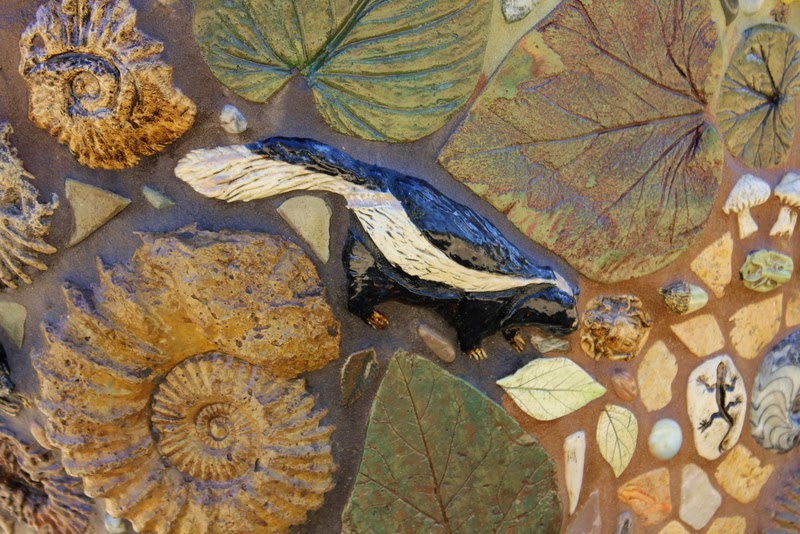
Mosaic fountain, part of Mosaic Oasis, by Colleen Barry


Earthstone, by Colleen Barry
Detail from Earthstone

Museum and Forest Camp
Paul Bunyan’s Forest Camp is a popular destination for children. It includes a playground; the Parrot Playhouse, a year-round lorikeet aviary; Wildlife Woods; a seasonal Butterfly House and an amphitheater where daily educational shows take place. There are lots of hands-on activities for kids, and this is where you’ll find the animals. Though we never found the newest addition, a young bobcat (she was being used in a presentation that we missed), we did see a porcupine, a couple of raptors and a beautiful red fox.


The museum houses several permanent and interactive exhibits focusing on local and regional history, as well as traveling exhibits. When we were there, so was Toytopia, an exploration of the past century of toy making. We saw the world’s largest Etch-A-Sketch (more than eight feet tall—and I didn’t take a picture!), a retro arcade with games like Tron and Donkey Kong, building areas for kids with Lego and Lincoln Logs, and toys from the early 1900s onward.

Sundial Bridge
This beautiful bridge is indeed a sundial, though the shadow of its 217-foot-tall pylon is only completely accurate once a year, on the summer solstice. Opened July 4, 2004, the Sundial Bridge is also a downtown entrance for Redding’s Sacramento River Trail system, a 35-mile long trail that extends along both sides of the river, connecting the bridge to the Shasta Dam. Made of steel, glass and granite, it’s 700 feet long and 23 feet wide. No vehicles are allowed on the bridge, and it’s an easy stroll across the river. When we were there, we saw men fly fishing on one side of the river, and Canada Geese bobbing and floating on the other side.


Sacramento River--see the teeny fishermen?


If you’re ever in the Redding area, the Turtle Bay Exploration Park is well worth the visit. There is no admission charge to walk over the Sundial Bridge and down the Sacramento River Trail, but you do have to pay to enter the botanical gardens, museum and forestry camp. If I lived in this area, I’d like to think I’d often be found here, though you know how that is. We don’t always use and appreciate the simple pleasures and everyday adventures we have available to us. (When was the last time I was at the USF Botanical Gardens, for instance?)

Where have your wanderings taken you lately?

Carl Sandburg

The Coin of Your Life

October 22, 2014

Photo courtesy Sanja Gjenero

“Time is the coin of your life. It is the only coin you have, and only you can determine how it will be spent. Be careful lest you let other people spend it for you.”
—Carl Sandburg

Friday, October 24 marks the 11th annual Take Back Your Time Day. How will you take charge of your time?

Everyday adventures

Homes Sweet Homes

October 20, 2014

Lucky me.

I can call more than one place home. There is, of course, my home here in Florida, where I’ve lived for more than 20 years, raised my son, put down roots. And there is California, the home of my birth and growing-up years, where my parents still live, and, I confess, where a piece of my heart remains. I just returned from a 10-day trip to California, and while I loved my time there, I was so very happy to come…home.

Always have to stop here for coffee!
When I arrive in CA, I always want to do everything at once—hug everyone, pet the cats (we all have cats), hear what’s been going on, go shopping, play games, and eat all the special foods they always have for me. I told everyone that I mainly wanted to just hang out and relax; they weren’t to worry about “entertaining” me. I run around enough at home. So that’s mainly what we did—I was able to sleep eight and nine hours a night without an elderly dog waking me up, I had time to read, and I even did a couple of watercolor sketches! We did go on a few planned outings—to Turtle Bay and the Sundial Bridge (look for a Field Trip Friday soon), and my favorite used bookstore with my mom; lunch out and a shopping trip with my stepmom. And since my Rays were not in the playoffs, I rooted for my stepmom’s favorite team, the San Francisco Giants, in their playoff games against Saint Louis. (They won and will be meeting the Kansas City Royals in the World Series starting tomorrow.)

One of my favorite places--the old cow barn at my mom's

Sketches

My dad making my favorite salad.
When I come back to Florida, I want to sleep in my own bed, drink my morning coffee made just so, wear the clothes I didn’t take on the trip…you get the idea. Now that I’m home home, I’m appreciating my life more: my work, my leisure, my little routines and treats. Whether it was because of the rest I got while in CA, or the fallish (for FL) weather, I feel reenergized and more awake. Ready to tackle daily life again. Grateful for the people, pets and places—the simple pleasures and everyday adventures—that feel like home.

My mom's newest addition

Misty, my dad and stepmom's cat
Like I said, lucky me.

Has anything reenergized you lately?

California

Living It Up in California

October 10, 2014


I’m living it up in California visiting my family—no housework, no cooking, no laundry…except for helping out, of course. And no writing, except for journaling. Time to catch up with the parents, refill the well, and take some much-needed time off. I’ll be back to the blog soon, and in the meantime I hope you have a very happy week!

Jennifer Maier

Rummage Sale

October 08, 2014


Introduction by Ted Kooser: I’d guess everybody reading this has felt the guilt of getting rid of belongings that meant more to somebody else than they did to you. Here’s a poem by Jennifer Maier, who lives in Seattle. Don’t call her up. All her stuff is gone.

Rummage Sale 

Forgive me, Aunt Phyllis, for rejecting the cut
glass dishes—the odd set you gathered piece
by piece from thirteen boxes of Lux laundry soap.

Pardon me, eggbeater, for preferring the whisk;
and you, small ship in a bottle, for the diminutive
size of your ocean. Please don’t tell my mother,

hideous lamp, that the light you provided
was never enough. Domestic deities, do not be angry
that my counters are not white with flour;

no one is sorrier than I, iron skillet, for the heavy
longing for lightness directing my mortal hand.
And my apologies, to you, above all,

forsaken dresses, that sway from a rod between
ladders behind me, clicking your plastic tongues
at the girl you once made beautiful,

and the woman, with a hard heart and
softening body, who stands in the driveway
making change.

American Life in Poetry is made possible by The Poetry Foundation (www.poetryfoundation.org), publisher of Poetry magazine. It is also supported by the Department of English at the University of Nebraska-Lincoln. Poem copyright ©2013 by Jennifer Maier from her most recent book of poems, Now, Now, University of Pittsburgh Press, 2013. Poem reprinted by permission of Jennifer Maier and the publisher. Introduction copyright © 2014 by The Poetry Foundation. The introduction's author, Ted Kooser, served as United States Poet Laureate Consultant in Poetry to the Library of Congress from 2004-2006.

All Quiet on the Western Front

Reading Outside My Comfort Zone: All Quiet on the Western Front

October 06, 2014


I usually avoid books on war (and other harrowing topics), but I needed a classic about war to finish my Back to the Classics challenge. I happened to have All Quiet on the Western Front on my TBR shelf, and since on its cover there was a banner proclaiming, “The greatest war novel of all time,” I thought I’d give it a try. And I’m so glad I did. This novel, by Erich Maria Remarque, was beautifully and sensitively written in a way that helped me understand the emotional experience of soldiers at war without overwhelming my emotions. Originally written in German, my copy was translated by A.W. Wheen and I found the writing simple and easy to read.  Some of the most affecting passages for me included the following:

Describing a dying friend: “Under the skin the life no longer pulses, it has already pressed out the boundaries of the body. Death is working from within. It already has command in the eyes. Here lies our comrade. Kemmerich, who a little while ago was roasting horse flesh with us and squatting in the shell-holes. He it is still and yet it is not he any longer. His features have become uncertain and faint, like a photographic plate from which two pictures have been taken. Even his voice sounds like ashes.”

After guarding Russian prisoners of war: “A word of command has made these silent figures our enemies; a word of command might transform them into our friends. At some table a document is signed by some persons whom none of us knows, and then for years together that very crime on which formerly the world’s condemnation and severest penalty fall, becomes our highest aim. But who can draw such a distinction when he looks at these quiet men with their childlike faces and apostles’ beards. Any non-commissioned officer is more of an enemy to a recruit, any schoolmaster to a pupil, than they are to us. And yet we would shoot at them again and they at us if they were free.”

Reflecting on the future: “I am young, I am twenty years old; yet I know nothing of life but despair, death, fear, and fatuous superficiality cast over an abyss of sorrow. I see how peoples are set against one another, and in silence, unknowingly, foolishly, obediently, innocently slay one another. I see that the keenest brains of the world invent weapons and words to make it yet more refined and enduring. And all men of my age, here and over there, throughout the whole world see these things; all my generation is experiencing these things with me…. Through the years our business has been killing;—it was our first calling in life. Our knowledge of life is limited to death. What will happen afterwards? And what shall come out of us?”

Remarque, who was born in 1898, knew whereof he wrote. He was conscripted into the German army at age 18, and eventually wounded several times. After his discharge, he worked as a teacher, stonecutter and test car driver for a tire company, among other things. All Quiet on the Western Front was first published as Im Westen Nichts Neues in German in 1929, and sold more than a million copies the first year. The English translation, published the same year, was just as successful. The book was subsequently translated into 12 languages and made into a movie in 1930. Unsurprisingly, Remarque’s books were banned in Germany in the 1930s, and publicly burned in 1933.

Remarque wrote nine more novels, though none was as successful as All Quiet. He led quite a colorful life, and died in Switzerland in 1970 from an aneurysm.

All Quiet on the Western Front gives us a peek inside the minds of those who actually fight. Warfare may have changed a lot since 1918, but I imagine those fighting still go through most of the emotions and experiences found in this novel. All Quiet was more than worth the read. I felt sensitized and educated rather than depressed, and would definitely recommend it.

What book(s) have you read that are outside your comfort zone?

Contentment

Three Forms of Happiness--and How to Boost Them

October 03, 2014

When we talk about “happiness” we’re really talking about several different things. I’ve chosen to categorize them like this: momentary pleasure, overall happiness and long-term contentment. Ideally, a truly happy life balances all three. Let’s look at these forms and at how we can boost each one.


Momentary pleasure. Momentary pleasure includes all our feel-good moments and jolts of fleeting pleasure. We feel it when we eat a brownie or have a massage, receive a compliment or buy a new shirt. Fleeting pleasures are nice while they last, and we can—and should—easily add them to our daily lives. We should be on the lookout for opportunities to do something nice for ourselves—whether that means taking a break to read a novel, buying some fresh flowers or savoring a delicious meal. We might even make a list of momentary pleasures to indulge in when the time is right.

Nice as it is, however, momentary pleasure is just the tip of the happiness iceberg, so to speak. Chasing momentary pleasure without regard to deeper forms of happiness can backfire, ultimately leaving us unhappy. Which brings us to…


Overall happiness. Overall happiness is a general good feeling about life. Baseline happiness, if you will. Generally, things are going right for you and you appreciate what’s going on in your life. This form of happiness is a little more work than momentary pleasure—you might do things such as work out, eat right, pay your bills on time or help out a neighbor in need—things that contribute to overall happiness but might not always offer momentary pleasure. (For example, I’d much rather eat a brownie than broccoli, but I know my health will suffer if I don’t eat right, and that definitely makes me unhappy). Gretchen Rubin’s excellent books The Happiness Project and Happier at Home both examine ways we can boost our overall happiness. And finally, we come to…


Long-term contentment. Contentment comes from deep within, running like an underground river, even when our outward circumstances seem unhappy. I believe it comes from alignment of purpose, knowing we’re primarily acting according to our deepest values. We can look within and know we’re doing what we believe to be right. We believe our lives are full of more good than bad, and we’re grateful. Boosting this form of happiness requires some introspection, examination of what we really believe, and deciding whether we feel we’re living those beliefs. Meditation and other spiritual practices can guide us to long-term contentment. One practice I’m working on incorporating is the “three good things” exercise: every day before bed record three good things from that day. It’s so easy for me to dwell on the negative; this practice helps me refocus on the positive.

Pursuing—and catching—happiness seems to involve a balance between nourishing the body and the soul, taking pleasure and giving it. How do you boost your happiness?

Elizabeth George Speare

Anything Might Be Possible

October 01, 2014


“After the keen still days of September, the October sun filled the world with mellow warmth...The maple tree in front of the doorstep burned like a gigantic red torch. The oaks along the roadway glowed yellow and bronze. The fields stretched like a carpet of jewels, emerald and topaz and garnet. Everywhere she walked the color shouted and sang around her...In October any wonderful unexpected thing might be possible.”
—Elizabeth George Speare, The Witch of Blackbird Pond