Challenges

Paying the Price

April 21, 2014

Fannin Hill, 2012. Photo courtesy Holly Bryan
We did get to go to Fannin Hill on Friday, and it was awesome. Unfortunately, I have no photos to show for it…just some sore muscles and good memories. And , of course, a whole lot of things to clean: my bridle bag, Tank’s shipping boots, my saddle bag and even Tank’s bridle (at one of the water troughs, he immersed his face up to the eyes and shook his head side to side, sending water cascading onto the ground and turning the leather of his bridle into a mucky mess). An outing like this means extra work before and after, as well as stepping outside my comfort zone during. Tank gets excited when we ride off site, and sometimes I feel like I’m on top of a rocket ready to explode. I have to work at communicating what I want in a way that makes sense to him and doesn’t frustrate him:

Tank: “If all the other horses are cantering and jumping over there, why are we over here jumping over this little log?”

Me: “Because those jumps are beyond my abilities and confidence right now—I know you could do it, but would I still be on your back on the other side?”

 Tank: “OK. I guess I don’t want you to hurt yourself. Who would bring me carrots?”

Every time we go to Fannin Hill, we try new things and come home inspired. This time, we practiced going up and down a small bank, which required him to jump up to a higher level while going up, and to step down (into the scary unknown) when going down. He did just fine going up, but was pretty skeptical of going down. We tried several different approaches until he hopped down like it was a non-issue.

Sometimes the best things require effort. In the past, I tended to give up too easily when faced with challenges. Tank is teaching me to think things through, break them down into smaller steps, and to keep trying slightly different approaches. I still find myself avoiding things because I either don’t know what to do, or I think it’s too hard, but I’m becoming more willing and able to pay the price for what I want. And that’s a lesson worth learning.

What dream are you willing to pay the price for?

Happiness

Lucky Link Love

April 18, 2014

Welcome to the Lucky Number Seven edition of Link Love. If the weather holds, today Tank and I are enjoying a Field Trip Friday at Fannin Hill. Enjoy the following links that have been making me happy lately:

Are you at the crossroads of Should and Must? This is an interesting article about choosing between the two. An excerpt:
“Should is how others want us to show up in the world — how we’re supposed to think, what we ought to say, what we should or shouldn’t do. It’s the vast array of expectations that others layer upon us….
“Must is different—there aren’t options and we don’t have a choice.
 “Must is who we are, what we believe, and what we do when we are alone with our truest, most authentic self. It’s our instincts, our cravings and longings, the things and places and ideas we burn for, the intuition that swells up from somewhere deep inside of us. Must is what happens when we stop conforming to other people’s ideals and start connecting to our own. Because when we choose Must, we are no longer looking for inspiration out there. Instead, we are listening to our calling from within, from some luminous, mysterious place.”
How to stop being an emotional sponge.

Introverts unite! Susan Cain, author of Quiet: The Power of Introverts in a World That Can’t Stop Talking, gives an inspiring TED talk about why introverts should be encouraged and valued. 

As a person who struggles with feeling overwhelmed, I found “25 Bold Ways to Avoid the Trap of Overwhelm” to be helpful. “Overwhelm is a story we tell ourselves. It offers us an excuse to get out of what we don’t want to do or don’t feel we can do. Overwhelm is an illusion.” Ouch.

I learned of this new quarterly online magazine through Danielle at A Work in Progress. Even though I do not need any more suggestions for what to read (I already have FAR too many books piled on my shelves or noted on lists), I’m still going to have some fun with this.

Looking for some help in achieving your goals? Check out the four-step “Commitment Contract” process at stickK. Sign up is free.

Four minutes of happy:


I love, love, love this song! Clap along! 

What’s making you happy this week?

Cherry Trees

Early Blooming

April 16, 2014


From your school days you may remember A. E. Housman’s poem that begins, “Loveliest of trees, the cherry now/ Is hung with bloom along the bough.” Here’s a look at a blossoming cherry, done 120 years later, on site among the famous cherry trees of Washington, by D.C. poet Judith Harris. [Introduction by Ted Kooser.]

In Your Absence

Not yet summer,   
but unseasonable heat   
pries open the cherry tree.   

It stands there stupefied,   
in its sham, pink frills,   
dense with early blooming.   

Then, as afternoon cools   
into more furtive winds,   
I look up to see   
a blizzard of petals   
rushing the sky.   

It is only April.   
I can’t stop my own life   
from hurrying by.   
The moon, already pacing.


American Life in Poetry is made possible by The Poetry Foundation (www.poetryfoundation.org), publisher of Poetry magazine. It is also supported by the Department of English at the University of Nebraska-Lincoln. Poem copyright ©2007 by Judith Harris, whose most recent collection of poems is The Bad Secret, Louisiana State University Press, 2006. Reprinted by permission of Judith Harris. Introduction copyright © 2014 by The Poetry Foundation. The introduction's author, Ted Kooser, served as United States Poet Laureate Consultant in Poetry to the Library of Congress from 2004-2006.

Belle

Playing With Words: An Introduction to Haiku

April 14, 2014


Since it’s National Poetry Month, I thought I’d share a brief look at one of my favorite forms of poetry: the haiku.

For many people, haiku is a more approachable form of poetry. Poems are short, usually three lines of 17 syllables or less—perfect for a hurried world. (And, dare I say, even Twitter-sized?) I was taught in school that they should be broken into 5-7-5 form, but it’s increasingly popular and acceptable to break the lines in a different pattern and/or use fewer than 17 syllables. Line breaks should be at natural pauses, and are used to punctuate the poem.

Haiku are deceptively simple—a lot is packed into a few syllables. They focus on what’s happening in the moment, often involve nature and frequently indicate a specific season. They should evoke some type of emotion. According to Creative Writing Now, “Instead of saying how a scene makes him or her feel, the poet shows the details that caused that emotion. If the sight of an empty winter sky made the poet feel lonely, describing that sky can give the same feeling to the reader.”

Even for a novice, haiku are fun to write and read. I’ve gotten away from this practice lately, but for a while I was writing haiku several times a week. This is my most recent one:

huddled like mourners
black vultures crowd together
warm April rain

Two more of my haiku appear in this post found at Belle, Book and Candle where she shares reader haiku. She also has two more posts on haiku here and here. And one of my favorite spots for a dose of haiku is Susan Tweit’s Pinterest page where she writes and posts a haiku and photo every day.

If you’re interested in a more in-depth exploration of haiku, I recommend The Haiku Handbook. For more information on writing your own haiku, click here.

Playing with words makes me happy—and haiku are a fun way to do that. Why not try your hand at haiku, and come back here to share them with us?

Happiness

Happily Human

April 11, 2014

Beautifully imperfect
“It’s great to be great, but it’s greater to be human.”
—Will Rogers

I have a confession to make. I’m not perfect. No, really, I know you all thought I was and you’re probably very disappointed to learn otherwise. Oh, wait. You didn’t think I was perfect. I did. Or, more accurately, I hoped you thought I was, if not perfect, then very, very close to it. It gives me great pain—and also great relief—to finally admit, publicly, that I’m flawed. I can be messy, selfish, stubborn, controlling, I hate to admit I’m wrong… I could go on, but my ego is begging me to quit. I’d really prefer to list “faults” that are really virtues in disguise (as we’ve been told to do on job interviews), but I’m finally becoming too old wise not to accept all parts of myself.

I’m tired of being afraid of mistakes and missteps, of being paralyzed by fear of looking foolish or hypocritical. I’m tired of unreasonable expectations (my own and society’s). I’m tired of perfectionism when it comes to appearance or character or accomplishment. I’m tired of trying to force myself into even attempting to look perfect when—newsflash!—NO ONE is perfect. No, not even me.

Why am I so afraid of showing my imperfections, of looking foolish and admitting mistakes? One reason—I feel a certain shame in admitting imperfection. I should always be kind, warm, giving, an excellent writer, wife and mother, and, on top of that, perfectly fit and healthy. (Shouldn’t I?) My people-pleasing, perfectionist little heart doesn’t want to do anything “wrong” and risk rejection. At bottom, I’m truly afraid if I don’t present myself as darn near perfect, I am not “enough”—and I won’t be liked, let alone loved.

I’m not sure exactly where this comes from. Perhaps because I’ve been given so much in my life—in teaching, examples to follow, health, good fortune and opportunity. I feel I have no excuse for not being, at the very least, really, really close to perfection. I don’t want to waste what I’ve been given. However, just because I know better doesn’t mean I can always do better. I’m still human, and to be human is to make mistakes. I’m still working on feeling OK with that.

The funny thing is, pretending to be perfect actually keeps me from receiving the love I want. Sharing mistakes and weaknesses—imperfections—deepens intimacy between people. And keeping up an appearance of perfection means I can’t share my weaknesses with others, and perhaps receive the help and encouragement I need. It also may keep others from sharing their imperfections with me and allowing me to help them.

Life isn’t about being perfect. It’s about growing, learning from mistakes when we make them. My faults don’t define me. They are just threads woven into the cloth of my personality. I also have many good qualities, and it’s the unique combination of faults and virtues that makes me me. I am human, and learning to be happily so. I want to be loved in spite of and because of my faults. I can’t hide them, from myself or from others. I’m taking to heart Edward G. Bulwer-Lytton’s words: “If you wish to be loved, show more of your faults than your virtues.”

What have you learned from imperfection? How do you overcome your own perfectionism?

Benjamin Zander

The Joyful Question

April 09, 2014


“Unlike success and failure, contribution has no other side. It is not arrived at by comparison. All at once I found that the fearful question, ‘Is it enough?’ and the even more fearful question, ‘Am I loved for who I am or for what I have accomplished?’ could both be replaced by the joyful question, ‘How will I be a contributor today?’
—Rosamund Stone Zander and Benjamin Zander, The Art of Possibility 

Beauty

Beauty and the Soul: The Power of Everyday Beauty to Heal

April 04, 2014


As I write this, I look out my office window at the greenness of spring in Florida—our oak trees have mostly leafed out, my crepe myrtle has the tiniest bronze leaflets clinging to its bare limbs and I know in time it will bear ruffley lavender flowers. A cardinal is visiting the bird feeder, his red feathers bright against the greens and browns of the front yard. I’m listening to acoustic guitar music on Pandora, and I have my window open to smell all that green leafiness and hear the birds’ songs more clearly. Not only do I enjoy looking and listening to the beauty around me, I find that it has a calming and uplifting effect on my mood.

While most people would not argue that beauty is nice, is it something we all need? Best-selling author Piero Ferrucci thinks it is, and explores that topic in his book Beauty and the Soul: The Extraordinary Power of Everyday Beauty to Heal Your Life.

Ferrucci believes that beauty is an essential ingredient in a happy, healthy life. He writes, “Beauty plays a central role in our decision to be here. The more we can perceive beauty in our surroundings, and also inside us, the more we will feel at home and glad to exist. Some perceive beauty in the sound of rain and shape of clouds, in people’s faces and voices, in birdsong and the rustling of leaves. Some see it in modern design or ancient embroidered silk, in a cathedral’s stained glass or an advertising poster, in the flowering of intelligence or in altruism, in musical phrasing or the melodic rhythm of poetry, in the dynamism of a statue or the lightness of a dance. For such people the world is a place of great interest, of continuing amazement. Their relation with life is erotic: They are in love with life.”

Ferrucci also notes that contact with beauty makes us less angry and anxious, and that Swedish studies indicate that those who attended theater, movies, concerts and exhibitions have a greater chance of longevity. One explanation is that beauty stimulates the immune system.

Of course, beauty doesn’t just exist in cultural events and experiences. Beauty is everywhere—we just need to notice it. To improve our ability to seek and find beauty, Ferrucci suggests keeping a diary of what we find beautiful, slowing down and paying more attention to what is all around us (“Hurry usually obliterates all forms of beauty”), and removing the attitudes that hamper beauty (“I don’t deserve it, it’s a waste of time, there are better things to think about…”).  As he notes, “Attention is nourishing. Anything we give our interest to grows and develops. Anything we neglect or ignore atrophies. Attention is like a spotlight on a theater stage. It gives emphasis. The world is what it is, but we provide the accent. We look for beauty, give it our vital interest, create space for it. Then beauty will proliferate for us.”

Beauty lifts up the soul, lightens burdens, gives hope and inspiration—all things we so desperately need in this world. If we seek beauty in our lives, we will add to our happiness.

What do you find beautiful? How can you add beauty to your days?

Kim Dower

Brilliantly Hydrated

April 02, 2014

Photo courtesy Liz West

My parents didn’t live long enough to be confronted with the notion of paying for a bottle of water. They’d be horrified. Pay for water? Who ever heard of such a thing? Well . . . Here’s a good poem by Kim Dower, who lives in Los Angeles, about what we go through to quench our thirst today. [Introduction by Ted Kooser.]

Bottled Water

I go to the corner liquor store
for a bottle of water, middle
of a hectic day, must get out
of the office, stop making decisions,
quit obsessing does my blue skirt clash
with my hot pink flats; should I get
my mother a caregiver or just put her
in a home, and I pull open the glass
refrigerator door, am confronted
by brands—Arrowhead, Glitter Geyser,
Deer Park, spring, summer, winter water,
and clearly the bosses of bottled water:
Real Water and Smart Water—how different
will they taste? If I drink Smart Water
will I raise my IQ but be less authentic?
If I choose Real Water will I no longer
deny the truth, but will I attract confused,
needy people who’ll take advantage
of my realness by dumping their problems
on me, and will I be too stupid to help them
sort through their murky dilemmas?
I take no chances, buy them both,
sparkling smart, purified real, drain both bottles,
look around to see is anyone watching?
I’m now brilliantly hydrated.

American Life in Poetry is made possible by The Poetry Foundation (www.poetryfoundation.org), publisher of Poetry magazine. It is also supported by the Department of English at the University of Nebraska-Lincoln. Poem copyright ©2012 by Kim Dower, whose most recent book of poems is Slice of Moon, Red Hen Press, 2013. Poem reprinted from Barrow Street, Winter 2012/13, by permission of Kim Dower and the publisher. Introduction copyright © 2014 by The Poetry Foundation. The introduction's author, Ted Kooser, served as United States Poet Laureate Consultant in Poetry to the Library of Congress from 2004-2006.

An Imaginary Visit to a Past Vacation

As in Art, So in Life

March 31, 2014


As I mentioned in “Hello Sketchbook, My Old Friend,” I’ve been taking Laure Ferlita’s An Imaginary Visit to a Past Vacation class. Not for the first time, I noticed I’m learning more in art class than simply how to sketch—I’m learning lessons that easily expand beyond the art studio. As in art, so in life:

Preparation makes everything easier… Laure encouraged us to do thumbnails (quick sketches in a junk journal to figure out placement of images and lettering).  Before starting a sketch, I made sure I had my palette, full waterbrushes, paper towels and tissues, my color chart, my reference photos, and a scrap piece of watercolor paper if I needed a quick color check. Once I started, I didn’t want to have to stop to hunt something down. This is also a good way to approach new projects and experiences: figure out what resources you need to have before you get started so that you can proceed smoothly.

…but sooner or later, I have to start. I sometimes let myself get stuck in preparation mode, forever putting off action. Facing a blank page in my sketchbook feels remarkably like facing decisions or starting major projects. Once that first mark hits the page—or I take that first action—I usually relax and can continue without too much fuss and bother.

I’m often my harshest critic. I was pretty happy with my sketches in this class, but in previous classes, I have been frankly embarrassed to share my work. I could see only the flaws in it, how it wasn’t what I wanted it to be, and how (I felt) it wasn’t as good as everyone else’s. My fellow classmates always found something good to say, and ways to encourage me not to give up. When I comment on my classmates’ art, I always look for something specific that I like about it, and I can always find it. I should be so generous with myself! I have a feeling my art isn’t the only area where I’m much harder on myself than is necessary.

As always, I had a great time in Laure’s class, and was able to take away more than just the beginnings of a new sketchbook. I still have one more assignment to complete, so excuse me while I get ready, get started, and ease up on myself. 

So what have you been up to lately?

Animals

The Accomplished Cat

March 28, 2014

It’s been a long time since I’ve had a cat, and I had forgotten some of the added services cats provide over and above being pets. Each cat has his or her own specialties, and here are a few of Prudy’s:

Alarm Clock. My cat alarm clock is set for 6:30 a.m. This is fine for the rare days that I need to get up that early—which, unfortunately for Prudy, are not that often. Many nights I must shut Prudy in my office/her bedroom so that I can get a full night’s sleep. My office is directly next door to our bedroom, so when her snooze alarm goes off at 7:15, I’m sure to hear it.

Declutterer. Some areas of our house now look a little, shall we say, minimalistic. For example, the dining room table, which used to have a lovely silk flower arrangement, is now a bare sheet of wood. Cats love to knock things off any surface they manage to get on, whether or not they are allowed on these surfaces. As Prudy’s ability to jump or climb has increased, so has the spareness of my décor—the sofa table, the aforementioned dining table, my dresser. Practically every horizontal surface in the house has been simplified if not stripped bare.  No, I suppose I didn’t really need that ceramic candle holder. But I’m still sad about the folk art cow she knocked off the kitchen sideboard.

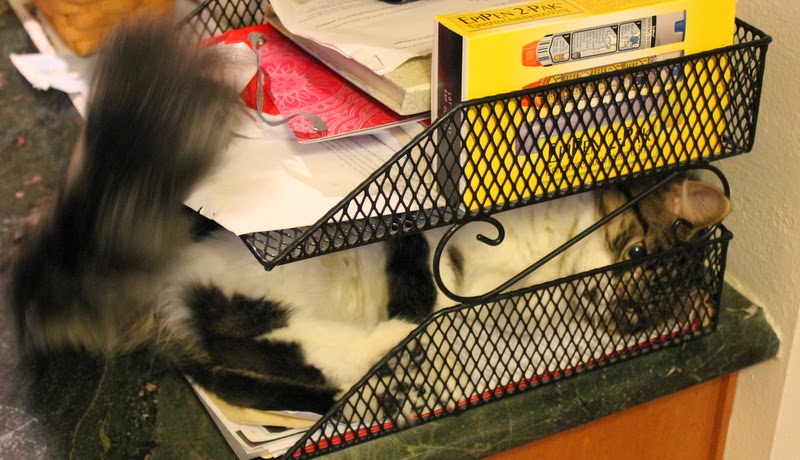
Are you sure you need all these papers?

Natural Antidepressant. Prudy is super soft to pet and very purry—she purrs when she eats, she purrs when she plays, she purrs when she’s in the mood for affection. She’ll climb on my lap, lie down, and sometimes go to sleep. She’ll even lie on her back and allow me to play with her paws and stroke her pouffy tail. It’s kind of hard to remain down when faced with all that cuteness.

Asleep on my lap

It's exhausting work being this accomplished

Personal Trainer. Monday morning (a day I had to get up at 6:30—thank you, Prudy), as I exited the bathroom back into our dark bedroom where my husband still slept, my bare feet met something soft and furry. In an effort not to flatten her, I performed some of the most intricate dance moves I’ve done in a long time.

Artist. I’ve been taking Laure Ferlita’s Imaginary Visit to a Past Vacation class, and the first time I worked on an assignment, Prudy lay down on my open palette. I suspect all future sketches will have a little cat hair accent in them somewhere. A new way to incorporate texture!

I consider myself lucky to live with such an accomplished cat, and look forward to seeing what other services she will bring to our lives. Not a bad return on the minimal adoption fee at the shelter!

What are your pets’ specialties?

Being present

Being Present

March 26, 2014


“Being present to the way things are is not the same as accepting things as they are in the resigned way of the cow. It doesn’t mean you should drown out your negative feelings or pretend you like what you really can’t stand…It simply means, being present without resistance: being present to what is happening and present to your reactions, no matter how intense.”
—Rosamund Stone Zander and Benjamin Zander, The Art of Possibility 

Being present

This Morning...

March 21, 2014

I hear:   leaves rustling as they drop from the oak trees; a muted radio and the sound of a nail gun popping from a renovation going on nearby; Scout barking; the roar of a leaf blower; a far-off train whistle; the pool filter clicking on; various birds chirping and singing.


I see: sunlight and shadows making patterns on the ground and the surface of the pool; orchid buds opening, Spanish moss lazily blowing; ripples on the pool from the cycling filter; foliage trembling in the breeze.

I feel: mild, damp air; achy back (I’ve been sitting too long); cool metal of the chair arm.

I smell: Cold coffee in my mug; dirt; green and growing things.

I taste: Coffee and biscotti.

The weather has been perfect for sitting outside this week, and I spent some time reading and writing on the lanai this morning. I’m amazed by all the sensory input even when I’m sitting quietly in my back yard!

What did you hear, see, smell, feel and taste today?

Happiness

March 20 Is International Day of Happiness—How Will You Celebrate?

March 19, 2014


Morning happiness

What: International Day of Happiness
When: March 20
Who: 193 member nations of the United Nations
Where: All over the world
Why: Because the happiness and well-being are recognized as universal goals and aspirations in the lives of people all over the world.
How: Up to you! Find or take a picture of something that makes you happy and post it to social media (use #happinessday to be part of the official celebration) or on the “Wall of Happiness.” Learn more about International Day of Happiness here.)

What makes you happy? Share your thoughts in the comments!

Happy!

Achievement

What Comes After?

March 17, 2014

I recently celebrated another milestone anniversary: 10 years of having my horse, Tank. I find this as mind blowing as knowing I’ve been married for 26 years and that I have a (nearly) adult child.

When I was looking for a horse of my own, and even when I bought him, I was totally focused on the goal of finding a horse. I wasn’t thinking about all the years we had ahead of us, the time we would share getting to know each other, learning to work together. Just like when I was dating and falling in love, or preparing to become a mother—I didn’t think so much about what would happen once I reached that milestone or achieved that goal. The “after” was a blank space in my mind.

What do we do after we get what we want—after we achieve something we’ve longed for? What happens after we fall in love, lose 20 pounds, have a child, get that coveted job, even buy that horse?

Reality sets in. The goal we once desired with all of our hearts is in our hands, and often we find it’s not all romantic dinners under the stars, buying new clothes in a smaller size, cuddling a sleeping baby, kudos from the boss, or galloping like the wind. There’s manure to shovel, diapers to change, compromises to be made and maintenance of all kinds to be done. In many cases, “after” lasts longer than “before.” How can we make the most of what comes after we reach a milestone or major goal?

  1. Appreciate what we have. Stop and look at what we’ve just achieved or received. Take it in. Isn’t it wonderful that we have this thing we have longed for for so long? Bask in the feeling and say a little thank you to the universe. It’s very easy to get caught up in the details, both good and bad, adjust to the new reality, and forget the work and sacrifices it took to get what we wanted.
  1. Don’t make comparisons with others. Since I came to horses as an adult—and a none-too-athletic one—my skills have grown more slowly than the young girls I often ride with. If I compared myself to them, I’d become dissatisfied with my experience, when what I have is all I ever wanted. If I compare my marriage, my relationship with my son, or my career with others’, I can become discouraged that what I have isn’t as outwardly “good.” Every person has his or her own abilities, challenges, lucky (or unlucky) breaks, and so on. And what we see from the outside is rarely the whole story. As Theodore Roosevelt said, “Comparison is the thief of joy.”
  1. Keep growing and learning. So we have this new thing/relationship. Now what? Is that the ultimate? How can we enhance and improve whatever-it-is? Growing and learning are what life’s all about. To return to my relationship with Tank, over the past 10 years I’ve spent most of my time learning, from the simple things (how to groom a horse or post a trot) to the more complex (how to “speak horse” or use tiny movements of my body to control where he goes and how fast).
If we appreciate what we have, don’t compare it with what others have, and keep learning so we can make it better, what comes after will better than we can even imagine.

What have you discovered about what comes after a big goal or milestone?

Since it's an anniversary, will there be (carrot) cake?

Allie Brosh

Random Acts of Reading

March 14, 2014


Did you know it’s National Reading Month in the United States? For me, every month is reading month. As I’ve mentioned frequently (possibly far too frequently), reading is one of my favorite simple pleasures. And I’ve been doing a lot of it, as usual. I’m determined to get a handle on the number of unread books I own, so I’ve been reading primarily from my own stacks, and trying, with mixed success, to curtail book purchasing. (So far this year I’ve spent only $3.75 on books—not counting books I’ve obtained through Paperback Swap and by using a credit at my local used bookstore.)

But I digress. The point (and I do have one) is that I’ve been reading from my own stacks while simultaneously trying not to rebuild them. I’ve read 11 books out of my 36-book goal so far. I thought I’d share a few bits and pieces from this year’s reads.

The first book I read this year, What Alice Forgot, was so delightful that I kept it in my library instead of passing it on. Alice Love thinks she’s 29 and pregnant with her first child when she regains consciousness after a fall at the gym. Turns out, she’s actually 39, the mother of three and about to be divorced. What happened during that missing 10 years? This book was fun to read, and also thought provoking: Is your life what you expected it to be 10 years ago?  

Their Eyes Were Watching God, by Zora Neale Hurston, was my first classic of the year. I had never read anything by this writer, and wasn’t sure what to expect. I enjoyed this book very much. Set in Florida, it follows Janie Crawford’s search for real love and her true self, and isn’t that what we’re all looking for? A tiny teaser:

“She was a rut in the road. Plenty of life beneath the surface but it was kept beaten down by the wheels….mostly she lived between her hat and her heels, with her emotional disturbances like shade patterns in the woods—come and gone with the sun.”

Interesting fact: Hurston wrote Their Eyes Were Watching God in only seven weeks!

Take the Cannoli, a book of essays by Sarah Vowell, was an impulse buy at my library’s book store. I’d read one other book by Vowell, who is also a contributor to radio’s “This American Life,” and I love her quirky writing voice. One of my favorite passages from Cannoli:

“Heaven, such as it is, is right here on earth. Behold: my revelation: I stand at the door in the morning, and lo, there is a newspaper, in sight like unto an emerald. And holy, holy is the coffee, which was, and is to come. And hark, I hear the voice of an angel round about the radio, saying, ‘Since my baby left me I found a new place to dwell.’ And lo, after this I beheld a great multitude, which no man could number, of shoes….”

(And speaking of “voice,” I just learned that Vowell was the voice of Violet in one of my favorite animated movies, The Incredibles.)

Hyperbole and a Half, by Allie Brosh, was a library book, I admit, but I couldn’t resist it. Brosh can make me laugh till I cry. The book contains original material, but some of it can be found on her blog. Check out these posts, also found in the book, for a taste of Brosh’s humor: “Dogs Don’t Understand the Basic Concept of Moving” or “The Party”.

What have you been reading? Any new discoveries?

Busy-ness

"Busy" Is the Enemy

March 12, 2014


“If your goal is to build a remarkable life, then busyness and exhaustion should be your enemy. If you’re chronically stressed and up late working, you’re doing something wrong….You’ve built a life around hard to do work, not hard work.

“The solution suggested by [research] is as simple as it is startling: Do less. But do what you do with complete and hard focus. Then when you’re done be done, and go enjoy the rest of the day.
—Cal Newport

Everyday adventures

Ordinary Happiness

March 10, 2014


As established research suggests, most of us realize we receive more lasting happiness from experiencing something than from buying something (unless we’re talking about, say, books or art supplies…or is that just me?).  But what types of experiences provide the most happiness?

I recently read about a study by some marketing professors examining this very question. Turns out, it depends in part on how old we are. The study, “Happiness from Ordinary and Extraordinary Experiences,” broke experiences into two categories: extraordinary (uncommon and infrequent), like having a child or taking a special vacation, and ordinary (common and frequent), like watching a sunset or savoring a meal. They also examined the role of age in the amount of happiness these activities give us.

The study found that, “Although happiness from extraordinary experiences does not change with age, ordinary experiences elicit greater happiness as people get older and their time remaining becomes limited.” (You can read the study here.) 

I don’t think of my time remaining being “limited” (though, of course, everyone’s is), but I already embrace the idea that I don’t have to do something extraordinary to feel happier. Simple, ordinary, pastimes do indeed provide me with great pleasure. This is a good thing, because extraordinary experiences are not always available to me—they are “uncommon and infrequent” by definition. However, in the meantime, I don’t have to wait—ordinary happiness is all around me.

I’m not saying I don’t still want those extraordinary experiences—I certainly wouldn’t turn down a trip to London, for example. I’m lucky enough to have done some traveling, to have owned a business, to get married and to have a child, experiences that qualify as extraordinary, and I’m sure that plays a part in my overall feeling of contentment in my life. But until that next trip or other “big” experience comes along, I’ll be happy sitting on my lanai sipping tea, taking a walk, sketching, laughing with my friends and generally enjoying the simple pleasures and everyday adventures of life.

What simple pleasures make you happy? And what extraordinary experience would you most like to have?

Attitudes

Are We Having Fun Yet?

March 07, 2014

When you were a kid, didn’t you think being an adult was going to be awesome? You’d be free—no one would tell you what to do, you could play all day if you wanted to, eat what you wanted, go to bed (and get up) when you wanted to. You’d fill your days with fun!

Scout and Nick: these two knew how to have fun.

I don’t know about you, but except for dimly-remembered college breaks, adulthood hasn’t followed that pattern for me! I’ve gone from college to working full time, to raising a child while working part time, all the while taking charge of an apartment or house, etc. Even now, with my child in college and with no job to report to, I spend most of my time doing things to keep my life running: shopping, cooking, cleaning, oil changes, doctor’s appointments, vet appointments, doing research and writing, exercising (because I want to be healthy, not because I love it), paying bills… When, exactly, is all that adult fun going to start?

I enjoy (to some extent) and value almost everything I do, but I do few things “just for fun.” I also manage to turn things that should be just for fun into learning opportunities instead of just play. Take reading, for example. I can’t just read for fun. I have to take part in reading challenges. Though I am careful to choose only challenges that appeal to me and don’t seem too difficult to complete, somehow labeling it a “challenge” adds an element of pressure to reading.

What about spending time with my horse? When I ride, I’m not just having fun. I’m working to become a better rider or teaching him something, even when I’m not taking a lesson.

I’m not saying learning opportunities, challenging myself, and so on is bad. On the contrary, I think using things I like doing to learn and grow is a great idea. I also think that I take it to extremes.

I really want to have more plain, old fun and to live more lightheartedly, so here are a few things I’m doing right now to make that happen:

Adjusting my attitude. I’m stepping back from the “challenge” aspect of my reading challenges and simply choosing the book I most want to read right now.  With Tank, I’m lightening up my expectations of our time together, and at least once a week just hanging out with him with no agenda.

Increasing the fun factor in areas that aren’t primarily fun—like cleaning the house. I listen to music on my iPod or I turn on a favorite TV show and clean while watching, or during commercials. (I’ve whipped my kitchen into shape in the past two weeks watching HGTV.) I open Pandora while working in my office (I’m typing to Bruno Mars’ “When I Was Your Man” right now.) I set a timer for 15 minutes and promise to quit work when it goes off and do something just for fun, like play with Prudy or read (for fun!).

Doing something just for the fun of it. No other reason. Just because I want to. Not because I’ll learn something or help someone, just for fun. Something that just occurs to me—like going to a food truck rally or spending the entire day in my pajamas.

Managing “false fun.” Who am I kidding? I have plenty of free time to do fun things—it’s just that I spend more of it than I’d like to in front of a screen, whether surfing the internet or watching TV. I enjoy both of those activities, and I don’t want to cut them out completely. So I have to manage them so I don’t play on the computer or watch TV when I have the mental and physical energy to do more worthwhile things, and so that they don’t eat up more time than they deserve.

It seems a bit ridiculous to have to put this much thought into fun—but I don’t think I’m alone in being hyper responsible sometimes, in feeling guilty if I’m not doing something “productive” all the time. I’m productive enough. And so are you. So let’s have some fun!

What do you do just for fun? When was the last time you did something just for the fun of it?


Wanna hang out?

Denise Low

I See a Young Woman

March 05, 2014

The persons we are when we are young are probably buried somewhere within us when we’ve grown old. Denise Low, who was the Kansas poet laureate, takes a look at a younger version of herself in this telling poem. [Introduction by Ted Kooser.]

Two Gates

I look through glass and see a young woman
of twenty, washing dishes, and the window
turns into a painting. She is myself thirty years ago.
She holds the same blue bowls and brass teapot
I still own. I see her outline against lamplight;
she knows only her side of the pane. The porch
where I stand is empty. Sunlight fades. I hear
water run in the sink as she lowers her head,
blind to the future. She does not imagine I exist.

I step forward for a better look and she dissolves
into lumber and paint. A gate I passed through
to the next life loses shape. Once more I stand
squared into the present, among maple trees
and scissor-tailed birds, in a garden, almost
a mother to that faint, distant woman.

American Life in Poetry is made possible by The Poetry Foundation (www.poetryfoundation.org), publisher of Poetry magazine. It is also supported by the Department of English at the University of Nebraska-Lincoln. Poem copyright ©2010 by Denise Low, from her most recent book of poetry, Ghost Stories of the New West, Woodley Memorial Press, 2010. Poem reprinted by permission of Denise Low and the publisher. Introduction copyright © 2014 by The Poetry Foundation. The introduction's author, Ted Kooser, served as United States Poet Laureate Consultant in Poetry to the Library of Congress from 2004-2006.


Not quite 30 years ago, but still...