Art

Hello Sketchbook, My Old Friend*

March 03, 2014


*with apologies to Simon and Garfunkel

I’m signed up to take another one of Laure Ferlita’s classes and looking forward to breaking in a new sketchbook! I just completed filling the pages of a sketchbook for the first time—though, truthfully, a few of the pages aren’t done. I can’t decide whether to go back and finish them, or just leave them as is. Whatever I decide, I’m not waiting to start a new sketchbook. I’ve got this one, and I’m playing with a color chart to get to know the paper. I think I’ll use photos from our New England anniversary trip for the class.

Everyday adventure, here I come.

Have you had any adventures lately?

Art

There Is No Short Cut

February 26, 2014


With Monday’s post in mind, here’s a quote on art that can be applied to life, too (just replace the word “art” with the word “life”):

“Sometimes, there is no such thing as a tutorial for the art we see. There is investigation. There is practice. There is appreciation. There is study. There is emulation. There is more study. There is more practice. There is searching for what's inside us. And if we are lucky, there is art. There is no easy tutorial for a process that blends all of that which could take the course of several years.

“There is no true short cut to art.”
—Jenny Doh, Crescendoh.com

Art

Life As Art

February 24, 2014


So many times our lives feel like they’ve been reduced to a to-do list we’re forever trying to finish. We tear through our weeks, striving to find a balance between doing and being, giving to others and taking care of ourselves. Even a happy life can be reduced to a black-and-white list of things accomplished. What if we think of life in a different way? What if we think about our days as blank canvases, waiting for us to paint them? What if we turn our lives into an art form, picturing each of our activities as a color?

Most of us spend a good deal of time working for the benefit of others, or to support ourselves financially. Even if we don’t especially enjoy our jobs, there is beauty in them, in the benefits they bring to us and others. We can think of them as the base color of our canvases, and picture those hours painted a favorite color. Our free time gives us a chance to add accent colors to our base color.

Just as each artist has her own vision for her art, each person will have her own vision for her life’s canvas: some people will want theirs primarily filled with one color, and others will want a canvas splashed with multiple colors. Some will gleefully spatter their canvases with bright tones, while others will choose a more muted, serene palette.  I like variety, so I’m happiest when my paintings have multiple colors. My ideal canvas would have plenty of purple and blue, the colors I associate with reading and writing. I’d also have strokes of red for physical activity, green for working for my family, even some yellow for doing nothing. (I’m not sure how a literal painting like this would look, but my imaginary painting looks great!)

At the end of each day, when we look at our finished canvases, what do we notice? Is our free time primarily filled with things we value? Have we let too much work take over? Or too much mindless entertainment? What about self-care, or acts of kindness? Do they appear? What does a week of canvases look like? A month? A year?

We are the artists of our own lives—why don’t we paint some masterpieces? (For more parallels between art and life, see “Artful Living: Applying the Five Es”.)

If your day was a painting, what colors would you fill your canvas with, and what would they represent?

Bookswept

Link Love, Volume Six

February 21, 2014


Is everyone in the mood for some link love?  Here are some of my latest internet discoveries…hope you enjoy!

I sort of do this on Wednesdays, but Bookswept is almost entirely made up of photos paired with quotes from books for a simple-yet-thought-provoking blog. 

I would much rather read a print magazine, but this digital one looks divine. Jennifer Carroll’s blog is also delightful.  

I’m a little tardy, but here are some awesome “start the new year right” quotes. It’s never too late to make a new start!

This article explains why we should pay more attention to our “tiny, joyful moments.” 

If you’ve ever spent one moment worrying about your weight, read this. Or watch this video, which is also linked in the post. Powerful.

Why we shouldn’t judge others by appearance. I had tears in my eyes by the end.

What has captured your interest lately?

Poetry

Releasing a Tree

February 19, 2014


One of the founders of modernist poetry, Ezra Pound, advised poets and artists to “make it new.” I’ve never before seen a poem about helping a tree shake the snow from itself, and I like this one by Thomas Reiter, who lives in New Jersey. [Introduction by Ted Kooser.]

Releasing a Tree

Softly pummeled overnight, the lower
limbs of our Norway spruce
flexed and the deepening snow held them.
Windless sunlight now, so I go out
wearing hip waders and carrying
not a fly rod but a garden hoe. I begin
worrying the snow for the holdfast
of a branch that’s so far down
a wren’s nest floats above it like a buoy.
I work the hoe, not chopping but cradling,
then pull straight up. A current of air
as the needles loft their burden
over my head. Those grace notes
of the snowfall, crystals giving off
copper, green, rose—watching them
I stumble over a branch, go down
and my gloves fill with snow. Ah, I find
my father here: I remember as a child
how flames touched my hand the time
I added wood to the stove in our ice-fishing
shanty, how he plunged that hand
through the hole into the river, teaching me
one kind of burning can ease another.
The branch bobs then tapers into place
and composes itself, looking
unchanged though all summer
it will bring up this day from underfoot.

American Life in Poetry is made possible by The Poetry Foundation (www.poetryfoundation.org), publisher of Poetry magazine. It is also supported by the Department of English at the University of Nebraska-Lincoln. Poem copyright ©2013 by Thomas Reiter, whose most recent book of poems is Catchment, Louisiana State Univ. Press, 2009. Poem reprinted from The Southern Review, Vol. 49, no. 1, by permission of Thomas Reiter and the publisher. Introduction copyright © 2014 by The Poetry Foundation. The introduction's author, Ted Kooser, served as United States Poet Laureate Consultant in Poetry to the Library of Congress from 2004-2006.

Depression

There's No Place Like the Barn

February 17, 2014


During the past few weeks as I’ve worked through a bout of depression, I’ve been learning ways to manage and uplift my mood. I’ve discovered that I wake up feeling fairly cheerful, but crash around 2 p.m., so it helps to have something fun planned or someplace happy to go around then. And while I have several “happy places,” for me there’s almost no place happier than the barn where I keep my horse. It’s a few minutes from my house, but it might as well be 100 miles away from all my cares.

Why do I love it so much? Aside from the obvious (my dream horse Tank lives there), it’s quiet and peaceful. There are lots of animals, both domestic and wild, and I have good friends there. The barn also holds great memories of accomplishment and fun times. When I first started lessons there, I knew nothing about the care of horses or how to ride. Little by little, I’ve learned everything from how to properly groom a horse, to how to jump small jumps.

When I’m at the barn, I’m not surrounded by competing things I “should” be doing. I don’t need to choose between working on an essay and making dinner, reading a book or folding laundry. I’m doing both what needs to be done and what I want to do. While I stand in a cloud of dust and hair as I brush Tank, I’m also looking for cuts, swellings, abrasions, bug bites or the start of any skin or hoof issues. I “need” to groom him—and I love doing it (while not for everyone, grooming a horse is one of my favorite simple pleasures). He loves it too, especially since he gets pieces of carrot as I work my way around his body. 

Once I walk through the gate, I don’t hear the voices in my head telling me I’m not good enough—I hear turkeys gobbling, the snort, squeal or blow of a horse, chickens clucking. I don’t smell the trash that needs to be emptied—I smell fresh air, hay and the warm scent of horse. I don’t see all the chores I have left to do, I see pricked ears, a gleaming coat, and the eager expression of an animal waiting for me.


When I’m ready to leave, I’m filthy, often sweaty and fatigued, but my mind is still. If I’ve been mulling over a problem, I often know the next step to take. If I felt a little icky physically, I’ve probably forgotten all about it. Things have settled and shifted, and I’m at peace and, at least for now, happy.

What about you? Where is your “happy place”?

David Kessler

Happiness Is Possible Today

February 12, 2014


“We insist that we can’t possibly be happy until tomorrow, when things change. But if happiness is possible tomorrow, it is also possible today. If love is possible tomorrow, it is possible today. We can find healing even if nothing changes. To surrender to life ‘as is’ can miraculously transform situations. It is in this surrender that we are able to receive. The universe gives us the tools to fulfill our destinies when we let things be.”
Elizabeth Kubler-Ross and David Kessler, Life Lessons: Two Experts on Death and Dying Teach Us About the Mysteries of Life and Living.

Comfort

The Dark Side

February 10, 2014


I’m sorry I’ve been a bit MIA here lately—ironically, or perhaps not as I’ll explain below—the author of a blog called Catching Happiness has been coping with a bout of depression.

I chose “catching happiness” as a theme for the blog because I’m not a naturally “happy” person. I’m naturally anxious and a little depressive. Since I know my default setting leans toward “sad” I work to look for the bright side, searching for the positive to counteract my natural tendencies, and mostly I’m able to maintain an optimistic outlook and attitude. When the dark side looms, sometimes there’s a triggering event, and sometimes it creeps up on me without my noticing…until I start to feel better, not realizing until then how unhappy I’d been feeling. Fortunately, I’ve never been suicidal, and I’ve never been so depressed that I couldn’t get out of bed. Sometimes, though, like during the past couple of weeks, it’s taken most of my energy to keep up with the basics.

Over the years, I’ve learned that during down times, I need routines and behaviors I can reach for when I begin to slide. The trick is making preparations before the darkness hits, because once it does, it’s too late to come up with ways to cope. To support myself, I focus on three things:

  • Comforts. My comforts include warm drinks like coffee and tea (my current favorite is pumpkin tea), settling under a throw blanket to read, using a heating pad for stressed-out achy body parts, warm baths (I see a definite trend towards warming myself), something funny to read and/or watch (what helped last week: Blandings), and pet therapy from Prudy, Scout and Tank.
  • Encouraging words. I have a stack of 3 x 5 cards with encouraging and uplifting quotes I’ve found, and when I’m down, I read them. Two of my Pinterest boards (Truth and Words Are Fun) focus on uplifting and encouraging words, and another contains pins that made me laugh. Posts from these blogs (click on name for a link to the post) have been helpful, as well: The Bloggess; Hyperbole and a Half and Stepchick. And instead of withdrawing, I’m working on communicating better with friends and family.
  • Small, practical things I can do, for myself and for others, to take myself out of my head. I often choose a small task that has been bugging me—the feeling of accomplishment on completing it is larger than the effort it takes to do the task. It could be as small as cleaning the faucet in the kitchen or replacing the batteries in the clock. Anything that will give me a checked off item on a to-do list.
I know that I’m very blessed and fortunate. My life is filled with precious gifts I am deeply grateful for, and I hold tight to those things, including my blog and all of you, when the dark side threatens. I appreciate your patience with me while I work things out. Regular posting to resume shortly!

Do you have any special ways you comfort yourself during difficult times?

Burning the Book

Burning Love

February 05, 2014

Photo courtesy dimitri_c

It pains an old booklover like me to think of somebody burning a book, but if you’ve gotten one for a quarter and it’s falling apart, well, maybe it’s OK as long as you might be planning to pick up a better copy. Here Ron Koertge, who lives in Pasadena, has some fun with the ashes of love poems. [Introduction by Ted Kooser.]

Burning the Book

The anthology of love poems I bought
for a quarter is brittle, anyway, and comes
apart when I read it.

One at a time, I throw pages on the fire
and watch smoke make its way up
and out.

I’m almost to the index when I hear
a murmuring in the street. My neighbors
are watching it snow.

I put on my blue jacket and join them.
The children stand with their mouths
open.

I can see nouns—longing, rapture, bliss—
land on every tongue, then disappear. 

American Life in Poetry is made possible by The Poetry Foundation (www.poetryfoundation.org), publisher of Poetry magazine. It is also supported by the Department of English at the University of Nebraska-Lincoln. Poem copyright ©2012 by Ron Koertge, whose most recent book of poems is Fever, Red Hen Press, 2006. Poem reprinted by permission of Ron Koertge. Introduction copyright © 2014 by The Poetry Foundation. The introduction's author, Ted Kooser, served as United States Poet Laureate Consultant in Poetry to the Library of Congress from 2004-2006.

Quotes

What We Seek

January 29, 2014


“After a certain point, it is necessary to let go of all outside help and focus in on our own strength and resourcefulness. What we seek, seeks us.”
—Anonymous

Being present

Prudy Was Here

January 24, 2014


The Christmas tree was just the beginning. Let me share a few more of Prudy’s recent exploits. There are only a few surfaces left that are safe from her depridations—and that will probably change as she gets older: the top of refrigerator (where we have to keep Scout’s food when she’s not actually eating it), the top of the armoire in my office (where I put fresh flowers if I have them) and so far, our dresser in the bedroom. (I’m pretty sure she could jump up on it—she just hasn’t seen any need to do so yet.)  Everywhere she goes, havoc! She loves to lie on my desk while I’m working, and her favorite way to get there is to run into the office, jump onto my rocking chair and spring onto the desk. With the following results:


She also decides it’s time to play around 11 p.m. and frequently has to be locked into the office for the night. She doesn’t seem to mind this—I hear her rolling her ball around in there, and she doesn’t start crying to get out until morning. However, she takes that time to explore the shelves and knock things over. I’ve found many of the little odds and ends I keep on my desk on the floor in front of it when I let her out in the morning. I use a docking station with my laptop so I have a better keyboard and monitor, and Prudy likes to jump on the shelf below my desk that holds my laptop, shutting the lid and turning it off, usually when I’m right in the middle of typing a sentence.

So far she’s not an especially naughty girl (knock on wood) and I know it’s only a matter of time before she’s a full-grown cat whose main activity is sleeping. I’m enjoying her loving nature, playfulness and curiosity while trying to stay one step ahead of her possible destructiveness (the silk flower arrangement from the dining room table now lives on top of the china cabinet, for example). For once, I’m not wishing away this stage, but appreciating it, pausing many times a day to play with her or pet her. (And I save my documents frequently!)

Often we (I) look forward too much, neglecting the present for the future, believing that it will somehow be better than right now. I look back at my life and see how fast it’s going, and how much time I wasted wishing I would grow up, wishing I had a husband and family, wishing my child would grow up…you see the pattern. I’m learning that appreciating the right now not only improves my experience of the present, but builds a store of warm memories, and hopefully, a happy future.

How do you appreciate the present?


Mo H. Saidi

Snow, Falling

January 22, 2014

Photo courtesy Alfred Borchard

Here’s a lovely poem about snow falling on San Antonio by Mo H. Saidi, an obstetrician and writer who, in addition to his medical training, has a Master’s degree in English and Literature from Harvard. [Introduction by Ted Kooser.]

The Night of the Snowfall

Snow falls gently in the Hill Country
covering the meadows and the valleys.
The sluggish streaks of smoke climb quietly
from the roofs but fail to reach the lazy clouds.

On Alamo Plaza in the heart of the night
and under the flood of lights, the flakes float
like frozen moths and glow like fireflies.
They drop on the blades of dormant grass.

They alight on the cobblestones and live awhile
in silence, they dissolve before dawn.
The wet limestone walls of the mission
glow proudly after the night of snowfall.

American Life in Poetry is made possible by The Poetry Foundation (www.poetryfoundation.org), publisher of Poetry magazine. It is also supported by the Department of English at the University of Nebraska-Lincoln. Poem copyright ©2010 by Mo H. Saidi from his most recent book of poems, The Color of Faith, Pecan Grove Press, 2010. Poem reprinted by permission of Mo H. Saidi and the publisher. Introduction copyright © 2014 by The Poetry Foundation. The introduction's author, Ted Kooser, served as United States Poet Laureate Consultant in Poetry to the Library of Congress from 2004-2006.

Art

Shut Up, Inner Critic

January 20, 2014

Lately I’ve been living with someone who has nothing good to say about me, who takes every opportunity to put me down and tell me I’m not good enough. In fact, she’s kind of a witch.

She’s my inner critic.

When I put pen to paper, she’s right there with “helpful” comments about how boring and bland my words are, and her most cutting criticism is that I have nothing to say. This criticism becomes a self-fulfilling prophecy and suddenly I don’t have anything to say. No words come. I sit staring at my blank page, bereft of ideas, frustrated that my writing time is slipping away with nothing to show for itself.

My inner critic has nothing constructive to say. She (my inner critic is a she) only tries to shut me down. Nothing I do is ever good enough, and I am not even close to being “good enough.” If she has good intentions, she’s going about it all wrong.

You don’t have to be a writer, artist or “creative” person to suffer from an inner critic. You may have one who trashes your appearance, athletic ability, intelligence, childrearing, housekeeping, or level of hospitality. When an area of life is important to you, you may find you have a small—or large—inner voice criticizing you. Your inner critic may try to keep you from doing what you want, or it may lash out when you’ve been human and made an error.

Frankly, I’m tired of my inner critic’s B.S. I don’t need any inner voices tearing me down. If she has nothing helpful to say, she can just shut up. I don’t let real people talk to me like that—why do I let her get away with it? Here are four things I’m doing to shut up my inner critic:

  1. Notice what she’s saying. Is there any truth at all or is it just generalized, unconstructive criticism? Occasionally, there may be a kernel of truth in what she says, but more often she makes big, sweeping statements that simply aren’t accurate. (I’m really not the most boring person in the world, for example.)
  2. Pretend I’ve overheard her criticizing someone else. Do I believe her, or would I argue with her, defending the other person?
  3. Talk back to her. Question her. Say, “Who cares what you think!” Tell her to shut up. Someone who speaks to me the way she does deserves little or no consideration for her feelings. One article I read suggested naming her, then telling her to shut up by name.
  4. Draw or paint a picture of her, then tape her mouth shut. I got this idea from Laure Ferlita—read her post “What Does Your Inner Critic Look Like?!” here
My inner critic doesn't like how I've drawn her...

I hope you don’t have such a vicious voice living inside your head, but if you do, try one or more of the above techniques to silence her. You don’t have to put up with that!

Do you have an inner critic? How do you silence him or her?

Books

More Than "Happiology"

January 17, 2014

As you might expect, I have an interest in positive psychology, the relatively new branch of psychology that focuses not on treating mental illness, but on building mental health and increasing happiness.  Positive psychology is not just “happiology”—about feeling good all the time. It strives to understand the elements of a truly satisfying life.

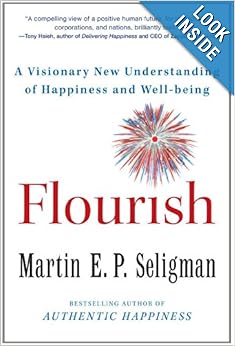
In Flourish: A Visionary New Understanding of Happiness and Well-being, Martin  Seligman, a psychologist and one of the pioneers in the field of positive psychology, builds on (and explains the weaknesses of) his work on “authentic happiness theory,” refining it into what he calls well-being theory. Seligman writes, “I used to think that the topic of positive psychology was happiness, that the gold standard for measuring happiness was life satisfaction, and that the goal of positive psychology was to increase life satisfaction. I now think that the topic of positive psychology is well-being, that the gold standard for measuring well-being is flourishing, and that the goal of positive psychology is to increase flourishing.” 

In Flourish, Seligman adds two more elements (Relationships and Achievement) to the three elements already named in authentic happiness theory (remember them by using the mnemonic PERMA):

  • Positive emotion (of which happiness and life satisfaction are all aspects)
  • Engagement (flow)
  • Relationships
  • Meaning
  • Achievement 
Each of these elements contributes to well-being without defining it.  Some are measured subjectively and others are measured objectively. Seligman added these additional dimensions because he feels that “life satisfaction holds too privileged a place in the measure of happiness” because “how much life satisfaction people report is itself determined by how good we feel at the very moment we are asked the question.” Many people who lack a natural cheerfulness may have more engagement and meaning in their lives than those who are more outwardly “happy.”

Flourish is an interesting book, and though it’s more theory than practical application, it does contain some interactive exercises (I mentioned one of them here). The book also contains a bit of history of positive psychology and Seligman’s career, as well as a defense of positive psychology against critics.

What I took from the book was the idea that well-being was a broader, richer concept than simple “happiness,” and that you can have well-being without constantly feeling cheerful or “happy.” I don’t believe it’s possible—or even desirable—to feel happy all the time. I do, however, feel that pursing the elements of PERMA will help you build a more deeply satisfying—and, yes, happier—life.

Leonie Dawson

The Real World

January 15, 2014


“What you think ‘the real world’ is is composed directly of the stuff you see and read. If you choose to read awful things, you’re going to think you live in an awful world.”
—Leonie Dawson

Animals

Some of My Best Teachers Have Four Legs

January 13, 2014

“Everything natural—every flower, tree, and animal—has important lessons to teach us if we would only stop, look, and listen.”—Eckhart Tolle

I’ve had various pets nearly all my life. Aside from their cuteness and cuddleability, pets can be expert teachers of life lessons (and if you doubt me, check out the delightful book Guardians of Being). Currently, I have one elderly dog, a “teenage” kitten, and a middle-aged horse. They’ve taught me many, many things (including don’t wear any clothes to the barn you’re not prepared to ruin, and no, the kitchen counter is not tall enough to keep food away from either the kitten OR the dog…). 

Here are a few of my favorite life lessons from my pets:


From Prudy:

There is a time for play and a time for cuddling. Know your priorities and stick to them.

The world is to be explored.

Like everyone until they prove unlikable.

Assume everyone likes you until proven otherwise.


From Scout:

Do everything joyfully: get up in the morning, go to bed at night, eat, announce your presence to the world.

Sleep when you’re tired, even if something interesting is going on elsewhere.

Don’t put up with bull$&@, but only do as much as you have to to get it to stop—don’t overreact.


From Tank:

You can make huge progress by taking many small steps.

Relationship is more important—and ultimately more satisfying—than tricks or blind obedience.

Hold out for your favorite treats. Spit out the ones you don’t like. Don’t waste time (or calories) on them.

Don’t let the turkeys get you down. 

Animals live in the moment. They don’t worry about what might happen tomorrow, or what the dog next door has, or what the horses in the next paddock might be saying behind their backs. Seems like some pretty valuable wisdom to me.

Have you learned any life lessons from an unusual source?

Bok Tower Gardens

Field Trip Friday: Bok Tower Gardens and Pinewood Estate

January 10, 2014


Welcome back to Field Trip Friday! This installment takes us to one of my new favorite central Florida locations: Bok Tower Gardens and Pinewood Estate in Lake Wales. My partner in adventure, Laure Ferlita, and I drove out there just before New Year’s to see the estate decorated for the holidays and wander through the beautiful gardens. I’ve been to Bok Tower before, but not since my son was a baby, and I’d never been to Pinewood Estate. We wandered slowly through the gardens and the home, sketched outside while drinking hot chai tea, ate lunch at the café and browsed the gift shop. We completely lost track of time and stayed for more than six hours! Though many things were blooming even in December, I want to go back in the spring for peak bloom season. 

Bok Tower Gardens
Most visitors to central Florida have heard of Busch Gardens, Sea World and Disney World—but probably not Bok Tower Gardens. Bok Tower is a totally different experience, a haven of beauty and peace in contrast to the craziness of the theme parks. The gardens were the project of Edward W. Bok, a successful publisher and Pulizer Prize-winning author. The 50-acre gardens were designed by Frederick Law Olmstead Jr. “to be a contemplative and informal woodland setting.” Crews laid irrigation pipes and brought in rich soil to create the conditions for a subtropical garden. After that, bushes and trees were planted, not only for their beauty, but to provide food for migrating birds. These plantings now provide shade for visitors as well as food and shelter for squirrels and other small creatures, and 126 bird species. The gardens house ferns, palms, oaks, pines, azaleas, magnolias, more than 150 types of camellias and many other blooming plants.


As lovely as the gardens are, the most striking and unusual feature of Bok Tower Gardens is the 205-foot marble and coquina “Singing Tower” that houses a 60-bell carillon. Carillon music is still played daily. To learn more about the carillon, click here. To actually hear it being played, click here. Mr. Bok is actually buried at the base of the tower.


Bok, who immigrated with his family from the Netherlands when he was six years old, presented the gardens to the American people in 1929 in gratitude for the opportunities he had been given. He did his best to live up to the advice given to him by his grandmother: “Make you the world a bit better or more beautiful because you have lived in it.” I’m now curious about Mr. Bok, and would like to read his autobiography

You can read more about Bok Tower Gardens by clicking here, or reading Bok Tower Gardens: America’s Taj Mahal

Pinewood Estate
Pinewood Estate was built in the early 1930s for Charles Austin Buck, a Bethlehem Steel vice president. The 20-room Mediterranean-style mansion has a barrel-tile roof, beautifully carved doors and woodwork, and is situated to provide a natural flow from house to garden. (Buck was an amateur horticulturist and had the gardens laid out first, and the home positioned later.) I don’t know if it was just the holiday decorations, but I thought the home had a warm and friendly feeling, in contrast to the mansions in Newport, RI


Each room was decorated for the holidays by volunteers and sponsored designers, and you could vote for your favorite room at the end of the self-guided tour. Volunteers and a historian were available to answer questions. My favorite room:


In 1970, Edward Bok’s daughter-in-law, Nellie Lee Holt Bok, led an effort to acquire Pinewood Estate (then called “El Retiro”) for Bok Tower Gardens, and the mansion was restored and opened to the public.

The back of house
The last thing we did before heading home was visit the “Window By the Pond,” a small wooden building with a large window overlooking a Florida bog setting. We sat quietly watching birds feasting on the seed left for them, an anhinga drying its wings, and one intrepid squirrel who jumped over the water to where the seed was placed.


Every time we take a field trip, we wonder why we don’t do it more often. Yes, it takes a bit more effort to find someplace of interest and get ourselves there than it does to meet at Panera for lunch, but it’s always worth the effort to fill the well. (And if you’re wondering about the sketches, as usual, mine is unfinished—and lucky to even be started. I forgot to bring paint, and had to borrow from Laure! But I did take a reference photo and plan to finish soon. Really!)

Have you taken any field trips lately? How do you “fill the well”?

Back to the Classics

Reading from the Mountain, Playing Mystery Bingo and Back to the Classics

January 08, 2014

It’s reading challenge time again. In 2014, I’m signing up for two challenges, ones I’ve done before, and using a third challenge as inspiration: the Back to the Classics Challenge.  Reading is practically my favorite thing, and I’ve decided to use that to gently step outside my usual comfort zone.


I’m returning to Bev’s (My Reader’s Block) Mount TBR Challenge in 2014, but stepping it up to the Mt. Vancouver level (36 books) because Something Must Be Done about the state of my bookshelves. This will truly be a challenge because I barely squeaked by with my 24 from last year, even after I got off to a good start. I’ll need to average three books a month from my own shelves to reach my goal. Fortunately, I’m well-equipped for this, and I’ll use books from my stash for my other two challenges. Now if only I can keep from being too distracted by the intriguing books I’ll hear about this year….

2014 Vintage Mystery BINGO Sign-UpVintage mysteries are my favorite, possibly because I grew up reading Agatha Christie, Ngaio Marsh, and Erle Stanley Gardner, and this will be my third vintage mystery challenge. This year, I’m playing Vintage Mystery Bingo, also hosted by Bev. I’m doing the Golden level, and might consider the Silver level as well if I find myself reading enough books from that era without putting strain on the other two challenges. I’ve already finished Georgette Heyer’s A Blunt Instrument and have started Sheila Pim’s Creeping Venom. This will be by far my easiest challenge—these books are the equivalent of eating cookies: delicious and comforting. 

And finally, I’m using the Back to the Classics Challenge, hosted by Karen at Books and Chocolate, as inspiration for reading more classics. (I’m not officially signing up because I’m not planning to write a blog post about each classic that I read—I’m just going to use the categories as guidelines.) I’ve wanted to read more classic literature but haven’t been able to discipline myself to do so, even though “classic” doesn’t have to mean difficult, long or boring. (Pride and Prejudice is a classic and one of my all-time favorite books, for example). This challenge seems within my reach, with six required books, and four more optional choices. Of course, I have a number of unread classics on my TBR shelves to choose from. (Thank you to Danielle at A Work in Progress for linking to Karen’s challenge.) 

It’s likely I’m biting off more than I can chew—but it’s a new year and everything seems possible! Even putting a dent in my (almost literal) mountain of unread books. (See the sidebar left for a link to my 2014 reading challenge log.)

Will you join any reading challenges in 2014?

#100HappyDays challenge

Three Ways to Focus on Happy Moments

January 06, 2014


Sometimes an idea just keeps presenting itself to me until I have to pay attention. In this case, the idea is noticing and recording things that make me happy.

First, I read about something called the “What-Went-Well Exercise” (also called “Three Blessings”), in Martin Seligman’s book, Flourish. He writes, “Every night for the next week, set aside ten minutes before you go to sleep. Write down three things that went well today and why they went well. You may use a journal or your computer to write about the events, but it is important that you have a physical record of what you wrote. The three things need not be earthshaking in importance…but they can be important.” (Seligman also encourages recording why the event happened, but I find that more problematic—many of my happy events, like “I rode Tank today” or even “I finished everything on my to-do list today,” don’t seem to have a “why” beyond “I just did it.” Maybe I’m missing something?) 

Next, I heard about the 100 Happy Days Challenge. Every day submit a picture of what made you happy to a social media site such as Instagram, Facebook or Twitter, with the public hashtag #100HappyDays. If you don’t want to do this publicly, you can come up with your own hashtag that you share only with those you want to see your photos, or you can send your photos to myhappyday(at)100happydays.com. (Of course, you don’t need to share your photos with anyone, but it helps keep you on track and “honest” if you do.)

According to the challenge organizers, “People successfully completing the challenge claimed to:
  • Start noticing what makes them happy every day;
  • Be in a better mood every day;
  • Start receiving more compliments from other people;
  • Realize how lucky they are to have the life they have;
  • Become more optimistic;
  • Fall in love during the challenge.”

Doesn’t that sound great? For more information, or to sign up for the challenge, click here

My third exposure to this idea came from Dani Dipirro at Positively Present: The Jar of Happy Things. During all of 2013, she wrote down favorite moments on bright scraps of paper, storing them in a jar (she had so many she had to buy a second jar!). I love the visual of the jar filling up with happy moments, and the idea of being able to read through a year’s worth of them all at once. Her post, titled “Five Benefits of Noting Happy Moments,” is worth a read. 

Why do any of these things? My reasons include, first, awareness in the present moment of all that is good and happy in my life. I have the habit of allowing myself to worry about what is not going right—or what bad things might happen in the future—instead of appreciating the good things (and there are plenty of them) right now.

Second, actually recording happy moments should help me remember them in the future if and when bad things happen.

Third, what you focus on expands. My hope is that by focusing on the happy moments, I will have more of them!

I’ve been doing the “What Went Right” exercise most nights since I first read about it, and I’m quite tempted to join the #100HappyDays Challenge—I love the idea of a photographic record of happiness! What about you? How do you keep track of the happy moments in your life?