25th Anniversary

Riding the Rails and the River in Connecticut

November 08, 2013

Our train
When last we left our intrepid travelers, they were luxuriating at the Bee and Thistle Inn…

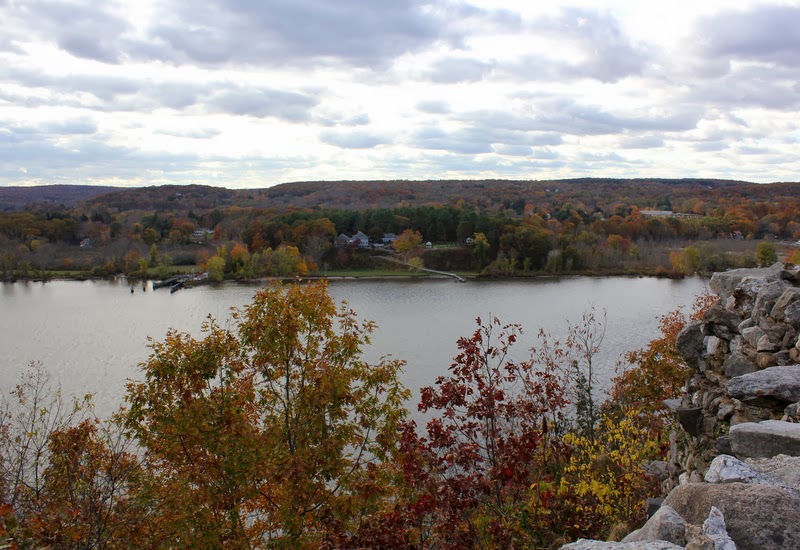
After my husband pried my fingers off the door to the inn (I would gladly have stayed in our cozy room at least one more night), we boarded the Essex Steam Train for a short ride through the woods along the Connecticut River, followed by a riverboat trip up the river itself. The day was cold and windy, but we braved the top deck to watch the river banks slide by, a few houses tucked in here and there, and the scarlet and yellow trees that seemed to grow right out of the rock in places.


As we floated by, what looked like a ruined castle loomed up on the hill above us. Our trip narrator identified it as Gillette Castle.


Gillette Castle, which is part of Gillette Castle State Park, was the property of actor William Gillette, whose adaptation of Sir Arthur Conan Doyle’s work and on-stage portrayal of Sherlock Holmes helped define the role. (He played Holmes more than 1,300 times over 30 years, and coined the phrase, “Oh, this is elementary, my dear fellow” which was later changed to Holmes’ most famous line, “Elementary, my dear Watson,” according to Wikipedia.) Gillette, who by all accounts was a clever and eccentric man, personally designed the 24-room house and its contents, including 47 intricate and unique door latches, no two of which are alike. The structurally sound home, build of fieldstone with a  steel framework, was designed to look like the ruins of castle you might see along the Rhine in Germany. It’s open to the public from Memorial Day weekend to Columbus Day weekend, but we were told that even without being able to enter the house, it would be worthwhile to walk around it, and take in the grounds and river views  After lunch, we drove up there and explored a small portion of the park, which was free to enter. It would be a marvelous place to sketch on a less windy and cold day.


The view from Gillette Castle

See the dragon's head?


When Gillette died, he had no one to leave his estate to and was concerned with what would happen to this property, putting specific instructions in his will to guarantee the property would not fall into the hands “of some blithering saphead who has no conception of where he is or with what surrounded.” In 1943, the Connecticut government purchased the property, renamed the home Gillette’s Castle and the 184-acre estate became Gillette Castle State Park. In 1986, it was added to the National Register of Historic Places.

Next and final stop: Boston, where we were forced to hide our resentment of the Boston Red Sox from rabid fans (Boston beat our home team, the Tampa Bay Rays, in the playoffs) and we were lucky to find a hotel room we could afford—the last game of the World Series was played the day we flew home.

25th Anniversary

In the Words of Mark Twain

November 06, 2013


One of the stops on our recent trip was Mark Twain’s home in Hartford, CT. Twain, whose real name was Samuel Clemens, moved to this house with his wife Olivia (“Livy”) in 1874. He and his family enjoyed some of their happiest years here, before financial problems forced them to move to Europe in 1891.

I’ve only read one or two of Mark Twain’s books, but after seeing Ken Burns’ excellent documentary, I want to read more (I still haven’t gotten around to reading Twain’s autobiography). He fascinates me. Here are some of my favorite Mark Twain quotes:

A person who won't read has no advantage over one who can't read.

Substitute “damn” every time you’re inclined to write “very”; your editor will delete it and the writing will be just as it should be. (I think of this when I’m tempted to use the word “very”!)

I am an old man and have known a great many troubles, but most of them never happened.

What a wee little part of a person’s life are his acts and his words! His real life is led in his head, and is known to none but himself.

The difference between the right word and the almost right word is the difference between lightning and a lightning bug.

Courage is resistance to fear, mastery of fear—not absence of fear.

Travel is fatal to prejudice, bigotry, and narrow-mindedness, and many of our people need it sorely on these accounts.

Keep away from people who try to belittle your ambitions. Small people always do that, but the really great make you feel that you, too, can become great.

In a good bookroom you feel in some mysterious way that you are absorbing the wisdom contained in all the books through your skin, without even opening them.

Life is short, break the rules, forgive quickly, kiss slowly, love truly, laugh uncontrollably, and never regret anything that made you smile. Twenty years from now you will be more disappointed by the things you didn't do than by the ones you did. So throw off the bowlines. Sail away from the safe harbor. Catch the trade winds in your sails. Explore. Dream. Discover.

The two most important days in your life are the day you are born and the day you find out why.

(Friday we’ll resume our travels in the Connecticut River Valley.)


25th Anniversary

In Which We Hit the Road with Angela and Great White*

November 04, 2013


Day one of our New England tour had us flying into Boston Logan Airport and renting a car to drive to our first night’s lodging in Newport, RI. (A word of advice about driving a rental car in or around Boston: don’t.) The most stressful part of the entire trip was the drive from the airport out of town. We had a GPS we had never used before, so as I was trying to figure out how to read it and orient myself on Boston’s roads, we found ourselves in tunnels and guess what?! You lose satellite service for a GPS in a tunnel. (We’re lucky we’re not still circling Boston underground.) I have no idea where we actually were, but we did eventually get out of there and on the road to Newport.

Admiral Fitzroy Inn 
After escaping from Boston, we drove to our first night’s hotel, the Admiral Fitzroy Inn, a former convent that is now a bed and breakfast. It was overcast and drizzling and we were tired and frazzled, so we dropped our bags in our room and went in search of dinner. We walked to The Mooring, recommended by the desk clerk (who also lent us an umbrella). We loved the food, and one dish, the “bag of doughnuts” (lobster, crab & shrimp fritters with chipotle-maple aioli), was possibly the best single thing I tasted the entire trip.

The Breakers
We made an early night of it (possibly because we were stuffed with good food), and got up the next morning to begin exploring. Newport has an interesting history, and was at one point the summer playground of some of America’s wealthiest families. We went to see The Breakers, the grandest and most famous of the Newport “cottages” (if you can call a 70-room mansion a cottage). I have never seen a more ornate home in my life. Sadly, we were not allowed to take photos of the interior of this house (or any house on the entire trip, actually) but I assure you, it was stunning and worth a visit. 

He'd be fun to sketch...


We walked around the corner from The Breakers to an entrance onto the Cliff Walk, a 3 ½ mile trail along the eastern shore of the island. We wandered only a small section of the path, enjoying the ocean views and a peek into the back yards of some enormous houses. (Part of Cliff Walk is still closed because of damage from Hurricane Sandy in 2012.)

Cliff Walk
From Cliff Walk, we headed to The Elms, another of the Newport mansions. Modeled after a mid-18th century French chateau, it was completed in 1901 for coal magnate Edward J. Berwind. Much less ornate than The Breakers, it was still a grand mansion.

The Elms
After our mansion tours, we hit the road again. We stopped at Stonington’s (CT) Old Lighthouse Museum (thanks, Cheryl, for the suggestion) and stopped briefly at Mystic for a late lunch—and no, we didn’t eat pizza.  We were too tired and it was too late in the day for us to hit Mystic Seaport, so we’ll just have to go there another time. 

Stonington's Old Lighthouse Museum

Climb the ladder to the top

Part of the view from the lighthouse

More views from the top

Climb back down
We wanted to be in position to ride the Essex Steam Train the following day, so we pushed on to the town of Old Lyme, where I’d heard about a bed and breakfast I hoped to stay at, The Bee and Thistle. Built in 1756, The Bee and Thistle was my favorite lodging, and why not? We had a gas fireplace in our room and an extra-long bathtub I could stretch out in. On top of that, they served the best breakfast and coffee we had on the trip. I would have liked to explore Old Lyme a bit more, but we had to move on.

The Bee and Thistle

Our room


Next up: Riding the rails and the river in the Connecticut River Valley, and the “ruined” castle on the hill…

*We named the GPS Angela, because its voice reminded me of Angela on The Office. “Great White” was our nickname for our car, which had a sort of shark fin-like thingy on the roof.

Concord

The Travel Effect

November 01, 2013

Perhaps this happens to you? You go on a trip someplace, and come home filled with the desire to make changes, to simplify and purge, to get things done, to live fully and embrace life.

Or is it just me?

I came home from our trip to New England filled with plans to:

Redo my schedule, setting aside much more time for reading and writing.
Learn about early American history.
Read and reread Louisa May Alcott’s works, and Walden. (FYI: note that Walden and Little Women are both free through Amazon’s Kindle. Links are below.)
Clean out all my closets.

And much more. Will I do those things? I don’t know—it depends on how long my recharging lasts. (I am so missing the cool, crisp weather, for it is repulsively warm and humid here right now, but We Will Not Speak of This. Cooler days are coming, I just need to hang on!)

I’ll write more about the trip next week, and share more photos, but today I’ll give you a little taste of two of my favorite experiences. (Click to enlarge the photos.)

Walden Pond


I read and enjoyed Walden several years ago, though I’m embarrassed to say it didn’t make much of a lasting impression on me. Still, when I found that we could visit Walden Pond, and see the site of Thoreau’s cabin while we were in Concord, I jumped at the chance. And I’m so glad I did. Walden Pond is a “kettle hole,” formed by a retreating glacier, in some places over 100 feet deep. We were able to walk all the way around it, soaking up the fresh air, the bright leaves, and watching people enjoying the park in their own ways—we saw men fishing, several families with children walking in the woods, a paddle boarder and two wetsuit-clad people swimming! Even though there were quite a few others there (and I’m sure it’s mobbed in the warmer months), it didn’t feel crowded and you could sense the peace and beauty that must have drawn Thoreau here.

Thoreau's Cove
Cabin site


Cabin replica
Orchard House


Just down the road from Walden sits Orchard House, the Alcott (as in Louisa May) family home for 20 years. Louisa May Alcott wrote Little Women while living here, at a small half-circle of a desk her father built into a wall of her room. (No photos were allowed inside, so I can’t show you what it looked like.) The house was already old when the Alcotts lived there, with the settling you’d expect of an old house. Orchard House was named for the apple orchard that once surrounded it, but Louisa called it “Apple Slump” because she felt like it was “slumping” into the ground, according to our tour guide. The Alcotts were an interesting and talented family—one of Louisa’s sisters was an actress, the other an artist—we saw much of her art work in the home, including sketches drawn directly on window casings and woodwork of her room. Alcott’s father, Bronson, was a philosopher and educator (though his revolutionary ideas about education kept him from being successful in his day) and her mother was essentially what we’d now call a social worker, according to our guide. The home was simple and warm, and filled with many items that belonged to the family, since Orchard House had only one owner after the Alcotts, and became a museum in 1911.

Now back to laundry and sorting through travel ephemera and photos. Stay tuned next week for autumn leaves, historic houses and more!

Share/Bookmark

Poetry

The Melancholy Tree

October 30, 2013

Photo courtesy Emil Bacik
Robert Morgan, who lives in Ithaca, New York, has long been one of my favorite American poets. He’s also a fine novelist and, recently, the biographer of Daniel Boone. His poems are often about customs and folklore, and this one is a good example. [Introduction by Ted Kooser.]

Living Tree

It’s said they planted trees by graves
to soak up spirits of the dead
through roots into the growing wood.
The favorite in the burial yards
I knew was common juniper.
One could do worse than pass into
such a species. I like to think
that when I’m gone the chemicals
and yes the spirit that was me
might be searched out by subtle roots
and raised with sap through capillaries
into an upright, fragrant trunk,
and aromatic twigs and bark,
through needles bright as hoarfrost to
the sunlight for a century
or more, in wood repelling rot
and standing tall with monuments
and statues there on the far hill,
erect as truth, a testimony,
in ground that’s dignified by loss,
around a melancholy tree
that’s pointing toward infinity.

American Life in Poetry is made possible by The Poetry Foundation (www.poetryfoundation.org), publisher of Poetry magazine. It is also supported by the Department of English at the University of Nebraska-Lincoln. Poem copyright ©2012 by Robert Morgan, whose most recent book of poems is Terroir, Penguin Poets, 2011. Poem reprinted from The Georgia Review, Spring 2012, by permission of Robert Morgan and the publisher. Introduction copyright © 2013 by The Poetry Foundation. The introduction's author, Ted Kooser, served as United States Poet Laureate Consultant in Poetry to the Library of Congress from 2004-2006.

25th Anniversary

On the Road

October 25, 2013


By the time you read this, my husband and I will be on the road in New England, taking our very-belated 25th anniversary trip. We’re hoping to see some fall foliage, enjoy crisp autumn air, and explore an area of the country we’ve never visited before. You can bet that I’m hoping to see some places of literary interest, like Concord, MA where Louisa May Alcott lived, and perhaps also Mark Twain’s home in Connecticut. We’ll be on the lookout for used book stores, places to sketch and take photos, quaint restaurants and shops…pretty much whatever strikes our fancy. I promise a full report when we return!

Have a great weekend!

Quotes

To Find the Beautiful

October 23, 2013


“Though we travel the world over to find the beautiful, we must carry it with us or we find it not.”
—Ralph Waldo Emerson

Everyday adventures

Today I'm Grateful For...

October 18, 2013


Gratitude has much to do with happiness, and I sometimes forget to stop and think about what I’m grateful for. As a part of paying more attention to my life, I’m making it a regular practice to jot down what I’m grateful for at least once a week. Here are just five things I came up with this morning:

Libraries. I’ve learned so much from library books (how to grow herbs in Florida, where to stay and eat in Boston, what is a happiness project?). I’ve been entertained by fiction and magazines, DVDs and CDs. I can download free music (through Freegal) and borrow materials from libraries all across the country. And those are just the services I use. My library offers much, much more. I don’t know what I’d do without the library system and I’m so grateful to be able to access it.

“Ordinary.” I love my daily routines and “ordinary” life (which I know is a very nice one). I don’t need anything big and extravagant to happen—I’m 99 percent content with the stuff of everyday life. That is a huge blessing.

My office. When I walked in here this morning and flipped on the light, I felt a rush of peace, contentment and happiness. I’m grateful to have my own space to inspire and recharge me.

My mother-in-law. She’s one of my best friends, and I know I’m lucky to feel that way.

Freedom to set my own schedule. I have plenty to do—as do we all—but I answer only to myself. I can decide when to write, when to cook or clean, when to run errands or when to chuck it all and play. I’m in charge, and sometimes I forget that. When I contemplate working in an office for someone else, I’m grateful that, for now, I don’t have to.

What are you grateful for?

Happiness

Being Happy

October 16, 2013


“Being happy doesn’t mean that everything is perfect.
It means you’ve decided to look beyond the imperfections.”
—Unknown

Everyday adventures

Fall Rerun: A Little Off the Top and Sides...and Belly

October 11, 2013

Note: This week I did my annual clipping job on Tank, so I'm rerunning the post I wrote about our equine spa services on Oct. 1, 2010. It wasn't nearly so much fun this year because I had to do all the treatments by myself--sure do miss my absent barn friends on days like this! Anyway, I'm still recovering from the process, so today's post will be a slightly-edited rerun.

My horse, who was born about five miles from where he lives now, apparently thinks he lives in Siberia. Every year in September he begins to grow a wooly winter coat suitable for life on the tundra. This is unfortunate, because we do not live in a tundra-like environment. We live in a tropical-rainforest-like environment: hot and sticky for much of the year. Once he’s grown his winter coat, he can be covered in sweat just from standing placidly in his paddock. If you add in a ride, he’s one soggy and overheated mess.

 So every year at this time, knowing we have at least three more months of not-so-wintry weather, I pull out my trusty clippers and give him a whole body clip. (He immediately begins to regrow that winter coat, but by the time it comes in completely, he’ll need it for the few cold winter days we have.)

This year before clipping, we added a new service to salon day at the barn: hair color. Since our horses live outside, not in stalls, their manes and tails bleach in the sun. So before his bath and clip, Tank had his mane and tail dyed. (You can imagine how much we all enjoyed this.)

At work on Tank's tail--a two-person job
Pitiful forelock
 After the dye job, it was time to clip. Clipping a horse is one of the less-fun jobs a horse owner has, because to get a good clip without ruining your clippers, you must bathe the horse, let him dry, then clip him. The whole process takes hours. So here, for the uninitiated, is what happens when you bathe and clip horse.

Take horse to wash rack. Spray all over with hose (the horse, not yourself, though you might just as well spray yourself and be done with it). Shampoo horse, taking special care with legs, as the hair there is often particularly thick and hard to clip. If you’re a girly horse owner, shampoo and condition mane and tail. While rinsing off shampoo, try not to let water from hose run down your arm and into your shoes as you spray the taller parts of the horse. Fail.

Are you sure we have to do this?
Squeegee horse with sweat scraper and dry with towel as much as you can to shorten air drying time. Go change your socks and, possibly, your shirt and shorts. (I frequently wear a bathing suit top and quick drying shorts when I bathe my horse.) Take horse for a walk, looking for edible things until you’re too tired and thirsty to do that anymore. (You can’t just turn him loose because he’s sure to roll and dirty up his clean coat.) While he’s drying, spray the hair with a silicone spray, such as Show Sheen, to help the clippers glide through easier. This adds a little to the drying time, but is worth it in the long run.

Tie up horse, and even though he’s still a little damp, you optimistically think there are some areas dry enough to start on. Begin clipping. Keep even pressure on the clippers so you have no gouged spots. Some people clip the legs first because they’re more technical (and ticklish) and it’s good to do them when you and the horse are fresh and your clipper blades are sharp. Some people start on the face. I personally like to see immediate progress, so I start somewhere I can see inroads, like the neck, chest or hindquarters. I also skip around when I get tired of working on one area, so my horse looks like nothing on earth until he’s completely done.

Making inroads
If you’re lucky and you have a cooperative horse, you may finish your horse clipping in one session. If you tire out, your clippers die or your horse decides he’s had enough, come back another time to finish the job. Better to have a funky-looking horse for a day or two than risk either of you melting down in the process.

Horse hair sticks to everything, so when you are done, you will be covered from head to foot with little pieces of hair. In fact, YOU will look like you need clipping. Turn your horse out or put him in his stall and offer him treats for being such a good boy. Go home, take a shower, pour yourself your adult beverage of choice and inform the family that dinner will come from the nearest pizza place that delivers.

The finished tail