Overcoming

Full

November 07, 2012


“Although the world is full of suffering, it is full also of the overcoming of it.”
—Helen Keller

Disasters

Helping After Sandy

November 05, 2012

day of giving vs 2 wblog ABCs Day of Giving to Help Hurricane Sandy Victims: Live Blog


I was going to post something today about personal space, and how much my husband and I are enjoying having our offices separated—but it just seemed too frivolous in the wake of Superstorm Sandy. We’ve weathered a few hurricanes since we moved to Florida, but nothing like what the people in the northeast are experiencing with Sandy. More than 100 people have died, and more than one million homes are still without power, with a nor’easter bringing cold, snow and wind predicted for later this week. (Click here for a state-by-state summary of Sandy’s aftermath. Jason Good, who lives in New Jersey and still has no power, blogged about Sandy here.) 

I’ve been thinking about the people affected by Superstorm Sandy—wondering how I could help. I can’t volunteer up there, so I’m looking for ways to help right here. Cash donations may seem less personal, but they are highly useful to relief agencies. Cash doesn’t have to be sorted, packaged or transported, and agencies have more flexibility to provide for the true needs of survivors. Here are a few organizations that are taking donations for those affected by Sandy.

The Red Cross. Visit www.redcross.org, call 800-Red-Cross or text the word “Redcross” to 90999 to make a $10 donation. You can also give blood, since many blood drives had to be canceled because of Sandy.

In conjunction with the Red Cross, ABC is sponsoring a “Day of Giving” today.  All day long, ABC’s shows will offer viewers a chance to donate to those affected by the storm.

The Salvation Army provides food, clean-up kits, shelter and “emotional and spiritual care” to storm victims.

Feeding America operates food banks all over the US, and is distributing emergency food, water and supplies to the storm’s victims.

AmeriCares provides medicine, medical supplies and humanitarian aid.

Save the Children focuses on relief and support for children affected by Sandy

The Humane Society is working to help pets affected by the storm, especially those were not able to be evacuated with their families. 

In addition to the above organizations, you can visit the National Voluntary Organizations Active in Disaster website for a list of volunteer organizations in your state.

I’ll get back to the personal space issue in a future post (and include some pictures of my husband’s new office). Today, I’m just grateful to have a roof over my head and electricity to power my household.

Books

When Is Negative Thinking Positive?

November 02, 2012

Photo courtesy John Nyberg

Do you get tired of being told to look on the bright side when you express a negative thought? Do you find yourself stifling your concerns out of a desire not to sound “negative”?

Turns out, there’s a place for negative, especially if it’s in the form of defensive pessimism.

I just finished reading The Positive Power of Negative Thinking, by Julie K. Norem, Ph.D.  In this book, Norem introduced me to the concepts of defensive pessimism and strategic optimism. People who use strategic optimism seek to avoid stirring up anxious feelings, often by setting high expectations, then not thinking about what could go wrong.  Those who use defensive pessimism set low expectations and mentally rehearse how things could go wrong.

On the surface, defensive pessimism sounds pretty dismal. However, Norem explains, “Defensive pessimism involves learning to tolerate negative emotions in order to get things done. [Defensive pessimists’] tolerance isn’t passive wallowing in negative feelings; it embodies confronting those feelings and rejecting the premise that feeling good should always be our most immediate aim.” 

These two strategies are used by people who have differing psychic make-ups: those who typically feel anxious and those who do not. Those who feel anxious need to find a way to handle their anxiety so that they can act, and those who don’t feel anxious need to find ways to stay anxiety-free. As Norem demonstrates, the strategies that work for one don’t work for the other, and if you try to change someone’s strategy, their performance suffers. Norem writes, “Defensive pessimism and strategic optimism develop in response to different experiences, and their strengths lie in the ways they address different problems. Defensive pessimism works to manage anxiety and help people feel more in control, whereas strategic optimism works to keep anxiety away and to protect self-esteem. In both cases, these strategies motivate effective action and often lead to good outcomes for those who use them.” (Norem notes that these concepts are different from dispositional optimism or pessimism.)

As in most things, if taken to extremes, both of these strategies can be dysfunctional. Defensive pessimists can spend too much time preparing for disaster and become such perfectionists that they never complete anything. Strategic optimists may become overconfident, ignore real dangers, or keep working at impossible tasks they should abandon

Norem doesn’t believe you should give up your natural tendencies. Whatever your strategy, be it defensive pessimism or strategic optimism, embrace it while making sure not to carry it too far. In addition, accept the strategies of others without trying to change them.

I think I fall more towards the defensive pessimist end of the spectrum, and this book clarified for me strategies to help get me through the anxious period and into the active period. (Truthfully, I often use “self-handicapper” strategies, discussed in chapter five—a tendency I need to overcome.)

Which do you use most often—defensive pessimism or strategic optimism?

Share/Bookmark

Halloween

Halloween Already?

October 31, 2012

Photo courtesy Karolina Michalak

I’m not alone in noticing how time accelerates as we grow older, and as the seasons grow ever more brief the holidays are gone in a wink.  This poem by Nancy Price about Halloween catches a little of that.  She’s an Iowan whose poems are so heartfelt, clear and useful that we could run them every week and none of you would complain. [Introduction by Ted Kooser.]


Trick or Treat
The ghost is a torn sheet,
the skeleton’s suit came from a rack in a store
the witch is flameproof, but who knows
what dark streets they have taken here?
Brother Death, here is a candy bar.
For the lady wearing the hat from Salem: gum.
And a penny for each eye, Lost Soul.
They fade away with their heavy sacks.
Thanks!  I yell just in time.
                                                 Thanks for another year!

American Life in Poetry is made possible by The Poetry Foundation (www.poetryfoundation.org), publisher of Poetry magazine. It is also supported by the Department of English at the University of Nebraska, Lincoln. Poem copyright ©2007 by Nancy Price from her book of poetry Two Voices and a Moon, Malmarie Press, 2007.  Reprinted by permission of Nancy Price. Introduction copyright 2012 by The Poetry Foundation.  The introduction’s author, Ted Kooser, served as United States Poet Laureate Consultant in Poetry to the Library of Congress from 2004-2006.

Film

The Last Roll of Film

October 29, 2012

Something’s not quite right with the color of the photographs, and several are completely unrecognizable. The color problem probably stems from keeping the film on my dresser for several years before having it developed, but what’s up with the unrecognizable ones?


I just had my last roll of film developed, and it made me kind of sad. I entered the digital photo age kicking and screaming. I loved my 35mm camera, loved the packets of shiny photos I had developed, loved the photo albums and scrapbooks I made with them. I feared my digital photos would never make it off my hard drive into prints. (I was mostly right about that, too. I don’t know which is worse: boxes of unsorted prints or computer files of unsorted images!)

I’m totally a digital convert now—I love the ability to take tons of photos and, even better, the simple software that allows me to crop and otherwise enhance them so I have images I think are beautiful. I’m looking into websites that allow you to make photo books to replace the scrapbooks and photo albums I used to make. The excitement of sending my film away and seeing if the photos I took are as good as I think they will be has been replaced by immediately checking the images, then popping a memory card into my laptop. Now that I’m converted to digital, I’m going to sell my 35mm SLR camera. It makes me a little sad, but I don’t need it or use it anymore.

So what was on that roll of film? Before-and-after photos of our kitchen when we changed the countertops from Formica to granite and added a new backsplash. (We made this home improvement right before Christmas—that’s when we do all our home improvements. It adds that perfect touch of panic to the festivities.) My husband and I were thinner. Nick was shorter. And Crusher was still with us. (Sniffle.)

Look how young Nick is!
Sometimes technology makes life better—it certainly has made photography more fun and easier for me, even though I still have a lot more to learn. My husband says I’ll soon exchange my paper books for an e-reader, but I’m not so sure about that. There’s more to reading a book than seeing words on a page.

How has technology made your life better? Is there anything you said you’d never do/try/use that you now find indispensable, like my digital camera?

Happiness

Link Love

October 26, 2012

Recognize the face on the mouse pad?

I’ve spent far, far too much time meandering through (in? on?) the internet lately. In order to justify that to myself, I thought I’d share some of my happy discoveries. Because I want everyone to waste as much time have as much fun as I do…

Puppy cam! Click here for a peek into the puppy room at the Service Dog Project in Ipswich, MA where mom Chaos is caring for her week-old puppies. 

Already thinking about the holidays, I found this post to have some really sweet handmade gift ideas. 

Scott Adams (the creator of “Dilbert”) on “engineering happiness”

Laure Ferlita shared this link with me. Gorgeous photography. 

For a good laugh (no pun intended), visit Jason Good at http://jasongood.net/. One of my favorite posts is here

I just discovered this blog, which has a philosophy I can agree with. I particularly liked this post

Have you discovered anything fun lately?

Attitudes

Little Decisions

October 24, 2012


“Happiness is not a brilliant climax to years of grim struggle and anxiety. It is a long succession of little decisions simply to be happy in the moment.”
—J. Donald Walters 

Note: Today is the 10th annual Take Back Your Time Day. Read more about it here or here.

Everyday adventures

Adventures in Orchids

October 22, 2012

Danger!

Finally we had some gorgeous, fall-like weather this weekend, so my husband, mother-in-law and I checked out an orchid show and sale at the USF Botanical Gardens in Tampa. Lucky for us, there were only 12 vendors. We still managed to buy six orchids.

It’s a sickness, I tell you.

My husband and I go for variety in both size and color. I’m partial to scented orchids, my husband likes the dramatic and unusual ones. (If it’s variety you want, orchids are your flower: according to Wikipedia, orchids are one of the largest families of flowering plants, with more than 20,000 species found in 880 genera. Horticulturalists have produced more than 100,000 hybrids and cultivars since the introduction of tropical species in the 19th century.)

The new additions joined their brethren on our lanai where I hope they’ll be happy. One of my next chores needs to be writing down what types of orchids I have and what conditions they like.

I never thought I’d be interested in orchids. I’ve always preferred flowers like peonies, hydrangeas, roses. I can’t grow those here in Florida—at least not very successfully. (I’ve also become resigned to the lack of tulips and daffodils in my life.) But I can grow orchids—they thrive in our humid climate, so I’m going with the flow. If I can’t have a cottage garden, I’ll have a tropical one instead. At least I have flowers.

Here are the new additions. This one is tiny:

Oncidium Tsiki Marguerite
At the other extreme, this vanda is huge: 


This one, also a vanda, is scented:


Just love the color of this:

Miltassia C.M. Fitch ‘Izumi’...or so says the label...
This was unlabeled, but I think it’s a phaleonopsis:


I don’t know what this is, either, and am not sure of what the label says. Any ideas?


It felt good to be outside (and not be sweaty), to drink in the beauty of the flowers, to be with people I love, while at the same time fanning my passion for orchids. A satisfactory Saturday.

How have you fed your passions lately?

Everyday adventures

A Room of My Own

October 19, 2012

I mentioned here that I’ve taken possession of my new office after my husband moved to his new space in our formal living room —really it’s my “old” office as it was mine (hence the lavender walls) until my husband took it over three years ago. I’ve spent many happy hours in here in the past week and a half—would you like a little tour? (Click on the photos to make them bigger.)

I’ve shared pictures of the shelves before, but this is what they look like now. A few things moved around, a few books disposed of and a few more purchased. 


Under my window, I have a white bench with some magazines, an African violet and some storage boxes for hiding messy projects (if only I could remember I put the projects in there…).


My desk—so wonderful to have room to spread out, and to have my little bits and bobs displayed. Last week I had some fresh flowers in that bare space on the left. On top of the hutch is my collection of old Nancy Drew books


I love this glider rocker for reading, writing (I write most first drafts in long hand) and thinking deep thoughts. I’ve had this chair since before my son was born, and I spent countless hours in it, feeding, rocking and singing to him. We recovered it a few years ago so it could go in the office. When I’m not in the chair, one of Scout’s dog beds is. She divides her time between my office and my husband’s.

Next to the rocker is a lateral filing cabinet and hutch. I still need to purge the files as well as arrange the photos and books a bit better.


This is the armoire desk we bought for me when my husband and I were trying to share the office. It’s now my—trumpet fanfare—art station. I keep all my supplies here, and can use the desk top to sketch and paint. It also stores some random office supplies I don’t have room for elsewhere.


Having my own space means a lot to me. I can play music. I can shut the door. I control the ceiling fan, a major bone of contention between me and my husband. It means I (we) take my work seriously because we’ve made a space for me to do it, rather than keeping me bouncing from one place to another.

I didn’t realize until I had to share how much having my own space meant to me. Every other place I tried to work (except my bedroom and that was an issue in itself) made me feel I was on display and I was frequently interrupted. I felt like I “wasn’t doing anything” when I was sitting quietly reading or thinking or even web surfing for work. Now I can daydream, think, and read to my heart’s content and no one looks over my shoulder while I do it. Or asks me what’s for dinner or if I’m doing laundry later.

And that, my friends, is my new artistic space.

I am very happy.

Scout is happy, too.
Do you have a space to call your own?

Antiques

Wanting In

October 17, 2012

Photo courtesy andrechinn via Flickr

At the beginning of the famous novel, "Remembrance of Things Past," the mere taste of a biscuit started Marcel Proust on a seven-volume remembrance. Here a bulldozer turns up an old doorknob, and look what happens in Shirley Buettner's imagination. [Introduction by Ted Kooser.]

Discovered 

While clearing the west
quarter for more cropland,
the Cat quarried
a porcelain doorknob

oystered in earth,
grained and crazed
like an historic egg,
with a screwless stem of

rusted and pitted iron.
I turn its cold white roundness
with my palm and
open the oak door

fitted with oval glass,
fretted with wood ivy,
and call my frontier neighbor.
Her voice comes distant but

clear, scolding children
in overalls
and highbutton shoes.
A bucket of fresh eggs and

a clutch of rhubarb rest
on her daisied oil-cloth.
She knew I would knock someday,
wanting in.

American Life in Poetry is made possible by The Poetry Foundation (www.poetryfoundation.org), publisher of Poetry magazine. It is also supported by the Department of English at the University of Nebraska-Lincoln. From Walking Out the Dark (Juniper Press, 1984). Copyright © 1984 by Shirley Buettner and reprinted by permission of the author. Introduction copyright © 2012 by The Poetry Foundation. The introduction's author, Ted Kooser, served as United States Poet Laureate Consultant in Poetry to the Library of Congress from 2004-2006.

Attitudes

Lucky

October 12, 2012

Twice on Wednesday I found myself talking to someone about how lucky I am. The first time, I was sitting on the back of my horse, talking to my friend and trainer, Gayle, about how my experience with Tank has been one of the best things in my whole life. We talked about how lucky I feel first to even own a horse, and also to have one that I’ve been able to bond with so closely. I mentioned that my life is so much better than I ever imagined it being. Though I was speaking out of the emotion of the moment, glossing over the pain and emotional storms I’ve weathered, it is true that I am lucky. If I started to list the struggles and problems of my life, that lucky feeling would certainly fade. It was then that I realized it’s my choice what version of my life to dwell on, and ultimately my choice whether I feel “lucky” or not.


In the second instance, I had emailed my friend Laure an image of some sketchbook pages I loved, expressing a desire to have my sketchbook resemble them. We emailed back and forth about developing artistic style, and I finished one email with, “I’m lucky to have some lovely artists to be influenced by, aren’t I?” While I’m still learning the basics of drawing and painting, let alone working on my “style,” between the support and encouragement of my friends (my classmates in Laure’s classes as well as Laure herself) and the wealth of material available in books and online, I have the ability to enjoy and learn from many different artists. I can’t help but be inspired. This may seem like an insignificant matter to feel lucky about—but isn’t life made up of “insignificant matters”?

Coincidentally, we have a new resident at our barn, a tiny, elderly pony whose name is Lucky. Poor Lucky was essentially starving to death because his previous owners (well-meaning but ignorant) didn’t realize the condition of his teeth made it impossible for him to eat normally—his food needs to be soaked into soupiness. Aside from his thinness and the neglect of his hooves and coat, he seems healthy.  He’s lucky to have been found by caring people who hope to help him, and a vet who is willing to take on some of his care without compensation. With any luck, he’ll live out his life in comfort, being spoiled by the girls (and the adults) at the barn.

Lucky doing what he does best
I guess what I’m trying to say is that feeling lucky is to some degree a matter of perspective, acknowledging the negatives but choosing to focus more on the positives. It’s part of my “Catching Happiness” philosophy, when I remember to live by it.

What makes you feel lucky?

Beautiful moments

Piece-ful

October 10, 2012


“There are few things more sacred than the moment you come to peace with your pieces.”

—Marney Makridakis

Busy-ness

Checking In

October 09, 2012

The craziness continues, but it’s good craziness.


After “sharing” home office space with my husband for three years (translation: I had a desk in there but I was rarely at it because our working styles were not compatible), he moved to his new office in our unused formal living room last week. I’ve spent much of the past few days cleaning and organizing my space and collecting my things from where they were scattered throughout the house. I’ve still got some organizing to do, but at least I know everything is here (somewhere) and I again have a door I can close when I need to.


I took the day yesterday to relieve my horse of his winter coat. (Click here to see what that entails.) Yes, even though it’s still near 90 degrees and humid, Tank was sporting his usual premature wooliness. I’m not quite finished—I have three legs left and some tidying—but he’s much more comfortable. Since he’s now shorn, that means it’s likely a cold front will come through and drop the temps. (Bring it on! I have a horse blanket.)

I expect to have a more “normal” schedule in the next week or so and will get back to more regular posting soon.

So what’s new with you?

Autumn

Autumn Descends

October 03, 2012


Much of the poetry that has endured the longest is about the relentless movement of time, and in ways all art is about just that. Here’s a landscape in which time is at work, by Geraldine Connolly, who lives in Montana. [Introduction by Ted Kooser.]

Flathead Lake, October

The eagle floats and glides,
circling the burnished aspen,

then takes the high pines
with a flash of underwing.

As surely as the eagle sails
toward the bay’s open curve,

as surely as he swoops and seizes
the struggling fish, pulling

it from an osprey’s beak;
so too, autumn descends,

to steal the glistening
summer from our open hands.

American Life in Poetry is made possible by The Poetry Foundation www.poetryfoundation.org), publisher of Poetry magazine. It is also supported by the Department of English at the University of Nebraska, Lincoln. Poem copyright ©2007 by Geraldine Connolly, from her most recent book of poems, Hand of the Wind, Iris Press, 2009. Reprinted by permission of Geraldine Connolly and the publisher. Introduction copyright  2012 by The Poetry Foundation. The introduction’s author, Ted Kooser, served as United States Poet Laureate Consultant in Poetry to the Library of Congress from 2004-2006.

Happiness

Triumphant

October 01, 2012

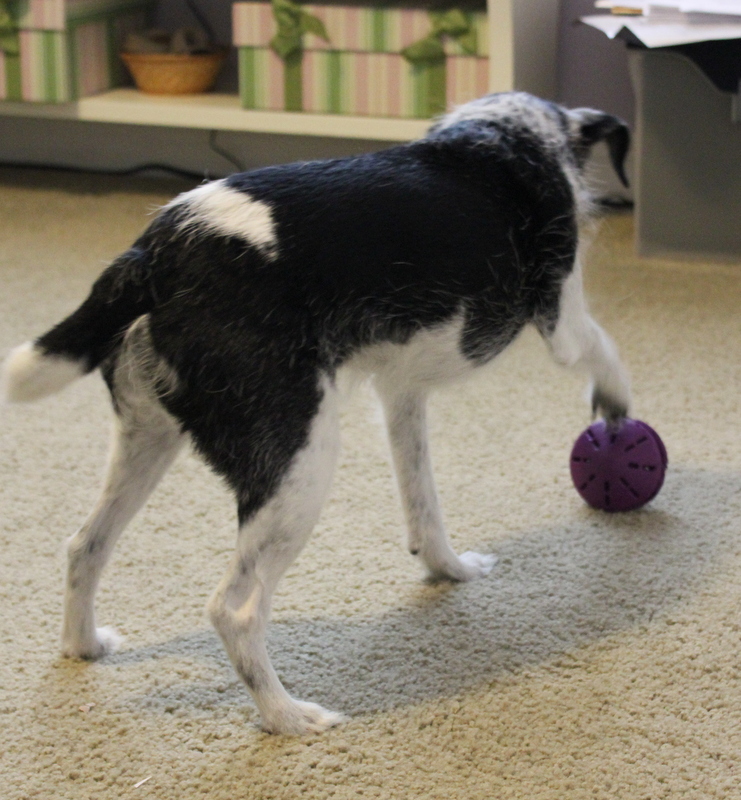
What is this thing? It smells like treats.
Nope, can't fit the whole thing in my mouth...
Maybe if I use my mind powers on it.
C'mon, man!


Ohhh, if I roll it, treats fall out!
Triumphant 

Busy-ness

Dog Paddling in the Ocean...

September 28, 2012


That’s what I feel like I’m doing. Anyone else? Is it just me, or does life seem unaccountably, almost unbearably busy lately? I feel frantic! I have no down time between activities. I’m distracted—more so than normal. I shudder to think what the holidays will be like when I feel like this in September.

Since reading World Enough and Time, I’ve become more aware of time and my use of it, even going so far as to keep a time log a couple of weeks ago. Maybe it’s because I’m more aware that it seems like life has sped up?

From keeping the time log, I learned that I multi-task A LOT, and I do a lot of small tasks that add up to big chunks of time. I had to use a pen with an extra fine tip in order to fit all I did into the half hour boxes of the time log! Even if I was working out on the elliptical machine, I was also reading a magazine. If we had the TV on, I was cooking or cleaning the kitchen, balancing the checkbook or folding laundry. The only time I had large stretches of time doing one thing was when I went to the barn, and that’s because I didn’t record each individual thing I did while I was there.

No wonder I’m so tired by the end of the day. I really do cram a lot of little tasks into my days, often doing them one right after another. Since I can’t really point to any major accomplishment, except maybe keeping our lives running, I never get a feeling of satisfaction and accomplishment from what I do. So many things I do “disappear”—they must be done again, and again (and again). They’re not even noticed by anyone unless I stop doing them.

Is this a problem? Maybe. If I’m running around filling my days with the little details, I never have to face my fears—the fear that I won’t have anything to say when I sit in front of a blank page, or the fear that if I stopped “doing,” my worth as a human being would plummet. I want to be a contributor in life, not just a taker, but the way in which I’m going about it now is not sustainable.

I don’t want to live like this anymore. I’m stepping back and calling a halt, starting with a day off tomorrow. I’m going to look at my current schedule and activities and ask:

*Does this need doing?
*Do I need to do it?
*Can it be done less frequently?
*Can someone help me with this so it will go quicker?

It’s a start. Maybe then I’ll be able to get my head above water.

Do you have any tips on controlling your schedule and commitments you can share?

Change

How to Change the World

September 26, 2012


“Am I going to change the world, or am I going to change me? Or maybe change the world a little bit, just by changing me?”
—Sarah (“Sadie”) Delany, Having Our Say: The Delany Sisters’ First 100 Years

Family

This and That

September 24, 2012

It’s fall! Can you tell? Our weather still says summer, but that didn't stop us from a this-and-that weekend, here at the Johnson household. My husband and I puttered about the house and yard, together and apart—a relaxing and satisfying way to spend Saturday and Sunday.


Some of the things we did:

I began putting out fall decorations, with this little set of votive candles I just bought. Everything else is in the attic…time to send someone up there to bring the boxes down.


We cleaned our potting bench. My husband has taken up vegetable gardening, so we now share the bench which I had let get into quite a state:


Better:


I cleaned and refilled the bird bath and squirrel bird feeders:

Ick
Much better
Come and get it!

I found a little friend keeping the orchids bug free:


Scout enjoyed the warmth of the sun:


We admired growing things:

Baby basils
Dendrobium Salaya Candy

There was also a little laundry, a little horse time, a little online puttering (Pinterest, A Bowl Full of Lemons, Blacksburg Belle and more), a little vacuuming, some sports on TV and, of course, some reading.

I'm at my happiest when I'm savoring these little moments, small accomplishments and simple pleasures. I’m grateful I had the time to slow down and enjoy them.

What did you do this weekend?

Flowers

The Promise

September 19, 2012


Jane Hirshfield, who lives in the San Francisco Bay area, is one of our country’s finest poets, and I have never seen a poem of hers that I didn’t admire. Here’s a fine one that I see as being about our inability to control the world beyond us. [Introduction by Ted Kooser.]

The Promise

Stay, I said
to the cut flowers.
They bowed
their heads lower.

Stay, I said to the spider,
who fled.

Stay, leaf.
It reddened,
embarrassed for me and itself.

Stay, I said to my body.
It sat as a dog does,
obedient for a moment,
soon starting to tremble.

Stay, to the earth
of riverine valley meadows,
of fossiled escarpments,
of limestone and sandstone.
It looked back
with a changing expression, in silence.

Stay, I said to my loves.
Each answered,
Always.

American Life in Poetry is made possible by The Poetry Foundation www.poetryfoundation.org), publisher of Poetry magazine. It is also supported by the Department of English at the University of Nebraska-Lincoln. Poem copyright ©2011 by Jane Hirshfield, from her most recent book of poems, Come, Thief, Alfred A. Knopf, 2011. Poem reprinted by permission of Jane Hirshfield and the publisher. Introduction copyright © 2012 by The Poetry Foundation. The introduction's author, Ted Kooser, served as United States Poet Laureate Consultant in Poetry to the Library of Congress from 2004-2006.