Everyday adventures

Pursuing Passions—5 Ways to Reignite the Spark

September 17, 2012


Since choosing “passion” as my word of the year, I’ve felt peculiarly passion-less. Ho hum. Frustrated and overwhelmed, yes. Lazy, yup. Motivated to pursue my passions? Uh, not really. What’s wrong with me?

Apparently, just choosing passion as a watchword doesn’t do it for me. I actually have to think about passion and do something to ignite it. In pondering this subject, I’ve found a few ways to reignite my flickering pilot light—maybe you’d be interested in hearing about what I’ve learned?


Perhaps the simplest trick is to set myself a specific and achievable goal. My horse, Tank, is one of my passions, but this time of year because of the heat and humidity, I find it more and more difficult to get myself down to the barn. When I’m there, I often choose not to do anything with him, but groom him and let him graze. Despite the whole “I can’t believe I have a horse” thing, I get just the tiniest bit bored, and we don’t really make any progress as a team. Hanging out is fine, but there are many things I’d like to learn—like trick or agility training, and how to do equine massage—and I want to keep up with our Parelli Natural Horsemanship games. While it’s still hot, I usually go to the barn about three times a week. One of those days, we’ll probably just continue to hang out, but I plan to have a goal, even if it’s a small one, for the other two days.

 Usually, I resist adding things to my schedule. I don’t like the feeling of being too busy, too scattered, pulled in 100 different directions. But I’ve noticed that sometimes if I’m feeling blasé, it’s because I’m not experiencing anything new—I’m stuck in a rut of same old, same old. Adding something fun, different, exciting can be just the spark that ignites a new passion, or reignites an old one. Right now, I’m taking one of Laure Ferlita’s terrific online classes. For a modest time investment, I’m having a ball revisiting San Francisco through the pages of my sketchbook.

Sure, you say. Adding something sounds great but how can I pack one more thing into my full schedule? To make room, I take something away. Don’t tell anyone, but my favorite thing to get rid of is household chores—I skip dusting, or order dinner instead of cooking it. I don’t shop or go to the library as often as usual. I also reduce my TV watching in favor of more enriching activities.

During the Summer Olympics, I watched hours of equestrian events on TV. I got excited watching those experts and their spectacular horses, and I took that excitement with me to the barn. Whatever your chosen passion, search out someone who’s really good at your shared passion. Don’t compare yourself or become discouraged because you’re not as good—be inspired by her or his accomplishments. I’ll never be an Olympic equestrian, but I can be a better rider and partner to Tank.


Once a month, I take a day off. I don’t do anything I don’t want to do. I don’t clean, cook, do laundry, run errands. I write only if I feel like it. (I always read!) Sometimes I go see Tank, and sometimes I hang out at home all day. I try not to get sucked into mindless web surfing, but if that’s what I feel like doing, I let myself. It takes a bit of life arrangement to do this, but surprisingly, I find that after just one day in which I don’t let myself work, I come back to the usual routine with lots more energy and passion.

None of these tips is revolutionary in any way, but that doesn’t mean it’s easy to implement them. Many days, especially during the hot summer months, all I want to do is flop on the couch and watch a movie, or curl up someplace cool with a book. It takes effort to pursue passions—but if I put in that effort, that little spark of passion burns up into a steady flame. My goal is to look back on a passionate life lived—not realize I wasted too much of my time on the trivial.

What are your tips or tricks for staying interested in your passions?

Accomplishments

Just (Don't) Do It

September 14, 2012

Despite the love/hate relationship I have with lists, I’m creating a new one: The Do Not Do List.

The Do Not Do List has been on my mind for quite a while. I’ve been jotting down things I won’t do anymore (see below) and I keep stumbling on articles that talk about the concept, which I think is a rather important one. Yes, it is important to know what you want to do. It is just as important to know what you will not do.

There are several reasons why something would land on a Do Not Do List. I’m not talking about the obvious illegal or immoral things, but things that, for whatever reason, you choose not to do. Maybe it’s a chore like washing windows, or a social obligation you decide no longer fits with your life. Do Not Dos can be as simple as “Do not check email before breakfast” or they can involve more weighty items related to work, parenting, volunteering, social or family issues. Each person’s list will be different.

Things for the Do Not Do list fall into a couple of categories: things you don’t want to do or dislike doing, and things you’d like to do, but currently don’t have the time or resources for. Think about that first type for a minute. We’re adults with (hopefully) mature minds of our own. Surely there are a number of things we do out of habit that we do not need to do. When we stop doing them, we free up time for more important and enjoyable activities.

The second category, things you’d like to do, can be placed temporarily on the Do Not Do List, to allow you to concentrate on a few priorities. You might develop a “Do Later” subcategory on the Do Not Do List. This is the type of thing I put on the Six-Year Calendar of Happiness.

The Do Not Do List helps you get rid of activities that are not adding to the sum of your happiness and productivity, but it also helps you focus on your most rewarding current priorities by streamlining your To Do List. Once something lands on the Do Not Do List, you don’t have to think about it anymore. You should feel a psychic burden lifted from your shoulders.

The Do Not Do List doesn’t have to be set in stone. Some things might stay on it for a week, a few months, a few years. Possibly some things will stay on it forever. Reevaluate occasionally to make sure it’s still working for you.

Here are a few examples of things I currently Do Not Do:

Take clothes to consignment stores. Too much work for not a big enough return. If I have unwanted clothes, I donate them to Goodwill Industries.

Read every article in a magazine. It might sound crazy, but I used to think I needed to read every single piece in a magazine, especially if I bought it instead of checking it out from the library. I would read articles that I was not particularly interested in because I was afraid of missing something I really needed to read, or the one paragraph or sentence that would spark a brilliant idea. I’ve come to realize that if there’s an idea or important concept out there for me, it will find me. I’ve also learned to stop reading books that I really don’t like.

Go on diets. Sure, I could stand to lose a few pounds. I have several strategies I use when the number on the scale (or the waistband on the pants) tells me my weight has crept up, but I do not cut out any food groups, restrict my calories to a very low level or follow someone else’s eating plan. I know those methods do not work for me. I become instantly rebellious, hyper focused on food and generally make things worse for myself. My way is excruciatingly slow (try five pounds in 10 weeks), but I do not usually feel deprived, and each time I have to make adjustments to keep my weight under control, I try to make lifetime habit changes. I also try to do it from a position of love for my body and what it does for me, instead of trying to punish it. Easier said than done, but I’m working on it.

Wear shoes, no matter how cute, that hurt my feet, legs or back. I’m constantly on the lookout for comfortable, cute shoes and I’m willing to pay a bit more for them. So far I’ve had limited success. (Suggestions welcomed!)

We live in a complicated world in which the ability to say no to the extraneous and focus on the essential has become a vital skill. We cannot possibly focus quality attention on as many things as demand that attention. We have to pick and choose, no matter how difficult that might be (and I find it difficult). Even if we feel guilty for giving up unpleasant tasks, it’s still easier to dispose of things we don’t like doing, and much harder to streamline our enjoyable interests.  What are we willing to give up in order to accomplish something significant in an area of highest priority? Putting those things on a Do Not Do List, or even a Do Later List, can help simplify and clarify our lives.

What is on your Do Not Do List?

Beauty

Light From Within

September 12, 2012

Photo courtesy Adam Jackson
“People are like stained glass windows, the true beauty can be seen only when there is light from within. The darker the night, the brighter the windows.”
—Elisabeth Kubler-Ross

Books

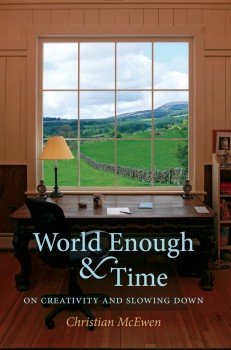
World Enough & Time

September 07, 2012


WETcoverweb


Even the title has a certain timeless feel to it.

I first read about the book World Enough & Time, by Christian McEwan, on Susan J. Tweit’s blog, and I ordered it at once. The subtitle, “On creativity and slowing down,” coupled with Tweit’s review of the book proved irresistible.

Amazon.com’s description says, “According to McEwen, the nonstop emphasis on productivity that is so prevalent in our society is counterproductive for anyone wanting to be creative”—something I wholeheartedly agree with. My default speed is slow. I spent a lot of time alone as a child, and though I was occasionally lonely, I mostly enjoyed the solitude and freedom to do and think as I chose. Spending afternoons in my room, listening to music, daydreaming, writing in my journal or reading formed my personality. As I have grown up and gone from child to parent, from student to worker, I’ve lost nearly all of that unscheduled, dreamy time and I want it back. I hate the speed of 21st century life, and the common assumption that busy is better and packed schedules equal fulfilling lives. McEwen encourages us to allow ourselves to slow down and pay attention.

This really excellent book deserves a slow and thoughtful read. McEwan has pondered long on her subject matter, and draws on a wide range of sources to flesh out her points, quoting writers, philosophers, artists, musicians, psychologists and others. Some reasons I liked World Enough & Time:

It reinforces something I believe in: slowing down is good for us, not just as a tool for creativity but also a way to heal troubled minds and hearts.

The way the book is written encourages you to slow down—not that it’s difficult to read, but that each page holds so much to digest. Before each new chapter is a title page with a single quote so that there is a sort of pause before you go on to new material. Each chapter ends with a couple of simple suggested activities and more quotes to ponder.

The writing is beautiful, with evocative chapter titles like “The Art of Looking,” “A Feast of Words,” “The Space Between” and “A Day So Happy.”

Here is one of my favorite passages from the book:

“Computer ‘memory’ is literal and predictable; it does not alter over time. Human memory is considerably more fluid. We need time to muse and dream, to mull, to ruminate, to sort through our own insights and associations. In the words of the philosopher William James, ‘The connecting is the thinking.’ Without space for that free-floating receptivity, short-term (or primary) memory is not transformed into the long-term (or secondary) kind. Our memories are not consolidated. We mislay the tiny details of our lived experience, the originality and satisfaction of our own opinions.” In other words, without time to process our lives, we forget them. I’ve often felt like an oddball because of my need for quiet time every day just to sit and think or daydream, letting my mind roam where it wants to go. I feel better about that need, now that I know it’s essential for realizing a fully-lived life.

World Enough & Time is not just a book for “creatives”—artists, writers, musicians, etc. It’s a book for anyone interested in stepping out of the mad rush of the world to live at his or her own pace.  I plan to keep it out where I can reread it more slowly (yes, I quickly read a book on slowing down!) and internalize its ideas.

How do you slow down the pace of life?

Life

Prairie Sure

September 05, 2012


I love the images in this poem by Carol Light, of Washington state.

Prairie Sure

Would I miss the way a breeze dimples
the butter-colored curtains on Sunday mornings,
or nights gnashed by cicadas and thunderstorms?
The leaning gossip, the half-alive ripple
of sunflowers, sagging eternities of corn 
and sorghum, September preaching yellow, yellow
in all directions, the windowsills swelling
with Mason jars, the blue sky bluest borne
through tinted glass above the milled grains?
The dust, the heat, distrusted, the screen door
slapping as the slat-backed porch swing sighs,
the hatch of houseflies, the furlongs of freight trains,
and how they sing this routine, so sure, so sure—
the rote grace of every tempered life?

American Life in Poetry is made possible by The Poetry Foundation (www.poetryfoundation.org), publisher of Poetry magazine. It is also supported by the Department of English at the University of Nebraska, Lincoln. Poem copyright ©2011 by Carol Light, whose poems have been published in Prairie Schooner, Poetry Northwest and elsewhere. Poem reprinted from The Literary Bohemian, Issue 12, June 2011, by permission of Carol Light and the publisher.

Birthdays

The Big One-Eight

August 31, 2012

My baby turns 18 today. I do not know how that is even possible.


Last night I spent some sweet hours looking through our family photos. All those trips to the park and the beach and the zoo, all those family get-togethers and vacations. (All those regrettable wardrobe choices as well as fluctuating weights and hair lengths…) How nice that only the good times live in our photos and I do not have visual reminders of the blown-out diapers, the sleepless nights, the battles over food and chores and homework (though, clearly, I remember them).

I didn’t find being a mother to be particularly easy or “natural.” The first year of our son Nick’s life was pretty hard on me. I went from working full time in our insurance agency with my husband to staying home full time with an infant who did not sleep well and wouldn’t take a bottle even of breast milk. My in-laws, who lived nearby, worked full time. My mom and stepmom in California also worked full time. We hadn’t been in Florida that long so I didn’t have a circle of friends to rely on for support, advice and commiseration. My closest friend had a three-month-old and lived more than an hour away. Nick was delivered by C-section, and just when I began to recover from that, I began having gall bladder attacks and had to have that organ removed when Nick was four months old. My husband, who was now running the agency without me, spent most of his time at the office and even when he was at home, he was emotionally drained. An organization called FEMALE (Formerly Employed Mothers at the Leading Edge), now known as Mothers & More, came to my rescue with chapter meetings (without kids) playgroups, outings with kids and mom’s night out activities. I met two of my closest friends through this group and we are still friends, all these years later (one of them is the Mary who took me to the winery a couple of weeks ago).

Despite that rough start, we eventually worked our way into being a family. And I have photographic proof that we’ve had a pretty good life. I’d like to share a few of the photos I found last night. The first was taken shortly after Nick was born:

Poor woman. Doesn't know what she's in for.
This is one of my all-time favorite photos. I was finally through that horrible, hard first year, and Nick and I had forged a close bond.


This photo captures one of my happiest memories. Nick had been given a child’s camera that took photos with 35mm film. One afternoon, we both took our cameras out on our nature trail to take pictures of what interested us. (Note the manly work boots and the walking stick.) I did have his photos developed, and I wonder if he has any of them still?


You’ve seen many photos of Scout on this blog. Here’s the first one I ever took of her. We always tell people that Scout chose Nick. My husband and I had chosen a puppy other than Scout from the litter, but when we came to take our chosen puppy home, this little black and white puppy would not stop following Nick around. He already liked her best from our first visit, so we changed our minds and took the black and white one home instead. Later, when we were going through photos of our first visit to see the puppies, we found this:


Most of the other puppies are doing their own thing, while Scout is licking Nick’s face.

The adage “The days are long but the years are short” most certainly applies to children. Nick’s gone from blocks and Legos, to Xbox and Facebook. He’s 6’1” and I couldn’t rock him in my arms if I wanted to. We’re looking at colleges and talking about professions instead of checking out preschools. But he’s still my baby, and always will be.

Even though he’s turning 18, Nick is still in high school, so I have a little more time to adjust to his newfound “manhood.” I can’t express in words how much, how fiercely I love him and how proud I am of him as he grows up and begins to make his way in the world. I can’t think of a more exciting, scary, rewarding everyday adventure than being his mom.

Happy birthday, Nick!

Bed

The Pleasure Hours

August 29, 2012


“Only one hour of the normal day is more pleasurable than the hour spent in bed with a book before going to sleep and that is the hour spent in bed with a book after being called in the morning.”
–Rose Macaulay

Everyday adventures

Stormy Weather

August 27, 2012


How lucky are we? Tropical Storm Isaac skirted farther to the west than we expected, and all we got was some rain (and a tornado watch). No school, no trash pickup, and government offices closed today. There could be some flooding of a river near us, but other than flooded roads we’ve been lucky. Again.

We prepared well for this storm—topping off our gas tanks, taking some cash out of the bank, making sure our hurricane food and water supplies were adequate, charging up the electronics and phones. I even went to the library to pick up two books on hold for me (wouldn’t want to run out of reading material, would I? Not that there’s the remotest chance of that). Last night, the worst of the storm looked likely to pass by us, so we didn’t have to bring in all our potted plants and patio furniture. Our preparations took on sort of the opposite of “If you build it, they will come” thinking—more like “If you prepare, the storm will pass you by.”  

Storms come to us all—both the physical and the emotional. With a hurricane or a tropical storm, you usually have plenty of warning. Not so for an earthquake, which I experienced several times growing up in California. There’s not a lot you can do, except try to be prepared for the inevitable. Store up food and water, fill your gas tank, fill your emotional well. And be grateful when all is calm.

A moment ago, I saw the sun peek out for the first time today. It’s gone again, but it reminded me that storms pass. And sometimes they’re not as bad as we expect.

It looks like Isaac will strengthen into a hurricane, and make landfall late Tuesday or early Wednesday somewhere on the Gulf Coast. My thoughts are with the people in the Gulf states—I hope they weather this storm safely. 

How do you prepare for storms—physical or emotional?

Everyday adventures

Look Mom, No Cavities!

August 24, 2012


Did you know that domestic horses need regular dental check ups? A combination of factors, including how a horse chews his food and the way a horse’s teeth continue to erupt through the gum during his lifetime, can create sharp edges or hooks that can actually cut his cheeks and tongue, affecting his eating and making it painful to be ridden with a bit in his mouth. Properly cared for teeth help the horse chew feed more effectively—he won’t drop as much, and there won’t be a build-up of improperly chewed food in his stomach that could cause impaction colic. Veterinarians often perform horse dental work, and there are also specialized equine dentists. They generally recommend dental check ups every six months to a year, depending on the horse’s needs.

When a vet or equine dentist takes off those sharp edges with a file, it’s called “floating” the teeth. This used to be done with a hand tool that looks like a large file (called a “float”), but many vets and equine dentists now use a power file with a diamond head—much easier on both vet and horse. The vet or equine dentist also inspects the mouth, teeth and gums for any abnormalities such as an abscess, broken or cracked teeth or even gum disease! Horses can also get cavities and need to have teeth pulled, just like humans. (As far as I know, brushing a horse’s teeth is not a common practice, however!)

As you might expect, horses do not generally like to have their mouths held open while a buzzing electric drill files down their molars. To float a horse’s teeth, he must be sedated. The vet/dentist uses a special halter and mouth speculum that holds the horse’s head up and his mouth open.

Hey, that's my tongue!
Last week, we had a visit from Advanced Equine Dentistry.  Dr. Jay Clifford is a vet, and Richard Grist, CEqD is an equine dentist.  They’re both very nice and easy to work with, so we always like seeing them. Tank is a good patient and is on a maintenance program, so it takes less than a half hour for him to board the rig, be sedated, have his teeth floated and be back out and waking up. (He always looks a little pathetic as the sedation wears off.) After an hour or so, I let him graze a bit before he goes back out with his buddies.

Zzzzzz...
So that’s your horse care lesson for the week, and Tank’s everyday adventure. Oh, and he got a clean bill of dental health!

Back to normal.

$500 Tip

Aaron's Last Wish

August 22, 2012

It started with a young man’s wish, left behind in his will: he wanted his family to leave an “awesome” tip for a server—not 25%, but something like $500 for a pizza. Aaron Collins died in July, just after his 30th birthday, and his family honored his last wish by collecting the funds for that “awesome tip,” eventually giving a $500 tip to a waitress who served them lunch. You can see the video here:


This act of generosity touched thousands of people who continue to send donations to the Collins family, who have pledged to keep leaving these tips until the money runs out. (As I write this, the donations stand at $58,787, or enough to give a $500 tip to 117 waiters or waitresses.) Others have taken it on themselves to leave their own substantial tips. (You can read more about this and see more videos by visiting aaroncollins.org.)

I love this story and wanted to share it with you. I’m touched by the love and generosity of the Collins family, and by the outflowing of love from people who have heard about what they are doing. You never know what a kind act will mean to someone, or how many people ultimately benefit.

Everyday adventures

Summer Wine

August 20, 2012


Saturday, my friend Mary took me to the Keel & Curley Winery in Plant City, FL, for a tasting and tour. What better way to spend a rainy afternoon than with a friend drinking wine?

Keel & Curley got its start in 2003 in owner Joe Keel’s kitchen. Keel, a blueberry farmer, was looking for a way to use end-of-season blueberries, and decided to try making wine with them. It took him a couple tries, but eventually he came up with a wine worth selling and Keel & Curley (Curley is Keel’s mother’s maiden name) was born. In addition to three types of blueberry wine, K & C also produce two blackberry wines and seven “fusion” wines: grape wines combined with other fruit juices. Their wines have won several awards, and in 2010, their Strawberry Riesling won Best of Show at the Florida State Fair International Wine Competition. Keel & Curley is the Tampa area’s only estate winery—meaning it is the only winery that grows and produces wine from its own fruit (in their case blueberries) on site. (They don’t grow all the other fruits they use in their wines on their own property.)

High bush blueberries
We arrived a half hour before our scheduled tour so we could divide up our tastings instead of doing them all at once. (Even with only a sip or two per wine, after tasting 12 of them at once I’d be reeling, and I wouldn’t be able to savor the different flavors.) After we checked in for our tour, we got our tasting cards and began with the Dry Blueberry (100% blueberry juice, with no sugar added).  The room where the tastings take place was a large open space with a distinctly happy vibe (sorry, I didn’t take any photos of the whole place—but you can see some on the K & C website). The wine hosts (a term I just made up) were friendly and knowledgeable, happily pouring wine and answering questions. I know very little about wine, but I enjoyed tasting the fruity combinations Keel & Curley produce. To me, they seemed sweeter and less complex in flavor than many other wines I’ve had, and according to our tour guide, they are considered “young wines,” and best drunk within a few years of bottling.

After tasting several wines, it was time for our tour. Our guide brought us to the large warehouse-type building that housed the entire small operation, from fermentation to clarification to bottling. The spotlessly clean building smelled yeasty, from the wine-making yeast used in the fermentation process. Wines in various stages of completion filled the imported (from Italy) stainless steel vats.

Fermenting wines
Filtering apparatus
Bottling machine
When we returned to the main building we finished up our wine tastings, and chose some wine to take home: Dry Blackberry, Wild Berry Pinot Noir, and Key West Key Lime Sauvignon Blanc (which I did not think I’d like but turned out to be one of my favorites).

Usually my Saturdays are taken up with chores or other work, or I keep myself available for family activities that we seldom seem to take advantage of. Thank you, Mary, for getting me out of my usual rut and taking me on an everyday adventure! I’ll think of you every time I raise my souvenir glass!

What did you do this weekend? I hope you had at least one everyday adventure.

Black Cow milkshakes

Happy Little Things: The Black Cow

August 17, 2012


When I was a teenager growing up in Southern California, I lived within walking distance of an Arby’s fast food place. Sometimes, when I had enough allowance left over after a visit to the record store (yes, record store—I’m 150 years old), I would walk to Arby’s for a Black Cow—a root beer-flavored shake (not a float).

My Arby’s sold the Black Cow all the time, not just during “Black Cow Month,” the way some franchises did, so I could indulge whenever I had the money, or when I could talk my mom into stopping there for lunch. Eventually I grew up and moved away and spent my disposable income on things other than Black Cows, but for years, every time we stopped at an Arby’s, I always hoped they’d have a Black Cow shake on the menu. Arby’s eventually discontinued the shake altogether and I went into mourning.

Now, thanks to the magic of the internet, I can satisfy my Black Cow cravings. However, as I was looking up information on the Black Cow, I discovered that the Arby’s version, a vanilla shake made with root beer flavored syrup, was an imposter. Generally, the term Black Cow refers to a root beer float, sometimes with chocolate syrup added to it! Now there’s a marvelous concept! Chocolate makes everything better. And if you use cola instead of root beer, it’s called a Brown Cow. Or sometimes the other way around. Or sometimes, it’s a root beer float made with chocolate ice cream. It gets a little confusing. Anyway, according to Wikipedia, the first Black Cow was what we now call a root beer float and debuted on Aug. 19, 1893. Frank J. Wisner had been producing soda waters for the people of Cripple Creek, CO, and wanted to come up with a drink the children would like. One night, inspired by the snow topping Cow Mountain (it reminded him of vanilla ice cream), he added a scoop of ice cream to the soda the kids liked: Myers Avenue Red root beer. The drink was hit, and the children shortened the original name, “Black Cow Mountain” to “Black Cow.”

With this information in hand, I decided to try several versions of the Black Cow—a root beer float with chocolate syrup, a vanilla shake with root beer extract and this: Black Cow Ice Cream!  All in the name of science, and all for you, I might add. I know this is the kind of hard-hitting experimentation you look for when you visit Catching Happiness.

The verdict: The ice cream tastes like a good chocolate ice cream with a root beer aftertaste—good on its own and makes a yummy root beer float. However, it’s just enough trouble to make that I probably won’t do it again. The vanilla shake with root beer extract was close, but a little bland. The winner? The root beer float with chocolate syrup! That’s what I’ll reach for the next time I want to satisfy my nostalgic craving for a Black Cow.

The aftermath of making the ice cream

What was one of your favorite childhood treats? Do you still indulge?

Beauty

Summer Afternoon

August 15, 2012


“Summer afternoon, summer afternoon; to me those have always been the two most beautiful words in the English language.”
—Henry James

It's National Relaxation Day today! Why not celebrate?

Randomness

Where's Ariel?

August 13, 2012

Seen on the street in San Francisco:


I hope she enjoyed her trip. Apparently, her co-workers missed her!

Books

Um...

August 10, 2012


What was all that about keeping life simple, reducing the amount of stuff on hand, etc.? I seem to have taken a step or two back, and it’s no surprise that books were involved.

I had been quite good about not buying a lot of books lately—that is until the bookish stars aligned in a most particular way in the past month. Suddenly I find myself inundated with a large pile of books from: 1. a library book sale; 2. my local used book store (where I at least turned in some books for credit); 3. Paperback Swap and 4. a sale at Abebooks.com. (I also bought a couple books from my library’s used book store as well. It’s a sickness, I tell you.)

I justify this sudden influx of books by noting that I’ve only bought books that I either can’t get at my library, books I especially want to add to my personal collection, or books that I need/want for reference for a writing project. I also can’t help it that one of the books on my Paperback Swap wish list became available during this same period…

And just when my to-be-read stack seemed to be shrinking.

Curious about all this book bounty? This post would be far too long if I describe all of these, so I’ll just share a few:

Tales of the City, Armistead Maupin. I found this at my local used book store. I was under the impression this was a series of essays, but it turns out it’s a novel, set in San Francisco. After visiting San Francisco, I’ve wanted to read more about it, and more books set there. 

Very New Orleans, Diana Hollingsworth Gessler. Another travel-inspired title. I’m adding this little illustrated book to my growing list of books about New Orleans, one of my favorite cities. 

The Solitary Summer, Elizabeth Von Arnim. A novel by the author who wrote Elizabeth and Her German Garden. In this book, Elizabeth is to have a summer all to herself, with no guests, but plenty of time for her books and her garden and general roaming of the countryside.  Sounds like heaven to me.  I bought this one and the next from the Abebooks sale. 

The Lady Vanishes, Ethel Lina White. I love mysteries, and this sounds like a good one. Originally published in the 1930s as The Wheel Spins, Alfred Hitchcock eventually made a movie out of it. 

Pears on a Willow Tree, Leslie Pietrzyk. This was one of the books my son could have chosen to read from his school’s summer reading list last summer. He didn’t choose it, but I decided to read it. Described as “a multigenerational roadmap of love and hate, distance and closeness….four generations of mothers and daughters of Polish ancestry are bound together by reminiscences and tangled relationships.” (Doesn’t sound like anything a teenage boy would want to read, does it? Who chooses the summer reading lists, anyway?!) Another purchase from my library’s bookstore.

Cousin Kate and The Spanish Bride, Georgette Heyer. I used to read Georgette Heyer’s historical romances when I was a teenager and young adult. This summer, I picked up Heyer’s biography, which turned out to be fascinating, and renewed my interest in her work. She was a very private woman, refused to do interviews to promote her books, and was quite expert on the Regency era in England in which so many of her books were set.

England As You Like It and England for All Seasons, Susan Allen Toth. I dare you to read Toth’s books on England and not want to pack your bag and go. I already had Toth’s My Love Affair With England and decided I wanted to complete the set—thanks to Paperback Swap, I did.  

Belle Weather, Celia Rivenbark. A collection of funny essays focusing on southern life. I’ve read her other books (including Bless YourHeart, Tramp, and Stop Dressing YourSix-Year-Old Like a Skank)  My library bookstore had Belle Weather for just a dollar, so I snatched it up.

I admit I go overboard with books. I really do not need to own all these books, but chances are pretty good that I will pass at least some of them on eventually, back to the used book store, library or Paperback Swap. In the meantime, I will revel in the wealth of printed material I have to choose from. I just finished a novel, so what shall I pick up next?

What do you go overboard with?

Happiness

Ode to Marbles

August 08, 2012

Photo courtesy  Malgorzata Replinska

I have always enjoyed poems that celebrate the small pleasures of life. Here Max Mendelsohn, age 12, of Weston, Massachusetts, tells us of the joy he finds in playing with marbles. [Introduction by Ted Kooser.]

Ode to Marbles

I love the sound of marbles   
scattered on the worn wooden floor,   
like children running away in a game of hide-and-seek.   
I love the sight of white marbles,   
blue marbles,   
green marbles, black,   
new marbles, old marbles,   
iridescent marbles,   
with glass-ribboned swirls,   
dancing round and round.   
I love the feel of marbles,   
cool, smooth,   
rolling freely in my palm,   
like smooth-sided stars   
that light up the worn world.

American Life in Poetry is made possible by The Poetry Foundation (www.poetryfoundation.org), publisher of Poetry magazine. It is also supported by the Department of English at the University of Nebraska-Lincoln. Poem copyright ©2004 by The Children’s Art Foundation. Reprinted from Stone Soup, May/June, 2004, by permission of the publisher, www.stonesoup.com. Introduction copyright © 2012 by The Poetry Foundation. The introduction's author, Ted Kooser, served as United States Poet Laureate Consultant in Poetry to the Library of Congress from 2004-2006.

Family

Adventures in Family Vocabulary

August 06, 2012

My husband and I have been married for 24 years, and over that time we’ve developed a set of words and phrases that serve as a kind of family shorthand for feelings and inside jokes. Most of them have an element of humor (good for diffusing sticky situations) and sometimes serve as a sort of verbal throwing-up-of-the-hands. For your amusement, I share a few of them below:


“I’m a delicate flower.” Meaning: whatever you’ve asked me to do is too hard, and I can’t/don’t want to do it. Sounds nicer than “You don’t really expect me to help you move that furniture, do you?”

“Pay the love toll.” Meaning: Before I give you what you want/you walk by me/you leave the house, I need a hug.

Hayseed/Nimrod. A hayseed is a person who has done something stupid, but doesn’t know any better. A nimrod knows better, but does the stupid thing anyway. With teenagers around, it’s often hard to discern between hayseed and nimrod behavior.

“Buy yourself a trinket.” Usually said by the lender to the lendee who is returning change after borrowing money. Sometimes we also say this when someone outside the immediate family tries to pay one of us back for something we paid for.

“You kids get off of my lawn.” We say this when we realize we just said something that makes us sound like old fogies. Usually accompanied by shaking a fist in the air.

Family vocabulary makes me happy. I feel more connected in an intimate way to my husband and son, because no one else completely understands the history and emotional content of our words. Sometimes saying a single word in a certain way diffuses tension, making us laugh instead of yell or cry.

Does your family have any words or phrases that serve as family shorthand or inside family jokes?

Did someone say HAYseed?

Dressage

2012 Summer Olympics—Horse Event Primer and a Few Fun Facts

August 03, 2012

Have you been watching the Olympics? I’ve been spending hours glued to the TV because…equestrian events! Thank you NBC Sports! So far they’ve had the sense to air good portions of the three equestrian events that take place at the Games: eventing, dressage and show jumping. If you’ve never watched equestrian events, here’s a quick primer for what you can see, and a few fun facts:


Currently, equestrian events are the only ones where men and women compete against each other as equals.

The three equestrian sports at the 2012 Olympics are dressage, “Grand Prix” or show jumping, and eventing (also known as three-day eventing).  Each sport has a separate team of riders and horses.

In dressage, horses perform a series of movements known as a “test.” The first two rounds, the movements are in compulsory order. The third round is “freestyle” and set to music. Dressage has been called “horse ballet.” In show jumping, horse and rider must complete a course of approximately 15 fences within a set amount of time. Penalties are assessed if poles are knocked down, a horse refuses a jump, or if the horse and rider do not complete the course within the time allowed. Eventing takes place over several days and includes three components—a dressage test, a cross country course, and a round of show jumping. (The dressage and jumping aspects are completed in the same manner as the regular dressage and show jumping, but at a less demanding level.) Eventing is the triathlon of horse competitions, and tests the horse’s fitness and the rider’s all-round skill.

In each of these sports, team and individual medals will be given out. Two hundred athletes will compete for the six gold, six silver and six bronze medals at the 2012 Olympics.

Riders must be a minimum age of 18 to compete in eventing or show jumping, and 16 to compete in dressage. The oldest member of the U.S. Olympic team is Karen O’Connor, a 54-year-old eventer competing in her fifth Olympics. The youngest is 18-year-old Reed Kessler, part of the show jumping team. And the oldest athlete at the entire 2012 Games competes in dressage: Japanese rider Hiroshi Hoketsu, age 71.

Equestrian events began in 682 B.C. when a four-horse chariot race took place at Greece’s 25th Olympiad.

Until 1952, only male cavalry officers were allowed to compete in equestrian events.

Lisa Hartel, of Denmark, won a silver medal in dressage at the 1952 Games, despite being paralyzed from the waist down by polio and having to be lifted on and off her horse.

Also in 1952, Foxhunter, the horse that carried Colonel Harry Llewellyn to Great Britain’s only gold medal of the Games (in team show jumping), received a congratulatory telegram from Winston Churchill.

The horses that compete in the Olympics have their own passports. The passports don’t have pictures, but line drawings indicating the horse's identifying features. They also contain a list of the horse’s vaccinations.

Check online or with your local TV stations if you’re interested in taking a peek at the world of equestrian sports (or click here for the best schedule I've found). Eventing finished earlier this week, dressage is taking place now and show jumping starts Saturday. Here’s a quick YouTube video from the eventing competition to whet your interest: 


What’s your favorite Olympic sport?

Flowers

Treat Yourself

August 01, 2012


“One of the secrets of a happy life is continuous small treats.”
—Iris Murdoch

How will you treat yourself today?

Change

Slack Tide

July 30, 2012


Every life has a series of tides, times of transition and fluctuating circumstances. For example, as children grow up, a parent’s focus changes from the physical care of changing diapers and feeing babies to supervising homework, and on to grilling teenagers about where they’re going and who they will be with. Parenting is a series of ebbs and flows as children’s needs change from one day to the next. Marriages, friendships, jobs, hobbies and interests all have their own rhythms of ebb and flow.

I’ve been thinking about ebbs and flows as my son prepares for his senior year in high school. In most ways he requires little care, and can even be helpful. In others, we’ve had to tighten up certain rules and practices. We’ve also made it a point to spend as much time with him as possible (and as he will allow!) while he’s still at home. In a short time (God willing) he’ll be gone, and we’ll be faced with the complete ebb of our roles as parents.

While this is happening, I’m trying to shift my focus from household responsibilities to writing projects. I’m finding this hard to do because there’s no guarantee my writing projects will be successful (and they’re certainly not contributing to the family finances right at this moment) and it’s easy to see when the bathroom is clean, the laundry is done and dinner is on the table. The problem is, my writing projects will never be successful if they don’t get the time and attention they need to blossom. That time and attention has to come from somewhere, and I can’t (and don’t want to) give up all leisure time, so some household stuff is just going to have to take a backseat.

While I’m learning to cope with the ebbs and flows of life, I’ve found these principles helpful.

Pay attention. What you need, what your family and friends need from you, may—will!—change. Maybe instead of a nap you need a bike ride, or vice versa. Maybe your best friend needs a kick in the pants instead of a listening ear, or vice versa. What was soothing or energizing last month might not do the trick today. As a sailor studies tides, watch for changes in the current of your life.

Go with the flow. Don’t fight the current. Don’t get hung up on what you “should” do or “should” have or “should” want. If you feel strongly that the tide is taking you away from where you want to be, know that new tides will come. The ocean, and your life, is always moving, always changing. Down times give way to up times. Try to keep your head above water and watch for a break in the current. Fighting the tides will exhaust you and can be dangerous. Allow the current to take you. You might end up someplace wonderful.

Float when you get the chance. Slack water, or slack tide, is the moment that tidal current ceases. This occurs just before the tide turns and begins running the other direction. If you’ve been paying attention and going with the flow, you should be able to sense this change and float for a while before flowing off to who knows where. Relax, gather strength and look forward to what’s next. (That’s kind of where I feel I am now.)

Ocean tides are among the most reliable natural phenomena in the world. In life, we are sure to face times of ebb and flow, just like the ocean. How about you? What is flowing into your life? Out of it?

P.S. I’ve had a big uptick in spam lately, so I’m putting word verification on for at least a little while—sorry for the inconvenience!

Animals

What Kind of Bird Is That?

July 27, 2012

Is the coast clear?

Yum, yum…

Oh, you saw that? Well, you meant for me to eat this, right?

Happy Friday. I’m going to go refill the feeder so the birds will have something to eat…

Happiness

A Happier Life

July 25, 2012


There is a type of poem, the Found Poem, that records an author’s discovery of the beauty that occasionally occurs in the everyday discourse of others. Such a poem might be words scrawled on a wadded scrap of paper, or buried in the classified ads, or on a billboard by the road. The poet makes it his or her poem by holding it up for us to look at. Here the Washington, D.C., poet Joshua Weiner directs us to the poetry in a letter written not by him but to him. [Introduction by Ted Kooser.]

Found Letter

What makes for a happier life, Josh, comes to this:   
Gifts freely given, that you never earned;   
Open affection with your wife and kids;   
Clear pipes in winter, in summer screens that fit;   
Few days in court, with little consequence;   
A quiet mind, a strong body, short hours   
In the office; close friends who speak the truth;   
Good food, cooked simply; a memory that’s rich   
Enough to build the future with; a bed   
In which to love, read, dream, and re-imagine love;   
A warm, dry field for laying down in sleep,   
And sleep to trim the long night coming;   
Knowledge of who you are, the wish to be   
None other; freedom to forget the time;   
To know the soul exceeds where it’s confined   
Yet does not seek the terms of its release,   
Like a child’s kite catching at the wind   
That flies because the hand holds tight the line.

American Life in Poetry is made possible by The Poetry Foundation (www.poetryfoundation.org), publisher of Poetry magazine. It is also supported by the Department of English at the University of Nebraska-Lincoln. Poem copyright © 2006 by Joshua Weiner. Reprinted from “From the Book of Giants,” University of Chicago Press, 2006, by permission of the author. Introduction copyright © 2012 by The Poetry Foundation. The introduction's author, Ted Kooser, served as United States Poet Laureate Consultant in Poetry to the Library of Congress from 2004-2006.

Beautiful moments

Noticing the Beautiful Moments

July 23, 2012


Life’s so busy, isn’t it? Our days are full of work, play, family, friends—and it’s good to have a full life. But it’s also good to slow down once in a while to notice the beautiful moments. Summer is perfect for this, because generally life’s fast pace slows down somewhat, and you might have a little more time to look for and appreciate those moments.

I’d like to share two beautiful moments I’ve had recently with my horse, Tank. He now shares a paddock with a small group of horses during the day (he still eats and spends the night in his smaller “private” paddock). I think likes being with his new friends, all mares except for a two-year old colt. At first, I wondered how this would affect how he feels about my coming to get him. When he lived alone, he was eager to see me. Would he still whinny, come to meet me at the gate, be happy to see me? Happily, the answer to these questions is yes. One of those moments I was talking about occurred last week as I stood at the gate of the large paddock, lead rope and halter in hand. Tank left his buddies and came to me, ears pricked, expression asking, “What are we doing today?” I stood there, melting into my boots (and not just because it was 92 degrees), marveling that this lovely, powerful creature belongs to me, knows me, looks to me for attention and guidance. After owning him for eight years, I sometimes take him for granted. Every now and then, I wake up the miracle of his presence in my life.

The second moment with Tank happened on Saturday. After we tacked up, I had a few minutes to wait until the riding lesson started, so I sat down in one of the green plastic outdoor chairs clustered under the trees. Tank stood next to me, relaxed, so I began to stroke and massage his ears and poll (the top of his head). He seemed to like it, slowly blinking his eyes and lowering his head. When I stopped, he left his head low, so I leaned forward and breathed into his nostrils (one way horses greet each other). I gently touched his muzzle with my forehead while we inhaled and exhaled together. We stayed like that for a few minutes, and I don’t know about Tank, but I found this so soothing that I nearly fell asleep.

My beautiful moments had nothing to do with achievement or accomplishing a goal. For once, I put aside my jabbering mind, my busyness, and relaxed into the present moment. I want to have more experiences like this—with Tank and in all areas of my life—moments where time stands still and the to-do list falls from memory, moments in which I truly realize how lucky I am and how grateful I am for my life.

I hope that you experience beautiful moments such as these. If you feel comfortable doing so, please share them in the comments. I’d love to hear from you.

Baseball

Play Ball!

July 20, 2012


Ah, the crack of the bat, the noise of the crowd, the smell of the…pressed Cuban sandwiches? That’s how we do it, here in Tampa Bay.

Yesterday my family and I went to a Tampa Bay Rays game—I’m the baseball fan in the family, so a summer isn’t complete for me without a game or two over at Tropicana Field in St. Petersburg. We like going to day games during the week—the crowds are usually smaller and we don’t get home at midnight.  (We’re fuddy-duddies, I admit.)

We had a great crowd today, more than 27,000. Lots of kids from local camps and childcare centers banging thunder sticks and hoping to catch a foul ball.

My favorite part:

The Tropicana Field roof—and the air conditioning contained therein.

Rays lefthander David Price getting ready to pitch.

Sorry, I didn’t get a photo of the Cuban sandwich before we ate it...

Oh, and best of all, the Rays beat Cleveland 6-0. And since Rays pitching struck out 10, we all get coupons for free pizza from Papa John’s!

Rays baseball—an awesome summer tradition. What are you favorite summer traditions?

Simple pleasures

Summer Day

July 18, 2012


“Rest is not idleness, and to lie sometimes on the grass on a summer day listening to the murmur of water, or watching the clouds float across the sky, is hardly a waste of time.”
—John Lubbock

Batteries

Don't Try This at Home

July 16, 2012


I just bought a new battery for my laptop, and for some reason I decided to read the single-page instruction manual it came with. I learned:

Never throw the battery pack into fire, as that could cause the battery pack to explode.
Never short-circuit the main battery pack by either accidentally or intentionally bringing the terminals in contact with another metal object. This could cause personal injury or a fire, and could also damage the battery pack.
Never hammer a nail into the battery pack.
Never hit a hammer on the battery pack.

You know someone, somewhere has done each one of these things. Possibly my son.

What I want to know is…why?

Why would you want to throw a laptop battery into a fire? Hit it with a hammer or pound a nail into it? The only reason I can think of is to find out what happens. Personally, I can’t imagine anything good coming from those actions, but that’s just me. I’m pretty cautious about experimentation.

But thankfully, not everyone is like me. We need people who are curious and test boundaries, or we’d never have inventions like the laptop and its battery-that-shouldn’t-be-hammered. People who step outside their comfort zones to try experiments the average person wouldn’t dream of have made the world an immeasurably better place, often at great cost to themselves. I’m grateful for the men and women who want to find out what happens. (All I ask is that they pause for a moment to ask themselves what could go wrong, and how they’re going to cope if it does.)

Once again, I guess people can be divided into two categories: Those who put their laptop batteries in their computers and those who come at them with a hammer. Which one are you?

July

July Pleasures

July 13, 2012


Jewel-toned fruits.
Fireworks.
Flip flops.
Baseball.
Fresh herbs.
Ice cream.
Cotton-ball clouds in cobalt skies…

July is really and truly summer. There’s no school (both June and August contain a few days of school where we live). Summer weather patterns set in and we get thunderstorms nearly every afternoon. I love to hear the rumble of thunder in the distance, watch the skies darken, hear the pounding rain. Then sun again. Sometimes we get “sunshowers”—rain and sunshine at the same time.

In July, we slow down. After all, it’s too hot and humid to do much of anything but sit. Grab a cool glass of something to drink, put your feet up and chill—usually with a good book. Yeah, that sounds pretty good. Think I’ll do that this weekend…

Every month, every season has its own pleasures. Though I like to complain about the heat and humidity, just this once I’m going to shut up and appreciate what July has to offer.

What are your favorite July pleasures?