| Palace of Fine Arts, San Francisco |
I don’t know how many of you like to travel, but I love it.
(You may have guessed that from some of my posts.) I don’t do as much of it as
I’d like to, and until the day comes when I can take off on a whim for parts
unknown, I’ll make do with armchair travel—which, come to think of it, would be
good for those who do not want to travel, but would like to broaden their
knowledge of the world in general.
Of course, reading books and watching movies set in
different cities and countries is one of the best ways to get a taste of a
location. My favorite getaway movies include Shirley Valentine, My Life in Ruins and Under the Tuscan Sun. For books, I often return to old favorites The Enchanted April (also an excellent movie) or one of Mary Stewart’s older novels, set in Greece :
This Rough Magic, The Moon-Spinners or My Brother Michael, for example.
Now, however, there are even more ways to get your travel
fix without leaving your comfortable home. The internet has brought us closer
together in a number of ways—there are websites devoted to cities, counties and
nations with photos that can transport you there with the click of a mouse.
If you’re feeling really ambitious, you could learn a
language. Rosetta Stone, Pimsleur and Tell Me More are three well-respected, fee-based
options. You could also check out free podcasts on iTunes and elsewhere, or
check out websites such as learnalanguage.com.
My current method of enjoying armchair travel is Laure
Ferlita’s Imaginary Trip to Greece
(see Imaginarytrips.com for a list of all Laure’s terrific classes). Not only am I improving my sketching
skills, I’m also learning more about Greece
with every lesson.
![]() |
| Erechtheion Porch of the Maidens |
Whether I’m looking at someone else’s pictures or creating
my own, armchair travel keeps me (somewhat) satisfied in between actual trips. How
do you satisfy your yen for travel?
I confess. In addition to being addicted to books, I also
have a small notebook fetish. From the purse-sized notebook I carry for jotting
things down on the run, to the multiple spiral or bound journals that congregate
on my shelves, I own a number of notebooks that I’m actively using as well as
ones that I haven’t yet cracked open. And even though I have plenty already, I
cannot help but be drawn to displays of notebooks and journals wherever I am. I
always have to pick them up to see how they feel and what kind of paper is
inside. I try not to overbuy, but really, is it so bad to have separate
notebooks for morning pages, a personal journal, books read, writing ideas and
all things wordy? And maybe one or two ready and waiting for when I fill up one
of the ones in use? (And then there are the sketchbooks. I have at least five of
those with varying types of paper: sketch, watercolor, multi-media. But that's another story.)
I guess it’s a fairly harmless and mostly inexpensive
obsession—and it makes me happy. I’m all for noticing, savoring and encouraging
the happy little things in life, and my notebook mania does makes me happy. I love every stage: browsing notebook choices, gloating over a shelf of blank notebooks, starting a new notebook and putting a period at the end of the last sentence of one I've filled up. Then I can start the whole process over again!
What little thing has made you happy this week?
“Notebooks are like
attics, a place for treasures which sometimes turn out to be junk, but take you
anyway to another time and place.” —Cynthia MacDonald
![]() |
| Photo courtesy lovetheson |
I’ve built many wren houses since my wife and I moved to the
country 25 years ago. It’s a good thing
to do in the winter. At one point I had
so many extra that in the spring I set up at a local farmers’ market and sold
them for five dollars apiece. I say all
this to assert that I am an authority at listening to the so small voices that
Thomas R. Smith captures in this poem. Smith lives in Wisconsin . [Introduction by Ted Kooser.]
Baby Wrens’ Voices
I am a student of wrens.
When the mother bird returns
to her brood, beak squirming
with winged breakfast, a shrill
clamor rises like jingling
from tiny, high-pitched bells.
Who’d have guessed such a small
house contained so many voices?
The sound they make is the pure sound
of life’s hunger. Who hangs our house
in the world’s branches, and listens
when we sing from our hunger?
Because I love best those songs
that shake the house of the singer,
I am a student of wrens.
American Life in Poetry is made possible by The Poetry
Foundation (www.poetryfoundation.org), publisher of Poetry magazine. It is also supported by the Department of
English at the University of Nebraska ,
Lincoln . Poem copyright ©2005 by Thomas R. Smith,
whose most recent book of poetry is “Waking Before Dawn,” Red Dragonfly Press,
2007. Poem reprinted from the chapbook
“Kinnickinnic,” Parallel Press, 2008, by permission of Thomas R. Smith and the
publisher. The poem first appeared in “There
is No Other Way to Speak,” the 2005 “winter book” of the Minnesota
Center for Book Arts, ed., Bill
Holm. Introduction copyright © 2009 by
The Poetry Foundation. The
introduction’s author, Ted Kooser, served as United States Poet Laureate
Consultant in Poetry to the Library of Congress from 2004-2006.
I’m always reading a book—usually more than one. Today is no
different, but I’m torn because I’m enjoying each one so much. Usually a
favorite emerges, and I put aside the others to finish it—that hasn’t happened
yet, but I’m getting pretty close to the end of a couple of these:
Just borrowed Outlander
from the library—a beautiful, 20th anniversary edition. (How did this book exist for 20 years
without my having picked it up?) I’m totally engrossed in Claire’s adventures
in 18th century Scotland ,
which is a good thing, because I only have three weeks to read this 650+ page
novel. So far I’m zipping along pretty quickly, so I think I can manage it. If
I can’t, my library offers a one-week grace period before they start charging
fines. Apparently I’m not the last person alive to read this, because there are
multiple holds on this book so I won’t be able to renew it.
Zen and Horses is an exploration of “lessons from a year of riding,” as the subtitle explains.
Ingrid Soren, who also teaches yoga and Zen, writes thoughtfully about what she learned, and beautifully describes the
countryside where she lives and rides: “It was a golden day in mid-September. The fields
were dormant, the stubble plowed under. The land lay quiet before the sowing of
the winter wheat. A light mist rose off the ground in the morning, obscuring
rust-tinged leaves as a low sun struggled through. Plums and apples dropped off
heavy trees into the damp grass, and blackberries shone on the bramble.”
I broke away from working with Getting Things Done, by David Allen, to write this blog post. I’m always trying to find better ways to organize my
time (so that I can have more time to read…and do other fun things) and this
book was recommended in something else I read. Allen’s system is by far the
most comprehensive I’ve seen, and I think that applying at least some of the
principles will help me. Some snippets of wisdom: “The vast majority of people
have been trying to get organized by rearranging incomplete lists of unclear
things; they haven’t yet realized how much and what they need to organize in
order to get the real payoff. They need to gather everything that requires
thinking about and then do that
thinking if their organizational efforts are to be successful.” I’m still in
the process of gathering everything together. The idea is to have one system to
keep track of everything—that way nothing falls through the cracks. (So far I’m
overwhelmed and intimidated by the amount of stuff I’m collecting—but
apparently that’s not unusual.)
One of the key things I’m learning from this book: Projects
are overwhelming, because you can’t “do” a project—you can only do actions
related to the project, some of which take only minutes. Ask yourself: what is
the next action I can take to move this project forward?
On a lighter note, I’m also reading Not So Funny When it Happened: The Best of Travel Humor and Misadventure. I picked this up when Outlander was “in transit” (on it’s way for me to pick up) and I
didn’t want to start a novel I’d just have to put down again while I tried to
finish Outlander. It’s easy to dip in
and out of, as each piece stands alone, and most are fairly short and funny.
So that's what I'm reading. How about you?
Every now and then, instead of all the suffering, problems,
irritations and frustrations of life, I see some things that fill me with wonder.
I hear a story about something amazing or inspirational or beautiful. I marvel
at the creativity and determination and sheer joyous spirit some people have.
I’d like to share a few of my more recent discoveries in this post.
An anonymous someone has left a number of intricate paper
sculptures carved from books at various libraries, museums and festivals in Scotland ,
beginning with the Scottish Poetry Library. (Click here for the whole story and photos of the amazing pieces.) Each piece was
accompanied by a tag with a short message. Here is the wording of the one found
at the Scottish Storytelling Centre, of a dragon in a nest: “A gift in support
of libraries, books, works, ideas…. Once upon a time there was a book and in
the book was a nest and in the nest was an egg and in the egg was a dragon and
in the dragon was a story….” I would go to Scotland
just to see these wonder-full creations!
This inspiring video (thanks to my husband who sent the link
to me) demonstrates the power of belief and persistence. It’s also a pretty
good advertisement for yoga!
Imagine that you’re blind. You’ve created a system using
elastic bands, to enable yourself to write in longhand the novel that’s brewing
in your brain. You complete 26 pages and begin to think about finding a publisher.
Then your son comes to visit and breaks the bad news: your pen had run out of
ink. Your pages are blank. What happens next is the wonder-full part: using a
special police technique that involved shining light on the paper from various
angles to reveal the indentations made by the pen, Dorset
County (England )
forensic service expert Kerry Savage was able to recover the entire manuscript
except for one line. Ms. Savage spent five months of lunch breaks working on
the project, in addition to her regular job helping to solve cases of murder,
fraud or arson. Click here for the whole story.
Scientists in a new field known as “soundscape ecology” are
using radio telescopes to record extended stretches of audio in wilderness
areas. They’re studying the sounds found in entire ecosystems, and the effects humans’
sounds have on nature, among other things. While this is interesting, what I
found wonder-full in this article was the links to short recordings of sounds found at Denali National Park and
Preserve, such as “Alpine stream feeding into an ice cave,” or “Bear with
cubs.” Sitting here in Florida , I
can listen to nature sounds from Alaska !
I hope you’ve enjoyed these stories—and I’d love to hear
from you if you have wonder-full stories of your own. Have a wonder-full
weekend!
“If your everyday life seems poor to you, do not accuse it;
accuse yourself, tell yourself you are not poet enough to summon up its riches;
since for the creator there is not poverty and no poor or unimportant
place.”
—Rainer Maria Rilke
Stumbled on this magazine at the grocery store:
I had not seen it before, but I see by the cover it’s
celebrating its fifth anniversary! I don’t know who thought of it, but
apparently someone felt that gardens and guns were a nifty combination. And
many other someones must agree, or it wouldn’t still be in print.
I should have flipped through it, but I was in a hurry to
finish shopping. Next time I see it, I’m going to take a peek.
What interesting combinations have you seen lately?
Ready for a return to San Francisco ?
Here are a few more highlights:
Mission Dolores is the
oldest building in San Francisco .
It was the sixth mission established by Father Junipero Serra (in late 1776)
and the building was completed in 1791. The Mission
was built with adobe walls four feet thick, and original redwood logs lashed
together with rawhide strips still support the roof. The Mission
survived the 1906 earthquake, but the parish church next door did not. The
current basilica dates from 1918. A small museum, cemetery and gift shop
complete the Mission Dolores complex.
| The original Mission |
One of our destinations was the Hyde Street Pier, part of
the San Francisco Maritime National Historical Park . Built for automobile ferries
between San Francisco and Sausalito ,
the pier now houses a number of historical vessels, including the ferry Eureka , the
square-rigger Balclutha, the
steam-powered tugboat Hercules, and a
number of smaller craft.
A quick stop for Irish coffee at “the” place to get it, the Buena
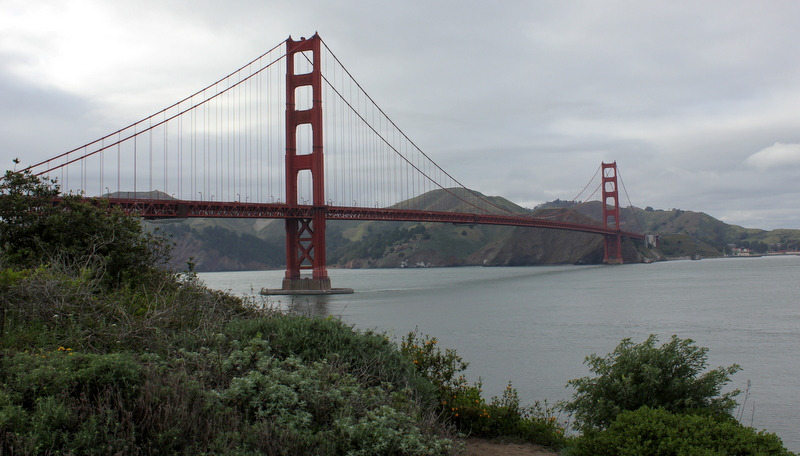
Vista , and we were off for the Golden
Gate Bridge again
to try to get some shots of the bridge without all the fog of the previous day.
This time, nature cooperated.
We ended the day with dinner at the Cliff House.
Unfortunately, it was too cloudy to see the sunset, but apparently this is a
great place to do so.
| View from Cliff House |
I’ve left out descriptions of some of the places we visited,
such as Japantown and the “Painted Ladies” (Victorian houses) near Alamo
Square . Even though we packed our days full of
sight seeing, we still missed so many places of interest: the Conservancy of
Flowers and other attractions at Golden Gate Park, several fine museums, the
Yerba Buena Gardens, Alcatraz and the whole of the Haight-Ashbury neighborhood,
to name only a few. We didn’t even ride a cable car—though we did ride
everything else! And we didn’t get out of the city to explore at all. I feel
like I’ve just had a taste of what San Francisco
has to offer.
Guess we’ll just have to go back.
David Wagoner, who lives in Washington
state, is one of our country’s most distinguished poets and the author of many
wonderful books. He is also one of our best at writing about nature, from which
we learn so much. Here is a recent poem by Wagoner that speaks to perseverance. [Introduction
by Ted Kooser.]
The Cherry Tree
Out of the nursery and into the garden
where it rooted and survived its first hard
winter,
then a few years of freedom while it
blossomed,
put out its first tentative branches,
withstood
the insects and the poisons for insects,
developed strange ideas about its height
and suffered the pruning of its quirks and
clutters,
its self-indulgent thrusts
and the infighting of stems at cross
purposes
year after year. Each April it
forgot
why it couldn’t do what it had to do,
and always after blossoms, fruit, and
leaf-fall,
was shown once more what simply couldn’t
happen.
Its oldest branches now, the survivors
carved
by knife blades, rain, and wind, are sending
shoots
straight up, blood red, into the light again.
American Life in Poetry is made possible by The Poetry
Foundation (www.poetryfoundation.org), publisher of Poetry magazine.
It is also supported by the Department of English at the University of
Nebraska-Lincoln. Poem copyright ©2008 by David Wagoner, whose most recent book
of poetry is Good Morning and Good Night, University of Illinois Press,
2005. Reprinted from Crazyhorse, No. 73, Spring 2008, by permission of
David Wagoner. Introduction copyright © 2012 by The Poetry Foundation. The
introduction's author, Ted Kooser, served as United States Poet Laureate
Consultant in Poetry to the Library of Congress from 2004-2006.
At this time last week, I was eating breakfast at Tyger’s (the
California Scramble: eggs, avocado, mushrooms, cheese and tomatoes—yum!) and reluctantly planning our final day in San Francisco .
Laure Ferlita and I made the trek cross country to gather material for articles and scout subjects for a
new online art class. It's a dirty job, but someone has to do it!
Even though I was born and raised in California ,
I’d never been to San Francisco for
longer than an overnight stay with my sister-in-law about 15 years ago. I
remember nothing about the city, except that we ate at an amazing restaurant
where the chef cooked up some French fries (not on the menu) for my 2-year-old
son so he’d have something to eat while the rest of us indulged in more
grown-up cuisine.
I did some research beforehand, trying to make sense of the
different neighborhoods (Russian Hill, Telegraph Hill, Haight-Ashbury ,
etc.) and how they fit together. The online travel boards agreed that having a
car wasn’t necessary, that public transportation was readily available and reasonably
priced, while parking and driving were headaches.
Well, yes and no. And yes. Public transport was available,
but the size of the city made it difficult to get from location to location
quickly—and while there is plenty of public transport, sometimes it’s a bit
confusing to figure out which method will get you where you want to go (street
car, cable car, bus or metro?) and how many hills you’ll have to climb in the
meantime. (Being from flat Florida ,
we found even those hills described as having “gentle inclines” taxing to the
cardiovascular system.)
We’d planned to rent a car for part of the visit anyway,
hoping to get out of the city to Muir Woods or Point Reyes ,
and by the time we picked it up, we were ready to brave the traffic of San
Francisco in order to see more in less time. The
traffic was indeed headache-inducing and so was parking, but we managed. And
no, we did not drive Lombard Street
(known as the world’s crookedest street) but we did take pictures of the
foolhardy brave folks who did. I did the driving and Laure the navigating, and
I could not have done it without her. She also made a fine coach through what
seemed to be constant parallel parking.
Even with the car, we still averaged around 10,000 steps a
day, logging more than 16,000 on our busiest day. Some of the things we saw included (click to enlarge photos):
Fortune cookies being made at the Golden Gate Fortune Cookie Company:
You can bring your own fortunes to be inserted into the cookies. We just bought a bag of already-assembled cookies. My fortune said, “Opportunity awaits you next Tuesday.” That was last Tuesday. I'm still waiting.
Brown velvet sea lions at Pier 39:
| Life is good. |
Japanese Tea Garden (located in Golden Gate Park):
| They are not kidding. See below: |
This garden has a real aura of
peace and tranquility even if it’s busy with visitors. I'd come back here.
San Francisco Botanical Gardens (also located in Golden Gate Park), beautiful flowers and friendly squirrels:
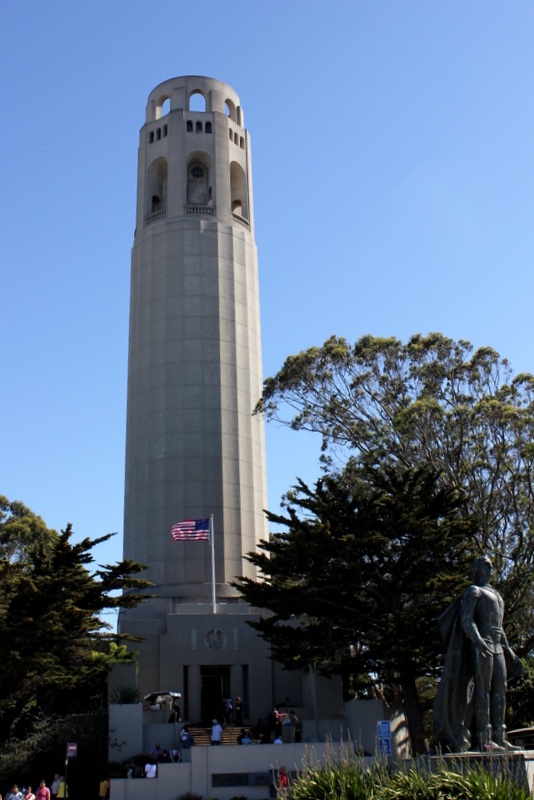
Coit Tower/Fillbert Steps:
For some reason, the murals at Coit Tower, located on Telegraph Hill, charmed me. They were part of the Public Works of Art Project (under the New Deal) and are mostly done in fresco, according to Wikipedia.
| "Old Man Weather" |
Views from the hill are pretty spectacular:
Just steps away from Coit
Tower , a hidden walkway and set of
stairs winds between homes perched on the hill, giving us peeks into backyards
and more beautiful views of the water (these are either the Filbert Steps or the Greenwich Street Stairs--I'm not sure which):
| Wouldn't this make a wonderful place to write or paint? |
Hope you’ll return Friday for part two of the San
Francisco travelogue! We felt like we barely scratched
the surface of what there was to see in the city. Have you ever been to San
Francisco? W hat are your favorite memories?
*Not really—the battery just wore out!