Happiness

In Hiding

March 13, 2012

“We are so accustomed to disguising our true nature from others, that we end up disguising it from ourselves.”

La Rochefoucauld


For a long time, I’ve known that I reveal different aspects of myself to different people. There are certain acceptable activities and topics of conversation with each group of friends and family, certain facets of my personality, likes and dislikes, that appear and disappear as needed. Like a chameleon changing colors to blend into her surroundings, I’ve become good at fitting in. Only a very few get to see most of me, and possibly no one has ever seen all of me, even my husband of 24 years. I don’t go so far as to do or say things I don’t believe in, but I keep in hiding aspects of myself I feel either would not be interesting to the other person or that might make them think less of me—not because I think whatever-it-is is boring or unacceptable, but because I think the other person does.

There are times when this is acceptable social behavior. Every single person does not need to know every single thing about me. But what if I’m only hiding myself because I want people to like me? How can people like me if they don’t know me? I have to accept that if I allow others to see me, all of me, some of them won’t like me. But some of them will, and it’s much better to have people like you for who you are than to try to change who you are so they will like you. This sounds to me like a lesson I should have learned long ago—but somehow it has escaped my notice until now.  Why now? Because of something that “asked” to be put on my vision board for 2012:


 I’m not sure yet what this will mean for me. I think it might mean taking more chances in my writing life, figuring out what I want and asking for it instead of just making do, not waiting for something to happen but taking charge and making it happen. Guarding my inner life a little less closely.

All my chameleon-like behavior sometimes leaves me wondering what, exactly, I do want or believe. Like La Rochefoucauld says, too much disguising can cut me off from an understanding of my true self. In some ways, I am still figuring out who I am. There are many things I’m still learning, many points of view I’d like to understand. 

Writing for this blog has helped me expose more of myself to the world than I would have felt comfortable doing in the past, even though, of course, it doesn’t express all of me, either. It has helped me think through and express some of my beliefs and opinions—sometimes opinions I didn’t know I had or had not yet put into words. I expect I’ll continue to write my way out of hiding because that’s just something that I do. (Thank you for coming along on the journey!)

Do you hide parts of yourself? What is the cost and what are the benefits of hiding?

Nurture

Wandering

March 09, 2012

I’ve been wanting to take a walk on the nature trail in my neighborhood with my camera for a long time. Usually when I’m on this trail, which winds for about four miles around my subdivision, I’m walking briskly for exercise and I don’t have the camera with me when something appealing comes into view. Yesterday, in the spirit of nurturing myself, I took half an hour to wander the trail near my house.


 A little breeze kept it from being too warm for comfort, but it was definitely warm enough for the shorts I was wearing. So much for winter. I turned right out of my back gate, and came to a large retention pond, now dry because of an ongoing drought, and the architectural skeleton of a tree. Every time I walk past this tree I think it would make a good line drawing. I took its picture, and maybe next time I’ll bring my sketchbook out instead. New growth has appeared on the branches—I’m not sure what kind of tree this is. Anyone know?


 Next, I snapped a shot of a neighbor’s purple martin house. Purple martins are murder on mosquitoes, something we have quite a lot of in Florida.


 The large oak tree and bench near a second retention pond, deserted today, but usually a good place to see birds:


 A four-legged neighbor:


Another tree dressing itself for spring:


I wish I was here:


…but I think the neighbors might object to my taking a nap in their back yard.

I turned around and explored the trail on the other side of our house, looking for signs of a return of the wild hogs (there was plenty of old churned-up earth where they foraged, but nothing new) when—surprise! I found this guy/girl sunning itself on the bank of a third small pond.


 As I walked home, I listened to the bird songs and the little rustlings of lizards in the dry leaves. The sun shone, the breeze blew and all was right with my world, at least for a little while. I’ll have to remember to wander with the camera or my sketchbook the next time I want to soothe an anxious soul.

Where do you wander to soothe your soul?

I think this is a little blue heron--he/she is keeping an eye on that gator!

Expectations

Well, What Did You Expect?

March 05, 2012

Saturday afternoon, my husband and I were in a minor fender bender. We weren’t hurt, the damage to our car is minimal, and the other driver’s insurance should cover the repair. While we waited for the police to arrive, my thoughts took the following turn: “Great. Here’s one more poopy thing happening to me this year. 2012 is shaping up just as poorly as 2011. What is going to happen next?”

I sat in my car, unhurt, watching the breeze blow Spanish moss on the oak trees while white fluffy clouds scudded across a blue sky, thinking poor, pitiful me thoughts. That was bad enough, but what bothered me most was the mindset I seem to have fallen into: being on the lookout for catastrophe. I don’t deny that bad things do happen, but this expecting catastrophe mindset is draining happiness out of my life, making me cringe and cower as I face each day, as if waiting for blows to fall. That’s not how I want to live!

A friend and I have an ongoing joke about “fresh hells”—as in “What fresh hell is this?”  At least, it started as a joke, a way to lighten up when something bad happened, as bad things do from time to time. We use the image and the phrase to help us laugh when we want to cry, and as a shorthand for some unwanted and un-looked for experiences. I don’t want necessarily to give up this joke, but maybe it’s time to add a positive version? Fresh heaven, perhaps?

Really, I’m grateful for my life, and the many beautiful things in it. Perhaps it’s time to go back to making lists of things I’m grateful for and things that make me happy. I believe we mostly find what we’re looking for, what we expect, and if my expectations are that things will be happy and good, they will be more likely to end up that way.

I’m expecting better things of 2012. How about you? How have your expectations affected your life?

Looking for a smile? You'll find one...

Horses

Pucker Up!

February 29, 2012


A horse’s head is big, and the closer you get to it, the bigger it gets.  Here is the Idaho poet, Robert Wrigley, offering us a horse’s head, up close, and covering a horse’s character, too. [Introduction by Ted Kooser.]

Kissing a Horse

Of the two spoiled, barn-sour geldings
we owned that year, it was Red—
skittish and prone to explode
even at fourteen years—who’d let me
hold to my face his own: the massive labyrinthine
caverns of the nostrils, the broad plain
up the head to the eyes.  He’d let me stroke
his coarse chin whiskers and take
his soft meaty underlip
in my hands, press my man’s carnivorous
kiss to his grass-nipping upper half of one, just
so that I could smell
the long way his breath had come from the rain
and the sun, the lungs and the heart,
from a world that meant no harm.

Reprinted from “Earthly Meditations:  New and Selected Poems,” published in 2006 by Penguin. Copyright © Robert Wrigley, 2006, and reprinted by permission of the author. This weekly column is supported by The Poetry Foundation, The Library of Congress, and the Department of English at the University of Nebraska-Lincoln.

Good days

A Good Day

February 24, 2012

Martha Beck wrote an article in the February issue of O Magazine about the difference between excitement and happiness. In it, Beck explains that “our culture has come to define happiness as an experience that blows your mind…. But happiness—real happiness—is something entirely different, at once calmer and more rewarding.”

This article reminded me of my own recent contemplation of what makes a good day—a plain, solid, happy day. What would it look like? Am I expecting exciting events or major achievements? Peak experiences? Or is happiness for me something much more subtle? And once I understood what contributed to a good day, how many of these things or experiences could I incorporate into my days?

On reflection, my definition of a good day is pretty simple. First, I’d wake up on my own, without using an alarm clock. I hate being jolted awake, and even my clock radio can be a little jarring. Maybe I hate being told what to do (“Get up!”) first thing in the morning? In addition to a peaceful waking up, I would like my good day to involve the following, in no particular order:

Going outside. 


Reading.


Doing something for someone else.

Laughing.

Writing, in a journal if nowhere else.


Paying attention to my animals.


Mostly eating healthy, real food.


Basking in some solitude in which to think.

Puttering around the house, setting things in order (NOT doing any major cleaning—do you think I’m crazy?)

Feeling like I have more than enough time to do what I want to do this day.

That’s one of my most treasured simple pleasures—feeling I have plenty of time. I seldom feel this way, however. More likely I feel behind and overwhelmed by the sheer number of things on my to-do list.

As Beck writes, “genuine happiness [is] abundant, sustainable delight in the beautiful moments of ordinary life.”

What does a good day look and feel like for you?

Energy

Keep the Channel Open

February 22, 2012


“There is a vitality, a life force, an energy, a quickening that is translated through you into action, and because there is only one of you in all of time, this expression is unique. And if you block it, it will never exist through any other medium and it will be lost. The world will not have it. It is not our business to determine how good it is nor how valuable nor how it compares with other expressions. It is your business to keep it yours clearly and directly, to keep the channel open.”
—Martha Graham

Everyday adventures

"Throw Me Something, Mister!"--Mardi Gras Fun Facts

February 20, 2012


I confess until recently, I didn’t know much about Mardi Gras—only that it involved parades, beads, and a reputation for debauched behavior. Even though many cities worldwide celebrate Mardi Gras (which takes place tomorrow), New Orleans is perhaps the most well-known location for major Mardi Gras festivities. On our trip to New Orleans in November, we stopped in at Blaine Kern’s Mardi Gras World for a tour and sketching. Before that trip, I learned some fun facts about Mardi Gras and New Orleans' famous celebrations in particular. For instance: 

In New Orleans, Carnival season involves many invitation-only balls and supper dances hosted by “krewes” (private clubs). These balls are traditionally very formal, with elegant decorations, tableaux presentations, and dancing for the costumed and masked members and their guests. The krewes also stage more than 50 parades during the season in the city and suburbs of New Orleans.

Historically, masks were worn to many of the balls, and eventually it became traditional to wear a mask on the street on Mardi Gras day. However, in the early 19th century, people behaved so outrageously while hidden behind masks that they were forbidden for decades!

Even though (or perhaps because?) this festival has roots in pagan celebrations, Pope Gregory XIII made Mardi Gras a Christian holiday in 1582 when he placed it on the calendar on the day before Ash Wednesday.

The first North American Mardi Gras took place when two French explorers and brothers, Pierre Le Moyne, Sieur d’Iberville and Jean-Baptiste Le Moyne, Sieur de Bienville, found the mouth of the Mississippi on Mardi Gras day (March 3) 1699. They made camp, named the spot Point du Mardi Gras, and celebrated. Bienville later went on to found New Orleans.

King cakes begin to be sold on Jan. 6 (also known as King’s Day). The brightly colored cakes have a small plastic baby baked inside them. According to tradition, whoever gets the baby in his or her piece has to buy the next cake.

King cake--Photo courtesy Wikimedia Commons
On Mardi Gras day, there are parades all day long. Sometimes as many as two million people flood the streets of New Orleans to celebrate.

Revelers line the parade routes hoping for “throws”—beads, doubloons, cups and other souvenirs. According to several New Orleans web sites, it’s a myth that you have to expose a particular body part to get beads!

Louisiana is the only state in which Mardi Gras is a legal holiday.

The Rex organization, which debuted in 1872, is responsible for the official Mardi Gras colors (purple, green and gold), for starting daytime parades, and for the anthem of Carnival, “If I Ever Cease to Love.” Every year, the organization chooses an outstanding civic leader to reign over Mardi Gras, and this person is known as Rex, King of Carnival. Rex arrives by boat on the Monday before Mardi Gras, and is conveyed to City Hall in a carriage where he accepts the keys to the city from city leaders. On Mardi Gras day, he rides his float through the streets of his kingdom.

Laissez les bon temps rouler! (“Let the good times roll!”) 
Do you celebrate Mardi Gras?

Want to know more? Check out Mardi Gras New Orleans  or New Orleans Online.

Light

The Value of Mystery

February 15, 2012


A wise friend told me that since the Age of Reason we’ve felt we had to explain everything, and that as a result we’ve forgotten the value of mystery. Here’s a poem by Lisel Mueller that celebrates mystery. Mueller is a Pulitzer Prize winning poet from Illinois. [Introduction by Ted Kooser.] 

Sometimes, When the Light 

Sometimes, when the light strikes at odd angles
and pulls you back into childhood

and you are passing a crumbling mansion
completely hidden behind old willows

or an empty convent guarded by hemlocks
and giant firs standing hip to hip,

you know again that behind that wall,
under the uncut hair of the willows

something secret is going on,
so marvelous and dangerous

that if you crawled through and saw,
you would die, or be happy forever.

American Life in Poetry is made possible by The Poetry Foundation (www.poetryfoundation.org), publisher of Poetry magazine. It is also supported by the Department of English at the University of Nebraska-Lincoln. Poem copyright ©1980 by Lisel Mueller, from her most recent book of poems, Alive Together: New and Selected Poems, Louisiana State University Press, 1996. Poem reprinted by permission of Lisel Mueller and the publisher. Introduction copyright © 2012 by The Poetry Foundation. The introduction's author, Ted Kooser, served as United States Poet Laureate Consultant in Poetry to the Library of Congress from 2004-2006.

Happiness

And the Reward Goes To...

February 13, 2012


Over lunch recently, a friend and I discussed why we don’t feel happier than we do. While we have the normal, everyday stresses most people have, we’re currently not coping with any major problems or crises. We figure our baseline level of happiness should be higher than it is. We weren’t complaining about it—just wondering why it was so. We felt like we should feel happier.

As I thought about this on my way home, I realized one reason could be that even though we don’t have any crises to deal with, we don’t have any major good things happening either. At this moment, our lives are filled with lots of work, a few annoyances and irritations, and not a lot of reward.

Reward. Perhaps that’s part of the key. We’re bulldozing through our tasks, not taking time to first notice and then reward our accomplishments and contributions. All work and no play make Jill an unhappy girl.

Most of us expect to bear a certain amount of responsibility and strive for achievement—after all, we’re grown ups, and grown ups take care of themselves and help others. However, when we don’t take time to notice and reward ourselves for what we accomplish, we risk burning out. If we wait for others to notice and reward, we’ll be waiting a long time. When was the last time someone complimented you for turning in a report on time, or even noticed that you mopped the kitchen floor? Just because something is expected of you doesn’t mean that it’s not worth rewarding. Most people I know tend to be pretty strict with themselves—work first (paid and non-paid), play/reward rarely…if ever.

I say it’s time to take rewards into our own hands, and to start doling them out liberally—to ourselves. Here are some basic principles to consider when thinking about rewards:
  • If you finish your allotted day’s work early, don’t pile on more in an effort to “get ahead.” I’ve made this mistake. Reward yourself by doing something fun instead. 
  • Work in small treats throughout the day instead of saving them up for the evening when you might be too tired to enjoy them.
  • Make sure the scale of the reward fits the accomplishment, but don’t limit your rewards to small things. Big accomplishments—or a series of small accomplishments—deserve big rewards.
  • Choose a reward when you’re setting your goal. Knowing you have your reward to look forward to can help you get through some less-than-happy to-dos.
  • Keep a file or list of rewards—tear out catalog pages or bookmark websites with items you’d love to have, for example. Make a list of things you enjoy doing (see below for some suggestions) that could be used as rewards.
  • Keep a running list of your accomplishments, completed tasks and contributions to others. It’s easy to forget what you’ve done, and just as easy to focus on what you’ve left undone.
  • Start a reward fund: put a small amount of money in your fund every time you accomplish something, and use the money for future rewards.
  • Choose rewards that you love and that will motivate you, not what someone else might enjoy—or that you think you should enjoy.
Here are some possible rewards, large and small:
  • Music. Listen to your favorites, or spend time exploring downloadable music and try something new.
  • Reading for fun—not for work or self-improvement. I’ve got a cup of tea and book waiting for me when I finish this blog post.
  • Spa services like massage, manicures or pedicures.
  • Fresh flowers.
  • Eating at your favorite restaurant, or buying take-out so you don’t have to cook.
  • Jewelry. It doesn’t have to be expensive—Etsy.com has a multitude of cute pieces for less than $50. You could also buy a charm for a bracelet or necklace to commemorate your achievement.
  • Adding to a collection.
  • Allowing yourself a small food treat—a piece of good quality chocolate or a rich cup of coffee, for example. I know this goes against much of the advice given for weight control, but the emphasis here is on small. Buy the best quality you can afford.
  • Time off—whether it’s an hour, a day or even a weekend. Take time to do exactly as you please. Or do nothing at all.
  • Nap.
  • Matinees—watch a movie, either at a theater or at home, in the middle of the day. I don’t know why, but this feels so decadent!
  • Attending your favorite sporting event.
  • Playing with your dog.
  • Practicing a hobby—whether it’s baking, painting, quilting, photography, or what have you. You may already take time to do your hobby, but if you think of it as a reward, you’ll assure yourself some guilt-free time to spend on it.
  • Weekend getaways, with a spouse or by yourself.
Rewards can boost mood, help us get through difficult tasks and situations, make life more enjoyable, even make us feel loved. Maybe you’re already rewarding yourself and you don’t realize it, or you feel guilty about it.  Start noticing your accomplishments, and notice what happens afterwards. Reward yourself appropriately today and you’ll be far more eager to get back to work tomorrow.

What’s your favorite way to reward yourself?

You deserve a reward--let's play!

Gardens

The World's Most Expensive Salad

February 10, 2012

Behold the harvest:


This is why gardening and I are not the best of friends. I start off all filled with ambition and plans for delicious homegrown produce, and this is what I get:


Even though I love the feeling of picking vegetables and herbs from my own plants (a genuine simple pleasure), I am really not the world’s best gardener, and I think my time and money would be better spent by participating in a CSA (Community Supported Agriculture) group. I’d like to think I have a green thumb, but the results prove otherwise.

Maybe I’ll stick to orchids.

Is there anything you would love to do better?

Growth

Preparing to Bloom

February 08, 2012


“Our consciousness rarely registers the beginning of a growth within us any more than without us: There have been many circulations of the sap before we detect even the smallest sign of the bud,”
—George Eliot, Silas Marner

Anne Morrow Lindbergh

Anne's Gifts

February 06, 2012

Anne Morrow Lindbergh
National Photo Company Collection, Public domain, via Wikimedia Commons

Anne Morrow Lindbergh is one of my favorite writers—and one of my heroes. Tomorrow will mark the 11th anniversary of her death at the age of 94, and in honor of her memory, I’d like to share with you some of what I’ve learned about her.

 I don’t remember how I discovered her writings, perhaps in my creative writing class in high school, but as a teenager, I was attracted to the romance of her life. She, a quiet, shy and studious girl, fell in love with dashing aviator (and “America’s most eligible bachelor”) Charles Lindbergh. Anne left behind her more privileged and intellectual background and embraced the action-filled life Charles lived. From the moment they announced their engagement, the media hounded them. The very private Anne Morrow became part of “America’s golden couple,” and the very public bride of a hero.

With Charles’ instruction and encouragement, Anne earned a private pilot’s license, and also eventually became the first woman to hold a first-class glider pilot’s license. These feats were unusual, because at the time women didn’t enter into “masculine” pursuits like aviation very often. She served as her husband’s radio operator, navigator and co-pilot on several long flights charting potential routes for commercial airlines. Eventually, Anne was the first woman awarded the National Geographic Society’s Hubbard Medal for her duties as “crew” on two of these survey flights. These flights, in sometimes dangerous conditions in their single-engine airplane over uncharted air space, brought Anne and Charles closer and were some of their happiest times together. (Later in life, Anne received several more awards for her contributions to aviation.)

Anne and Charles had six children, though tragically, their first child, Charles Jr., was kidnapped and killed at the age of 18 months. For many years, Anne felt continually pulled between her roles—her diaries show a constant battle for time and space to write and think, all while raising children and accompanying Charles on many of his flights. As she writes in the introduction of Locked Rooms and Open Doors, “But on the other hand, the trip [an Atlantic survey flight], especially as it was prolonged for five and a half months, separated me from my child [their second son, Jon], the most healing and nourishing element in my life. It also crowded out any possibility of a quiet contemplative coming to terms with grief, for me a necessary inner process, and it meant a long interruption in the work I had just restarted of writing my book [North to the Orient].”

Despite the many demands on her time, Anne produced 13 books, including five volumes of diaries and letters. Her most famous book, Gift From the Sea, a collection of essays about women’s roles, was inspired by a vacation on Florida’s Captiva Island. North to the Orient, was 1935’s number one bestseller.

Despite a number of serious challenges to their relationship, Anne and Charles remained married until Charles’ death in 1974. Anne continued to write after his death, though she did not publish any more books.

I want to be like Anne Morrow Lindbergh in the sense that I fully enter into life while still retaining a sense of myself and my own work. She was able to move beyond her comfort zone and achieve more than she ever dreamed possible. It encourages me that she felt the same work/family tug of war I do, even though she lived in a different time and under different circumstances. I’m not alone in feeling torn between the needs of my family and my own ambitions.

I recently picked up a lovely copy of Gift From the Sea at my library’s bookstore—I’ll end this post with some of Anne’s words on the topic of solitude taken from it:

“For it is not physical solitude that actually separates one from other men, not physical isolation, but spiritual isolation. It is not the desert island nor the stony wilderness that cuts you off from the people you love. It is the wilderness in the mind, the desert wastes in the heart through which one wanders lost and a stranger. When one is a stranger to oneself then one is estranged from others too. If one is out of touch with oneself, then one cannot touch others…. Only when one is connected to one’s own core is one connected to others, I am beginning to discover. And, for me, the core, the inner spring, can best be refound through solitude.”

If you want to know more about Anne Morrow Lindbergh, check out Kathleen C. Winters’ biography, Anne Morrow Lindbergh: First Lady of the Air, or pick up one of Anne’s collections of diaries and letters.

Books

No Passport Necessary

February 03, 2012

Reading makes immigrants of us all. It takes us away from home, but more important, it finds homes for us everywhere.”
—Jean Rhys

I’ve always thought one of the great benefits of reading is the peek you get into other lives and cultures. Non-fiction is great for this of course, but fiction also brings other places and cultures to life. I’ve been lucky enough to travel a bit for real—but I’ve visited many more places, and stayed much longer, through the books I’ve read.

Here are some of my favorite destinations, and the books, both fiction and non-fiction, that have taken me there:

Greece—As a teenager, I discovered Mary Stewart’s novels, several of which are set in Greece. My Brother Michael (Delphi), This Rough Magic (Corfu) and The Moon-Spinners (Crete) ignited my interest in visiting Greece. Four and a half years ago, I took my battered copy of My Brother Michael with me when I finally had the chance to walk in the shadow of the ruins at Delphi. Can you resist this description: “Ahead of us the mountain thrust that great buttress out into the valley, the river of olive trees swirling round it as the water swirls round the prow of  a ship, to spread out beyond into a great flat lake that filled the plain. High up, in the angle where the bluff joined the mountain, I saw it, Apollo’s temple, six columns of apricot stone, glowing against the climbing darkness of the trees behind. Above them soared the sunburned cliffs; below was a tumble, as yet unrecognizable, of what must be monument and treasury and shrine…. Above, the indescribable sky of Hellas; below, the silver tide of the olives everlastingly rippling down to the sea.”

Delphi
Prince Edward Island, Canada—As a devout Anne of Green Gables fan, I still hope to visit good old PEI in person—definitely a “bucket list” travel destination.

Maine—Sarah Graves pens a terrific series of mysteries set in Maine (The Dead Cat Bounce is the first one), and Drinking the Rain was one of my favorite non-fiction reads last year. 

England—I’m a big fan of mysteries—and many of my favorite murders take place in England. Agatha Christie, Patricia Wentworth, Josephine Tey, Dorothy L. Sayers and many more authors show us the history of London or the tranquil countryside while mining the dark side of human nature. On a more peaceful note, Susan Allen Toth’s My Love Affair With England made me want to rent a flat, unpack and stay a while—and Scotland Yard’s services were not required.

Here’s an excerpt from Toth's piece on England’s footpaths:

“Our path turned out to be a rocky track, an easy half-mile walk, that took us gradually over a slight incline and then down to the shores of the lake. The track cut across the top of a moorland that seemed absolutely deserted, not even any sheep drifting over its barren slopes. It was late September, and under heavy gray skies, the grass looked almost brown, and the empty fells as if they had already fallen into a winter sleep.

“Devoke Water lay in a shallow bowl formed by treeless gray-green fells. The surface of the lake was absolutely still, a steely gray that seemed a mirror image of the lowering sky. An old boat house, which seemed abandoned but was securely locked, looked as ancient as the landscape to which it now belonged.”

Italy—After reading The Enchanted April  or A Room With a View, who wouldn’t want to visit Venice or rent a castle overlooking the Mediterranean? (Both of these books have been turned into lovely movies that will further whet your desire for a trip to Italy.)

In addition to these, I’ve visited New York City with Nero Wolf and Archie Goodwin, Egypt with Amelia Peabody and the Four Corners area of New Mexico and Arizona with  Lt. Joe Leaphorn and Sergeant Jim Chee—I could go on and on, but I want to know:

Where has your reading taken you? Where will you go next? Where do you think I should go next?

(Visit Danielle Torres' blog here for a list of 13 books set in the Middle East!)

National Poetry Month

Winter Sun

February 01, 2012


It seems to me that most poems are set in spring or summer, and I was pleased to discover this one by Molly Fisk, a Californian, set in cold midwinter. [Introduction by Ted Kooser.]

Winter Sun

How valuable it is in these short days,
threading through empty maple branches,
the lacy-needled sugar pines.

Its glint off sheets of ice tells the story
of Death’s brightness, her bitter cold.

We can make do with so little, just the hint
of warmth, the slanted light.

The way we stand there, soaking in it,
mittened fingers reaching.

And how carefully we gather what we can
to offer later, in darkness, one body to another.

American Life in Poetry is made possible by The Poetry Foundation (www.poetryfoundation.org)publisher of Poetry magazine.  It is also supported by the Department of English at the University of Nebraska, Lincoln.  Poem copyright ©2010 by Molly Fisk from her most recent book of poetry, “The More Difficult Beauty,” Hip Pocket Press, 2010.  Reprinted by permission of Molly Fisk and the publisher.  Introduction copyright ©2011 by The Poetry Foundation.  The introduction’s author, Ted Kooser, served as United States Poet Laureate Consultant in Poetry to the Library of Congress from 2004-2006.


NOTE: Poetry magazine, published by the Poetry Foundation, will give away an unlimited number of free copies of the April 2012 issue to book clubs and reading groups that submit their request by March 23. This is in honor of National Poetry Month and the magazine's centennial. Click here to request your reading group's free copy.

Happiness

What's Wrong With a Dog's Life?

January 30, 2012


At least this dog’s life:

Begin the day eating sausage from a fork

Curl up in your cozy new bed

Change positions

Well, it is exhausting work!

There are some days when I would like to be my dog!

Junk food

Beyond the Junk Food of Life

January 27, 2012


A second word has surfaced as important in my mind this year: Nourish. Looking up nourish in the dictionary, I find it means to nurture, to promote growth, to cherish, strengthen and build up. I can’t think of a better, more positive word to live by, and to serve as companion to passion.

Just as passion can be applied to all areas of my life, so can nourish. Nourish involves more than the food and drink I put into my mouth every day. It’s about making the choice to strengthen, build up, nurture and cherish myself and those around me. To nourish myself, yes, I will focus on nutrition, exercise, sleep—but also, I’ll allow—no, encourage—leisure time, reading, sketching, plain old noodling. These things nourish my soul. And I find when my soul feels nourished, my body is much more likely to also.

I will choose nourishing thoughts—not getting caught up in a cycle of guilt or self-criticism, but focusing on the uplifting and positive—pretty much what I try to do with this blog.

This will involve looking beyond the easiest, most convenient choice. To go back to eating, sure, a bag of Cheetos or some cookies might soothe me momentarily, but they will not nourish me. They’ll leave me feeling guilty, wanting more, even sick if I really overindulge. In the same way, mindlessly watching TV or surfing the ’net can temporarily soothe—but they won’t really nourish me down deep inside. Reading, drawing or painting, playing with Tank, having meaningful conversations, meditating, taking a walk outside, even a nap—these are some things that really nourish, and they won’t leave me feeling bad about myself later.

As a mother, wife, daughter and friend I help nourish others—and I love that. I’m realizing to do so I must nourish myself, and not take shortcuts with the junk food of life. I want to take as much care with myself as I do with others. That doesn’t mean I won’t ever allow myself a piece of chocolate (would life be worth living? I think not.) or an episode of Castle. It just means most of my choices will be nourishing ones.

What nourishes you? What do you sometimes do instead of what you know you’d find deeply satisfying?

Learning

Seize the Day

January 25, 2012


“Life is not about enduring, it's about rejoicing; it's not about tolerating, it's about embracing. There is always something beautiful to be found in the mundane, something powerful to be learned in the trials, something joyous to experience in the interruptions to routine. Savor these moments! Seize the day!”
—Kerri Miles Dowd (Washington State high school teacher and good friend!)

Calendars

Paper or Plastic?

January 23, 2012

Personal organizer, that is.

Most of us use some sort of system to stay organized and on track. Some people opt for electronic organizers (“plastic”), and others stick with paper-based systems. You can probably guess: I’m a paper person. (Yes, I know, it’s the 21st century.)


Electronic organizers have certain advantages—they’re lightweight and portable, hold tons of information, can be kept current when synced with your computer and can often access email. But there’s just something so deeply satisfying in putting my pen to paper, in writing in my obligations and, eventually, crossing them off. My personal organizer has a month-at-a-glance calendar, a two-page spread for each week, a section for important numbers and quite a hefty section devoted to books I want to read. I have some favorite pictures in there, too. I find it very easy to use—just flip it open and jot down whatever-it-is. It’s also a fun way to look back on previous months with their notes, questions, birthdays and social engagements. I’ve had the binder itself since we moved to Florida more than 20 years ago! I love sitting down with it on Sunday afternoons to plan out my week. It’s like an old—albeit slightly grubby and battered—friend. It can’t break, run out of batteries or crash and eat my data, though it can be a pain to transfer data when a new year rolls around and it can get messy when I tuck various bits of paper into the front and back pockets. Choosing new inserts each year is a simple pleasure I always look forward to. I try to make it pleasant to work with all year long.

Old Faithful
Of course there’s no right or wrong organizer system—just one that feels right to you and one that you’ll use. (I’ve found from sad experience that it doesn’t help to write down the appointment if you don’t look at the calendar again.)

And now I’m going to go cross off “write blog post” on my to-do list for today!

What type of organizer do you use? Do you prefer paper or plastic?

Poetry

Trust

January 18, 2012


Life becomes more complicated every day, and each of us can control only so much of what happens. As for the rest? Poet Thomas R. Smith of Wisconsin offers some practical advice. [Introduction by Ted Kooser.]

Trust

It’s like so many other things in life
to which you must say no or yes.
So you take your car to the new mechanic.
Sometimes the best thing to do is trust.

The package left with the disreputable-looking
clerk, the check gulped by the night deposit,
the envelope passed by dozens of strangers—
all show up at their intended destinations.

The theft that could have happened doesn’t.
Wind finally gets where it was going
through the snowy trees, and the river, even
when frozen, arrives at the right place.

And sometimes you sense how faithfully your life
is delivered, even though you can’t read the address.

American Life in Poetry is made possible by The Poetry Foundation (www.poetryfoundation.org), publisher of Poetry magazine. It is also supported by the Department of English at the University of Nebraska, Lincoln. Poem copyright © 2003 by Thomas R. Smith. Reprinted from “Waking before Dawn,” Thomas R. Smith, Red Dragonfly Press, 2007, by permission of the author and publisher. Introduction copyright © 2006 by The Poetry Foundation. The introduction’s author, Ted Kooser, served as United States Poet Laureate Consultant in Poetry to the Library of Congress from 2004-2006.

Internet

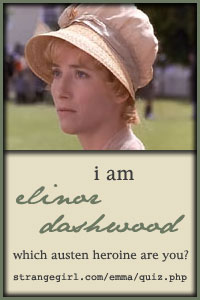
I Am Elinor Dashwood and Other Internet Discoveries

January 16, 2012


Life cannot be just about organizing, striving and deep thought—a girl has to have some fun, too. If you’ve got a few moments to spare and a computer handy, here are some fun quizzes you can take online. You can take quizzes on the sites below without entering any personal information—as with anything on the Internet, use caution when visiting unfamiliar websites and always be careful what personal information you disclose.
 
Beliefnet.com has quite a few quizzes of varying degrees of seriousness—I took this one to find out what kind of traveler I am.

Gretchen Rubin’s Happiness Project site is full of interesting happiness-related content. Here are two quizzes to help you increase your happiness: How Well Do You Know Yourself? and What's Your Personality Type for Play?

Blogthings.com has contains many, many quick and quirky quizzes. I spent far too long poking around there. (My supervillain name is Toxic Viper. What’s yours?)

What are your favorite online time-wasters? And I’m dying to know: which Jane Austen heroine are you?

Passion

Uh-Oh

January 13, 2012

This is my third year of choosing a “word of the year” to guide me—sort of a theme that sums up the attitude I’d like to take with me for the coming year. In 2010, I chose open. Last year, I chose light. This year, the word is…

Passion.

And it scares me to death. Why, you ask? Passion seems a little out of control, just a little “out there” for me. It feels risky, like I’ll be forced out of hiding. Passionate people tend to get noticed. I’m not sure I’m really comfortable with that. Passion can get people in trouble.

There were other words I was considering: focus, clarity, flow, commit (and more). They each capture a little piece of what I’m looking for in 2012—I’ve felt stuck for a long time and I want to be un-stuck. I want a smooth, vibrant flow of energy streaming through me, instead of operating in fits and starts the way I have been. I want to focus that energy on a few important areas instead of shooting off into the atmosphere every which way. And I want some clarity of purpose, so I can commit to those goals.

Specifically, I’ve been struggling with that clarity and commitment to my writing for several years now. I believe it’s mainly been fear that has held me back from making a commitment, from really going for it. I’ve been afraid to feel passion for my writing, afraid I won’t have anything to say, afraid no one will read my work and that they’ll hate it if they do. What if people read my work and it makes no impression at all? Or maybe, just maybe, I’ll become successful and that will bring a whole new set of expectations and anxieties.

Passion can override all of this. I’ve seen it happen before, most notably with my horse. I was a 40-year-old beginner rider with limited experience with horses and a distaste for getting dirty and sweaty when I found Tank. My passion for horses, and more specifically for him, swept away my fears and my reluctance to get dirty. (Like Rose in Titanic, I’m usually more of an indoor girl.) I still get scared (and I still hate being sweaty) but my passion for playing with Tank makes up for it. I’m looking to unleash some of that same passion in other areas of my life.

Totally worth all the sweat and dirt
If I allow passion into my writing, it won’t matter what other people think, good bad or indifferent. What matters will be that I said what I needed to say, I allowed my voice to speak.

In all areas of life, I hope living with passion will fill me with energy, with enthusiasm, with strength to carry on in the face of setbacks and obstacles. I’ve already noticed that I go through each day with a little more interest and curiosity because I’m looking for things to be passionate about. It’s so early yet, but I feel optimistic about a passion-filled 2012.

What are your expectations for 2012? Did you choose a word of the year, and if so, does it scare you a little bit?

**By the way, what first gave me the idea of passion as a word of the year was seeing The Million Dollar Quartet at my local performing arts center. The passion of the original performers, as well as the actors/musicians who did the show the night I saw it, woke me up to the fact that I’ve been going through life lately in a rather ho-hum manner. “Quartet” is a fantastic show and if it comes to your town, go see it if you can.

Possibility

A Glass of Possibility, Please

January 11, 2012


“If I were to wish for anything I should not wish for wealth and power, but for the passionate sense of what can be, for the eye which, ever young and ardent, sees the possible. Pleasure disappoints, possibility never. And what wine is so sparkling, what so fragrant, what so intoxicating as possibility?”
—Soren Kirkegaard, Either/Or

Clutter

Letting Go, Making Room

January 09, 2012

About this time of year, I usually get a bee in my bonnet about simplifying and decluttering, both physically and mentally. 2012 is no different. Maybe it’s because the holidays seem to wreak havoc with my home and schedule and I’m desperate to get back to some semblance of order! I’m not the only one who feels this way, though, and it’s been reassuring to read others’ words about the whole process, and why it’s important and necessary.

The desire to clear out is more than just a desire for tidy desktops and crystalline thinking. It also has to do with making room amid the clutter for who you want to be and what you want to come into your life. Edward W. Smith put it this way in Sixty Seconds to Success: “Make room for the new you. You may not have totally determined who the new you is going to be, but you probably have decided that there are some things about the current you, that you want to change. Well while you are working on what the new you will be, start ‘cleaning out a room’ for the new you to live in. Get rid of the junk in your life both physical and mental that doesn't fit you anymore. Take things out of your schedule that are taking your time away from finding out what you want to do. By making room for the new you, you will create a vacuum that the new you will rush in to fill and you will be on your way to the top.”

It seems to me this process is largely about letting go. Letting go of the stuff that crowds our lives, whether it be kitchen gadgets, sporting equipment, or unexamined and outdated beliefs. Perhaps this means admitting we bought something for the person we wish we were, not the person we really are, or realizing that one of our “shoulds” is really someone else’s idea, not our own.

This periodic clearing out is important because too much mental and physical clutter distracts us from our primary goals by the constant irritations of having too much to do, and/or living in a messy, disorganized house.

The thing is: sometimes letting go is scary and hard. Christine Kane understands this, but points out that “We need to pay attention to what we are telling our subconscious minds when we hold on.” She goes on to write, “What are you holding onto? What thoughts and beliefs are you putting out into the Universe by clinging to it? Are you telling yourself you don’t believe in the inevitability of your own success and prosperity? Or that you don’t believe you can expand and create better things in your life?” (This is totally me. I cling, I grasp, I hold on to and try to control everything I can—and some things I can’t.)

Letting go can feel like failure or wastefulness. But things change—people and situations change. What served us well no longer does. Let go of those things, and maybe someone else can use them. Something even better is waiting for the chance to come in—we just have to make room for it.

What things are you clearing out this year? What one thing can you let go of today?

Might this be part of my problem?

2011

Contemplation Month

January 06, 2012

I intended to make December a month of both reflection and looking forward: reflection on the experiences and lessons of 2011 and the effects of my word of the year (light), as well as contemplation of the coming year and its new word.

What was I thinking?

In reality, for me, December is possibly the worst month for reflection, filled as it is with holiday doings and extra activity of all sorts. I believe I managed exactly one evening of quiet contemplation, and I went to bed following that feeling overwhelmed and depressed. Not exactly what I’d had in mind.

Remember this for future years: Save the contemplation for after the holidays, when the kid is back in school, the husband is back at work and the house isn’t wall-to-wall chaos, It’s too overwhelming otherwise, and I just frustrate myself. January will have to become Contemplation Month.

I have to admit that with a few notable exceptions, 2011 was a rough year. (I’m not the only one who feels this way about 2011, but I think Jen Lancaster put it best when she wrote “2011 Blew Goats”—I’d have to agree.)

And yet.

Here I sit, in my comfortable home, with my intact family, plenty to eat, clothes on my back and leisure time I don’t have to spend struggling for survival. I should be—and I am—grateful. But I don’t want to be just grateful that I avoided the worst of disasters. I want to be joyful, hopeful. I can’t say I’ve felt all that joyful recently. It’s been a struggle to remain positive—light, if you will—in the face of repeated distressing situations. No, I haven’t had a major tragedy occur, knock on wood, but I have had a string of minor challenges/accidents/stressful situations to cope with for most of 2011 and I’m feeling a bit emotionally ragged. As someone once said, “What I am looking for is a blessing that is not in disguise.”

I will say that my word of the year did help me hold on, to look for the bright side, to search for the silver lining in the storm clouds. I needed light as a word of the year in 2011.

I haven’t chosen a word for 2012 yet, though that’s high on my agenda. You’d better believe I’ll take care when I do!

What were some of the high and low points of 2011 for you? If you chose a word of the year, did it “help”?


My word of the year is treats...or maybe nap...