![]() |
| Photo courtesy Mirko Harnisch |
But I digress. Where was I? Oh, yes, guilty pleasures. While I was baking said cookies, I was watching—and I almost hate to admit this—a Netflix disk of Laverne & Shirley. Go ahead, laugh if you want. My husband does. L & S came out in the late 70s/early 80s, and I remember watching it with my mom. It’s a silly show, but one with a sweet heart and optimistic spirit. I like to have the TV on when I bake, but I can’t watch anything too engrossing. I either lose crucial plot points, or get caught up in what I’m watching and burn the cookies. Laverne & Shirley was perfect for my purposes. Guilty pleasure piled upon guilty pleasure.
Double Date is set in the 50s (coincidentally, so is Laverne & Shirley), and I thought the story held up well, even though it’s incredibly sweet and innocent compared with today’s children’s/tween books. Just before their senior year of high school, Pam and Penny move with their mother and grandmother to a small town outside of Chicago, so their mother can open her own interior design business. Pam is the more self-assured twin, popular with everyone, while Penny is quieter, unsure of herself and more serious. The story takes place through the school year, and Penny learns to come out from under Pam’s shadow and blossom into herself. I can see why I liked this so much when I was growing up—I must have identified with Penny.
Between cookies, Laverne & Shirley and Double Date, I had a very comforting weekend.
What guilty pleasures, or comfort reads, have you indulged in lately?
On our last full day in New Orleans, we spent the morning touring and sketching at the Beauregard-Keyes House. Built in 1826 by a well-to-do auctioneer, it takes its name from its most famous residents, Confederate General P.G.T. Beauregard, who lived there for some time during the mid-1860s, and author Frances Parkinson Keyes, an author who penned 51 books beginning in 1919.
During the tour, I confess I was much more interested in Mrs. Keyes than in General Beauregard, so most of the information I took away concerned her. Mrs. Keyes (pronounced to rhyme with “eyes”) rented the house in 1944 from a group of ladies who had saved the house from demolition in 1925. (They had tackled the house as a historical project because General Beauregard had lived there.) Mrs. Keyes eventually bought the house and restored both it and the formal garden, and turned the kitchen washhouse into her writing studio. For 25 years, she lived there during the winter months and wrote several of her books there, including the only one that I have read, Dinner at Antoine’s. She died there in 1970.
The house contains furniture belonging to General Beauregard and his family, as well as many items Mrs. Keyes collected throughout her life: dolls, fans, and veilleuses, described to us as nightlights, but originally used to keep a small portion of drink or semi-liquid food warm at nighttime, usually for an infant or sick person. I loved the veilleuses Mrs. Keyes collected and wanted to bring a similar one home as a souvenir, but the only ones sold in the museum gift shop were plain white and not particularly attractive. Something to look for in antiques stores, perhaps.
| A veilleuse |
| Handwritten manuscript for The Chess Player |
| Two sketchers at work |
| All our sketchbooks. Mine is the one on the bottom left. |
![]() |
| Photo courtesy Jonathan King |
Bach in the DC Subway
As an experiment,
The Washington Post
asked a concert violinist—
wearing jeans, tennis shoes,
and a baseball cap—
to stand near a trash can
at rush hour in the subway
and play Bach
on a Stradivarius.
Partita No. 2 in D Minor
called out to commuters
like an ocean to waves,
sang to the station
about why we should bother
to live.
A thousand people
streamed by. Seven of them
paused for a minute or so
and thirty-two dollars floated
into the open violin case.
A café hostess who drifted
over to the open door
each time she was free
said later that Bach
gave her peace,
and all the children,
all of them,
waded into the music
as if it were water,
listening until they had to be
rescued by parents
who had somewhere else to go.
American Life in Poetry is made possible by The Poetry Foundation (www.poetryfoundation.org), publisher of Poetry magazine. It is also supported by the Department of English at the University of Nebraska, Lincoln. Poem copyright ©2008 by David Lee Garrison, whose most recent book of poems is “Sweeping the Cemetery: New and Selected Poems,” Browser Books Publishing, 2007. Poem reprinted from “Rattle,” Vol. 14, No. 2, Winter 2008, by permission of David Lee Garrison and the publisher. Introduction copyright © 2009 by The Poetry Foundation. The introduction’s author, Ted Kooser, served as United States Poet Laureate Consultant in Poetry to the Library of Congress from 2004-2006.
When I was a child, every Thanksgiving my mom and I would make the drive from our Southern California home to visit my grandparents in Cottonwood. Aside from the game-playing and family fun, I looked forward to getting my fill of one of my favorite fruits: the pomegranate. My great-grandparents, who lived across the street from my grandparents, had several pomegranate trees so my grandma always had at least one big box of the sweet, juicy fruit. I remember often eating more than one a day, prying the ruby-like seeds, called arils, from the bitter membrane, liberally decorating my clothes with hard-to-get-out juice spots, and turning my fingernails purple.
I just learned today that November is National Pomegranate Month, so in honor of that, I decided to learn a bit more about one of my favorite fruits. If you like your food to come with a story, then pomegranates are the fruit for you.
Pomegranates are one of the earliest cultivated fruits, and can be traced back to 3000 B.C. They’re linked to health (scientists have discovered they’re full of antioxidants, vitamins and minerals that may help protect against heart disease, cancer and age-related maladies), fertility, prosperity and rebirth. Hoping for a second life, some ancient Egyptians, including King Tut, were buried with pomegranates.
However, my favorite pomegranate story is the Greek myth featuring Persephone, Hades and Demeter. In one version of the myth, Hades, god of the underworld, abducted beautiful Persephone to be his wife. Persephone’s mother, Demeter, the goddess in charge of crops and the harvest, didn’t know what had become of Persephone, and began to neglect her duties as she mourned and searched for her daughter. When crops withered and died, man begged Zeus to intervene and get Demeter back on the job. Zeus finally agreed, but said that if Persephone had eaten anything while she was in the underworld, she would be bound to return to Hades and the underworld for half the year (some versions of the myth say a third of the year). Alas, Persephone had eaten some pomegranate seeds offered to her by Hades and was thus bound to spend part of the year with him, and part of the year with her mother. Therefore, the pomegranate is one of Persephone’s symbols.
Pomegranates were originally grown in Persia (Iran) and other areas of the Middle East and Asia, but most of the pomegranates we eat here in the U.S. are probably grown in California’s San Joaquin Valley. Pomegranate season usually starts in October, with peak season in November and December. At my grocery store, they cost $2 each on sale (so far), so I don’t buy as many of them as I would like. (Oh for the days of eating them for free at my grandma’s!) I’ve always just eaten the fruit plain, but you can also add the seeds to yogurt, salads, ice cream or cereal, and there are a number of recipes that call for the addition of pomegranate seeds. When buying pomegranates, look for a fruit heavy for its size, with a smooth, bright skin. You can keep them in the fridge for up to two or three months.
Pomegranates might require a little patience and tenacity to eat, but to me they’re both a simple pleasure and an everyday adventure. Even though they seem expensive, they are cheaper than a bag of Doritos, and much healthier for me! Even if they do leave me with purple fingernails.
Note: The New Orleans travelogue will continue in future posts.
I am grateful for so much this Thanksgiving—family, friends, good health, and my wonderful readers and followers. Thank you for sharing yourselves with me these past two years. I hope you have a marvelous Thanksgiving!
Saturday, my husband left half his chicken parmesan sandwich for me on the kitchen counter. When I came into the kitchen, the paper plate was on the floor, the meat portion of the sandwich was gone and my 12-year-old Jack Russell Terrier, who spends most of her time sleeping, was licking the tile.
This is the kitchen counter (it's not usually so clean).
This is the dog.
She usually looks like this:
Do you think she’s just lulling our suspicions?
Tuesday morning, our Tours By Isabelle guide, John, drove us from the French Quarter to a plantation called Oak Alley. Oak Alley is about halfway between Baton Rouge and New Orleans, and on the way there, we took a road running along the Mississippi, lined with sugar cane fields and old plantations in various states of repair.
Sometime in the 1700s, an unknown settler built a small house, where the plantation house now stands, and planted two rows of 14 live oak trees, forming an alley leading from the house towards the Mississippi River. In 1839, a wealthy Creole sugar planter bought the property and built the home that now stands to please his young wife. However, according to our Oak Alley guide, though the planter himself loved plantation life, his wife preferred town living and escaped back to New Orleans every chance she could. Eventually, after the planter died, his wife and then his son tried unsuccessfully to run the plantation. It had to be sold to cover the family’s debts, and later fell into disrepair. (We were told that at one point, cattle broke into the home seeking shelter!) In the 1920s, Mr. and Mrs. Andrew Steward began the restoration of Oak Alley, the first example of ante-bellum restoration along the River Road. Oak Alley is now a National Historic Landmark, run by a non-profit organization. The land around it is still working acreage, leased to local farmers. In addition, a number of movies, videos, commercials and TV shows have been filmed there (for instance, Oak Alley is Louis’ homeplace in Interview With the Vampire).
| View of alley from second floor balcony |
Oak Alley was my first real taste of artistic frustration on this trip. I still consider myself a beginner at sketching on location, but found myself disappointed by my lack of ability to produce the images I had in my head. I know that is something that will come with time and practice, and I tried to adjust my expectations to fit what I was able to accomplish right then. I loved seeing my fellow travelers’ journal pages, trying hard not to be embarrassed by my own, while holding out hope that someday my own pages would look something like theirs. It’s hard to accept limitations—hardest when you think you should be able to perform a certain way. (I finished one page, and began another, so at least I didn’t give up!)
| Kettle used to boil sugar cane |
![]() |
| Photo courtesy stock.xchng |
Like Coins, November
We drove past late fall fields as flat and cold
as sheets of tin and, in the distance, trees
were tossed like coins against the sky. Stunned gold
and bronze, oaks, maples stood in twos and threes:
some copper bright, a few dull brown and, now
and then, the shock of one so steeled with frost
it glittered like a dime. The autumn boughs
and blackened branches wore a somber gloss
that whispered tails to me, not heads. I read
memorial columns in their trunks; their leaves
spelled UNUM, cent; and yours, the only head. . .
in penny profile, Lincoln-like (one sleeve,
one eye) but even it was turning tails
as russet leaves lay spent across the trails.
American Life in Poetry is made possible by The Poetry Foundation (www.poetryfoundation.org), publisher of Poetry magazine. It is also supported by the Department of English at the University of Nebraska, Lincoln. Poem copyright ©2008 by Elizabeth Klise von Zerneck. Reprinted from “The Spoon River Poetry Review,” Vol. XXXIII, no. 1, 2008, by permission of Elizabeth Klise von Zerneck and the publisher. Introduction copyright © 2009 by The Poetry Foundation. The introduction’s author, Ted Kooser, served as United States Poet Laureate Consultant in Poetry to the Library of Congress from 2004-2006.
What is it about New Orleans—especially the French Quarter? I returned Friday night from my second visit to NOLA, this time as part of Laure Ferlita’s Imaginary Trips Made Real painting holiday, and I’m more enchanted than ever. The city continues to reveal new aspects of itself, tantalizing me with glimpses of seductive alleyways, the old and the new living side by side, snatches of music on the air, and delicious food aromas (and flavors). Despite sampling nearly every New Orleans culinary specialty, I managed to avoid gaining weight—probably because we walked nearly everywhere, racking up an average of more than 10,000 steps per day (or 87,330 steps according to my rough estimate). Just for kicks, I brought my pedometer with me and wore it every day to see how much ground we covered. (Our high: 18,877!)
Eight artists, including me, joined Laure for the trip. Though we’d never met in person, I “knew” several of the women through blogging. The camaraderie of the whole group was magical, a term I heard several people use about this experience. Laure had lined up a number of tours with opportunity for sketching afterwards, and made reservations, when possible, at some of NOLA’s iconic restaurants. I’ll write more about the trip in future posts, but to start with, I’ll share our first destination, Blaine Kern’s Mardi Gras World.
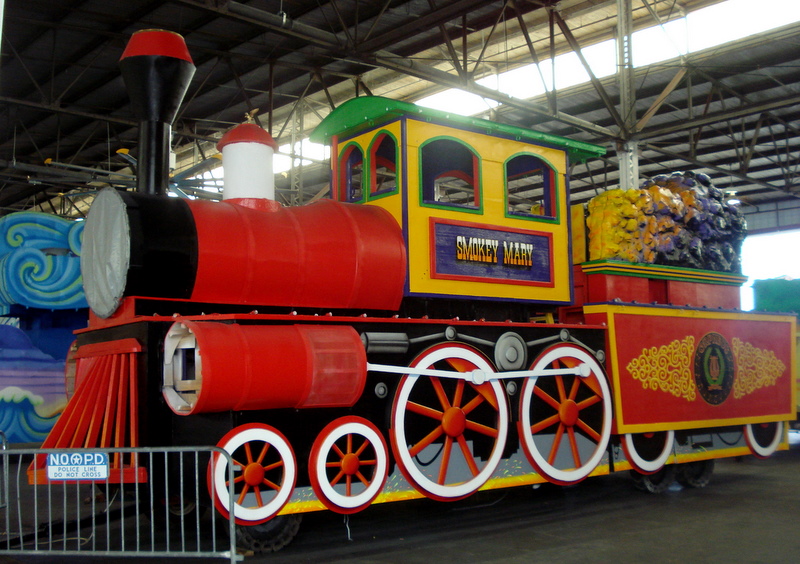
The artists at Mardi Gras World work on props and floats for Mardi Gras parades year round, beginning the day after Mardi Gras. Mardi Gras is the last day of Carnival, which begins on the Feast of Epiphany Jan. 6 and ends on the Tuesday before Ash Wednesday. Mardi Gras parades can take place any time during Carnival. Mardi Gras World produces about 600 floats per year, for about 40 of the 54 parades thrown by the New Orleans krewes each year. Each krewe chooses a different theme for its parade every year, so the only float that stays the same is the krewe’s signature float. Below are pictures of parts of the signature float of Harry Connick Jr.’s krewe, Orpheus:
| "Smokey Mary" |
| Diagram of float |
If you ever find yourself in New Orleans (and I sincerely hope you do), the trip to Mardi Gras World is worth your time. Even if you don’t pull out a sketchbook.
Mardi Gras World was just the beginning of our adventures. We ate lunch at Antoine’s the second oldest restaurant in the French Quarter (opened in 1840). Antoine himself invented dishes such as Chicken Creole, Crayfish Etoufee and Shrimp Remoulade. His son Jules created, among other things, Oysters Rockefeller. We spent the afternoon taking a walking tour of the French Quarter with a guide from the Friends of the Cabildo and later walked to dinner at Mother’s.
And that was just Day 1.
I’m in New Orleans with Laure Ferlita, attending Imaginary Trips’ first “Imaginary Trips Made Real” artist’s painting holiday. In between sketching on location, we’re exploring the history, culture and food of the Crescent City.
Hope you have a great week, and I’ll report in soon!
—Diane Ackerman
You can also develop a great strength training program with horses. Aside from the obvious hauling of hay or bags of feed, or shoveling manure, there’s always carrying your saddle (especially if it’s a western saddle—those things are heavy!), or attempting to hold up your horse as he leans on you while you clean his feet. Posting a trot and riding without stirrups are excellent exercises for the thigh muscles as well.
Don’t forget the fitness benefits of relaxation. Being around a horse, at least for me, provides a way to lower my blood pressure. Just looking at horses, stroking their soft coats and smelling that warm barn smell makes me feel calmer.
By all rights, I should be a lot thinner than I am after burning all those calories at the barn. (Maybe it has something to do with the chocolate one of my barn buddies gave me…hmm…)
Have you found any unusual ways to get fit?
| Pet, friend, therapist, and now personal trainer? |
Everybody
I stood at a bus corner
one afternoon, waiting
for the #2. An old
guy stood waiting too.
I stared at him. He
caught my stare, grinned,
gap-toothed. Will you
sign my coat? he said.
Held out a pen. He wore
a dirty canvas coat that
had signatures all over
it, hundreds, maybe
thousands.
I’m trying
to get everybody, he
said.
I signed. On a
little space on a pocket.
Sometimes I remember:
I am one of everybody.
American Life in Poetry is made possible by The Poetry Foundation (www.poetryfoundation.org), publisher of Poetry magazine. It is also supported by the Department of English at the University of Nebraska, Lincoln. Poem copyright ©2006 by Marie Sheppard Williams. Reprinted from “The California Review,” Volume 32, no. 4, by permission of Marie Sheppard Williams and the publisher. Introduction copyright © 2009 by The Poetry Foundation. The introduction’s author, Ted Kooser, served as United States Poet Laureate Consultant in Poetry to the Library of Congress from 2004-2006.
It all started Friday. I went for a ride on Tank, because we finally got a REAL cold front that dropped our temperatures into the—oh joy!—70s. (I’d skipped my normal Wednesday ride because the heat and humidity were so bad I was extremely cranky, and cranky rider often = cranky horse…something I don’t think any of us wants to see.) Tank and I had a lovely ride, and practiced longer stretches of trotting to build muscle (for both of us) without winding up in a puddle of sweat.
When I got home, I opened all the windows in the house and sat outside on the lanai to read for a bit before dinner.
Saturday, I started the day with three of the loveliest words in the English language: library book sale. So far as I know, this was the first one my local branch has hosted, and though I tried not to get my hopes too high, I was eager to see what they’d have. Danielle at A Work in Progress often has wonderful luck at her library book sales, and I hoped maybe it would rub off on me. The sale was fairly small, and I came home with only three books: Stephen King’s Duma Key (to replace our missing copy—a truly amazing, though creepy, story); Perfectly Imperfect, by Lee Woodruff, a collection of essays about being a wife, mother, daughter and friend; and Sarah’s Key (Tatiana de Rosnay), a book I've had on my TBR list for a while. The lady who checked me out exclaimed, “Oh, this is such a good book,” when she saw it, so I feel that’s a good omen.
Later that day, my husband and I joined another couple for a trip to a little town nearby to browse antiques stores. No one found any treasures to take home, but we enjoyed the beautiful day, and the poking around through others’ interesting and unusual possessions.
We also stopped here:
Friends of ours own this candy store, so we bought an assortment of chocolate to (ahem) support their fledgling business.
And Sunday? Well, Sunday was the best of all. My son and husband went mountain biking, leaving me home alone for most of the day. I filled the hours, which went by like minutes, with reading (the Sunday paper and The Winter Sea), puttering (cleaned off my kitchen desk and the drawers and cabinet surrounding it while watching Eat Pray Love on dvd) and simply chilling out and enjoying the solitude. I also watched one of Laure Ferlita’s class videos, and fooled around trying to figure out what to sketch for the assignment.
My weekend was the perfect blend of activity and relaxation, solitude and togetherness. I especially loved doing something fun with my husband, instead of doing errands or household projects. I hope future weekends will be just as wonderful.
How was your weekend?
| All this fun is just exhausting... |
| I take classes with Laure Ferlita... |
A poor memory? I would have thought the opposite: a good memory to keep in mind the positive things that happen. Isn’t that what gratitude lists and such are all about? But after a little thought, I realize there are plenty of things we’d be wise to forget, such as:
Mistakes we’ve made. I know I need to work on this, because when I make a mistake, I have a tendency to replay it in my mind over and over, often blowing it out of proportion. Everyone makes mistakes. I make mistakes, even though I really don’t want to admit that I do. If necessary, apologize, and/or make things right, then move on. Cling to the philosophy, as the heroine in Anne of Green Gables did, that “tomorrow is a new day with no mistakes in it yet.”
Wrongs done to us. What good does it really do to dwell on them? Life isn’t fair. Some people are jerks. Other people make mistakes (see above) and hurt us, whether accidentally or on purpose. Let it go.
Past situations we wish were different. The ridiculous fight you had with your spouse. The time you didn’t make the varsity [insert sport here] team. The investment you made/didn’t make at the wrong/right time. The past is done…it’s passed. Time to move on.
As Barbara Ann Kipfer wrote in Field Guide to Happiness for Women (where I found the Albert Schweitzer quote), “The concept of forgetting the things that should be forgotten adds happiness to your life. But the flip side is knowing what not to forget.” Remember the good things: the love of your family and friends, the small details of today that give you joy, what you truly are grateful for. And, according to Kipfer, “Don’t forget that you are in charge of creating your own happiness.”
What do you want to forget? What do you want to remember?
I know a few people who simply don’t read. Well, that’s not quite accurate—they don’t read books. They read things on the internet, or they flip through magazines or the newspaper. Some simply aren’t interested in books, while others say they fall asleep as soon as they sit down with a book.
This is unthinkable.
My life would be immeasurably poorer without books. They’ve been my teachers and companions since I first deciphered letters on the page. If I were an Egyptian queen, I’d want to be buried with my library.
I find connection with other people through reading—a sort of validation that my feelings and thoughts are not unique to the world. I find this particularly in the writings of women, especially those who have the experience of trying to balance family commitments with some type of artistic life.
I read to learn—not only about practicalities, like how to take better photos (The Digital Photography Book) or use my time more effectively (168 Hours), but to see what it would be like to live in a different time, or as a man, or even as a horse (Black Beauty). As a writer, I read to improve my writing by immersing myself in beautiful language. I observe how other writers structure their work, and play with words. I read to try to understand other people’s points of view, thus expanding my own. I read to escape to new worlds, to laugh, to enrich my life. I know reading books isn't the only way to do these things, but I feel that people who don't read books miss out on a lot.
Mostly, though, I read for the sheer pleasure of it.
Why do you read?
October
I used to think the land
had something to say to us,
back when wildflowers
would come right up to your hand
as if they were tame.
Sooner or later, I thought,
the wind would begin to make sense
if I listened hard
and took notes religiously.
That was spring.
Now I’m not so sure:
the cloudless sky has a flat affect
and the fields plowed down after harvest
seem so expressionless,
keeping their own counsel.
This afternoon, nut tree leaves
blow across them
as if autumn had written us a long letter,
changed its mind,
and tore it into little scraps.
American Life in Poetry is made possible by The Poetry Foundation, publisher of Poetry magazine. It is also supported by the Department of English at the University of Nebraska-Lincoln. Poem copyright ©2010 by Don Thompson, whose most recent book of poetry is Where We Live, Parallel Press, 2009. Reprinted from Plainsongs, Vol. 30, no. 3, Spring 2010, by permission of Don Thompson and the publisher. Introduction copyright ©2011 by The Poetry Foundation. The introduction's author, Ted Kooser, served as United States Poet Laureate Consultant in Poetry to the Library of Congress from 2004-2006.
| Life is good |
I have a complaint. Where has the Table of Contents gone? Two of the books I’m reading have chapters with names instead of just numbers, but no Table of Contents. The publisher couldn’t spare the space or paper for a Table of Contents, yet they can have a page in the back with details about the book’s typeface?! I’m as interested in the typeface as the next person (not very), but I’d rather be able to read the chapter titles and speculate on their contents. I also like consulting the TOC to see how I’m progressing through the book. I don’t like flipping through the book to read the chapter titles, or trying to assess my progress through them this way. It’s just one of my quirks.
A quirk is a peculiarity of behavior, an idiosyncrasy. Our quirks are part of the reason we are who we are—and most of them are completely harmless, though they may seem strange to others. Some of them become habits, or even superstitions—like the hockey players who will not step on the team logo on the floor of their locker room (and won’t allow visitors to do so, either) or the Hollywood writer who backs out of a room in which something good happened.
Quirks can be as simple as whether you put on both socks, then both shoes, or a sock and a shoe and a sock and a shoe; how you take your shower; in what order you eat the foods that make up your dinner (“never end with a bite of something you don’t like”). Some of my additional quirks include:
- I often get the hiccups when I take the first sip or two of a carbonated drink.
- I don’t like mayonnaise on anything except steamed artichokes.
- I keep lists of all the books I read each year.
- I talk to my dog and my horse just like they are people. (They don’t talk back, however, at least in words…)
- I prefer to slice fruit like apples, peaches or plums rather than eat them whole.
| Morning |
After spending a few days with my mom and step dad, I headed back down to Sacramento to return my rental car and meet my dad and step mom. My companions on the drive:
I loved the drive to and from my mom’s house—it’s straight and easy, up Interstate 5, a trip we took many times when I was growing up. The drive gave me time to think, to sing along with the iPod, to watch for landmarks from my childhood letting me know I was getting close to my destination. I love the openness, the flat fields backed by misty little hills in the distance.
Sacramento was HOT. One hundred degrees a couple of the three days I was there—but, say it with me, it was a dry heat! And it was cool in the morning and evening, so still not as uncomfortable as Florida.
My step mom and I spent our time doing all the things we enjoyed when I was growing up: shopping, going to the movies and visiting with family. My step brother came over for dinner and we visited my step grandma at her assisted living facility, where my step uncle met us. (My dad and step mom have been married for more than 30 years, so her family is my family.) And, of course, there’s my “sister”:
One of the highlights of the trip: Harness racing at Cal Expo. My dad used to take us to these when I came to visit him in the summer. I adored watching the horses race, and one memorable evening, we got to ride in the starting car. Occasionally we’d arrive early and walk through the stables where I breathed in the scent of hay and horse and walked on air for hours afterwards.
Harness racers are standardbreds, who trot or pace around a track pulling a two-wheeled cart (called a sulky) and driver, at up to speeds of more than 30 mph. (In the pace, the two legs on the same side of the horse move forward together, unlike the trot, where the two legs diagonally opposite from each other move forward together.) Most races are a mile long. The most famous race is the Hambletonian, held every year in August at The Meadowlands racetrack in New Jersey, but you can see harness racing at many county and state fairs all over the U.S. (For more information, see http://www.ustrotting.com/. To learn more about standardbreds, go here.)
We ate dinner at the Turf Club and spent several hours watching the races. And let me tell you, it’s far too easy to place bets. You can buy a voucher for whatever amount you want, then slip your voucher into a machine, use a touch screen to place your bet and away you(r money) go(es). I limited myself to a $20 voucher.
My system of betting was highly scientific. First, I chose a horse whose name had some meaning for me. I got my dad to decipher the racing form and quickly read up on the horse’s stats. I usually placed a “win, place, show” bet, so that I would win if my horse came in first, second or third, and I liked to bet on long shots (or at least not favorites). My first race, I chose “Racetrack Diva” in honor of my friend’s horse, Glory, an off-the-track thoroughbred. Diva obliged me by coming in third. The next race I bet on, I chose “Amazon Dot” because of my love affair with Amazon.com. Dot won the race! I began to feel pretty proud of my system! You can guess what happened next. For the rest of the evening, none of my choices came in better than fourth. I ended the evening with a net loss of $3.90, which I consider well worth it for the amount of entertainment I got.
My family—both sets—basically spoiled me while I was in California, and gave me a much-needed break from my everyday responsibilities. I felt so lucky to be able to see my California family while my Florida family took care of themselves.
Monday, I asked, “What makes a place home for you?” This morning, I found an answer: “Where we love is home—home that our feet may leave but not our hearts.” (Oliver Wendell Holmes)
Indian Summer
There’s a farm auction up the road.
Wind has its bid in for the leaves.
Already bugs flurry the headlights
between cornfields at night.
If this world were permanent,
I could dance full as the squaw dress
on the clothesline.
I would not see winter
in the square of white yard-light on the wall.
But something tugs at me.
The world is at a loss and I am part of it
migrating daily.
Everything is up for grabs
like a box of farm tools broken open.
I hear the spirits often in the garden
and along the shore of corn.
I know this place is not mine.
I hear them up the road again.
This world is a horizon, an open sea.
Behind the house, the white iceberg of the barn.
American Life in Poetry is made possible by The Poetry Foundation (www.poetryfoundation.org), publisher of Poetry magazine. It is also supported by the Department of English at the University of Nebraska, Lincoln. Copyright ©2007 by Diane Glancy, whose novel “The Reason For Crows,” is forthcoming from State University of New York Press, 2009. Poem reprinted from “Asylum in the Grasslands,” University of Arizona Press, 2007, by permission of Diane Glancy. Introduction copyright © 2009 by The Poetry Foundation. The introduction’s author, Ted Kooser, served as United States Poet Laureate Consultant in Poetry to the Library of Congress from 2004-2006.