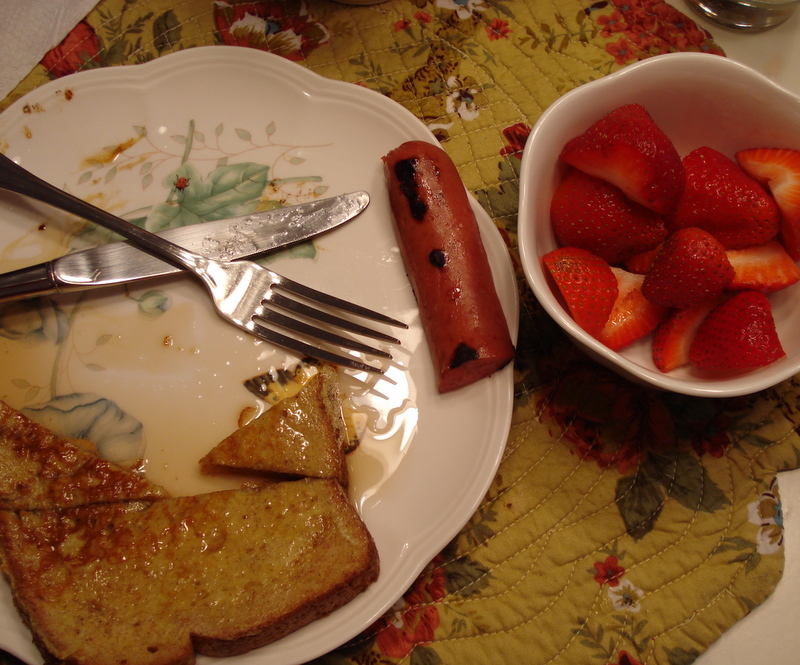
I'm up to my eyeballs in article writing (thanks, Michele!), so I'll just share this photo with you:
Sometime in our lives my husband and I must have angered Poseidon, mythological god of the sea. We’ve been on three cruises together, and all three have featured the unexpected, if not the downright awful.
It all started on our honeymoon. My father had given us a four-night cruise as a wedding present. After embarking from San Pedro (CA) the day after our wedding, we were to visit San Diego, Catalina Island and Ensenada, Mexico. We’d endured a wild rainstorm on our wedding day, but the next morning dawned sunny and bright. The sea was a little choppy, but nothing Dramamine couldn’t handle.
Our first shore excursion, to the San Diego Zoo, provided us with a clue that the storm had left lasting effects. Many of the animal habitats lay strewn with tree limbs and other by-products of the wind and rain. We saw quite a few bewildered-looking animals exploring their “redecorated” homes.
The zoo was a bit messy, but otherwise fine, and our stop at Catalina was uneventful. But when we reached Ensenada, we were told the port was torn up and we weren’t able to dock. Our planned horseback-riding-on-the-beach excursion was exchanged for a day at anchor in the harbor where my new husband tried to teach me to play chess.
Two years later, we braved a second cruise, a more ambitious one: from Venice to ports in Turkey and Greece. Our troubles began before we even boarded the ship. We flew from our home in California to New York City, where we planned a couple of days’ sight-seeing before flying to Milan. A medical emergency on board forced us to make an emergency landing in Denver, where the size of the plane and the shortness of the runway destroyed our landing gear. The airline had to fly parts and mechanics to Denver to fix the plane, and an eight-hour unplanned layover—spent entirely in the airport, waiting for news about when we would fly out—ensued.
Next, when we disembarked in Milan, I left our contact lens solution on the airplane. After we moved on to Venice before our cruise, it rained constantly as we tried to explore the beautiful old city. Pictures from this trip feature us wearing chic green plastic bag slickers—and glasses!
When we finally boarded the ship, our cabin was situated next door to crews' quarters where they argued constantly and loudly. It featured a wall-mounted toilet-flushing button so stiff I had to use my foot in order to press it hard enough to do the job. Another storm delayed the cruise so that our shore excursions took place at night. We “saw” Greece from a bus in the dark. On the trip home, which took more than 24 hours, I came down with a cold. While waiting for our connecting flight at JFK, we were reduced to eating out of vending machines and drinking our souvenir Greek Metaxa out of a paper bag.
| One thing we did see: Corinth Canal |
While we were on the land portion of our tour, news reports of a “sick ship”—our ship!—reached us. The illness, Norovirus, was described as “a mild gastrointestinal illness,” but the cruise before ours had to head back early because so many passengers became ill, and so the ship could be disinfected before our cruise began.
We were a little nervous about boarding, but all seemed fine. Aside from industrial-sized containers of hand sanitizer on every deck and not being able to serve ourselves from the buffet, there seemed to be no sign of the previous passengers’ illness. The ship was lovely, our stateroom comfortable (with an easily-flushed toilet) and to our son’s joy and our eventual thankfulness, two TVs. We enjoyed the gorgeous scenery and cushy shipboard amenities. Our son gloried in the freedom of the kids’ programs, and roaming the ship with new friends and a walkie-talkie to keep in touch with us.
It was just after a stop at Glacier Bay that I started to feel a little queasy. I popped some additional seasickness medicine, but it didn’t help. I quickly went from sipping champagne and eating chocolate-dipped strawberries to being confined to my bathroom. My son didn’t even make it back to the cabin—he threw up in the elevator. My poor husband had to take care of him while I collapsed in bed. “Mild” illness? I've never been so sick in my life.
A “cabin call” from the medical staff distributed shots and other medications to battle the virus. Just as I started to feel a little better, my husband began to fall ill.
Aside from feeling so bad, between the actual illness and quarantine days, we missed two out of three ports of call, including our helicopter/glacier/sled dog shore excursion. (We couldn’t have been sick or quarantined during one of our days at sea, oh no.) When we finally staggered off the boat, we vowed never again. The only bright spot in this horrific trip was that our parents, who were all in their late 60s, did not get the virus, and by all accounts, had a marvelous time.
So when it’s time to plan our next vacation and one of us says, “Hey, let’s go on a cruise,” we laugh ourselves silly and make different plans. Land plans.
Increase sources of happiness. This is probably the simplest and most obvious way to feel happier. My greatest sources of feeling good include spending time with friends, playing with Tank, reading and sketching. What gives you joy? What do you like to do? How can you have more fun? To feel happier, we should include one or more of our favorite pastimes every day.
| Watercolor sketch from Laure Ferlita's class |
Decrease sources of unhappiness and bad feelings. Maybe that means tackling some unfinished business or dealing with a difficult situation. Since I’ve found the importance of mindset in how I feel about my life, I’ve been examining some of my feelings and attitudes, and banishing the ones that aren’t true or are bringing me pain or discomfort. Replacing old ways of thinking with new ones can feel a little unsettling, but getting rid of the sources of nagging bad feelings frees up space in our hearts for happiness.
“Feeling right”
This means feeling as if you are doing what you are meant to do. I ask myself frequently, Am I the person I want to be? Do I respect myself? Am I doing work that feels “right”? These past few months I’ve questioned whether or not I really want to continue to write, and wondered if I still have anything to say (that anyone would want to read). For now, I still keep returning to the keyboard because writing is too much a part of who I am for me to easily cast it aside. It still feels “right,” even when it’s hard. How comfortable are you with who you are? Sometimes “feeling right” makes us happy in the face of frustration and obstacles.
“Atmosphere of growth”
Deep and lasting happiness comes more easily in an atmosphere of growth. That is, when you’re learning something new, increasing your skills, stepping outside your comfort zone, or challenging yourself. Yes, there’s definitely a time for simple relaxation, for “noodling,” for “fun” fun that doesn’t put too many demands on you. But that shouldn’t be the extent of your fun. Owning Tank is a perfect example of this. There is a good deal of “fun” fun to be had in horse ownership—but I’d be lying if I said everything about it was easy. I’m pushed outside my comfort zone nearly every time I get on his back, because correct English-style riding is challenging. It’s not simply sitting on the horse’s back and letting him do the work. Being the leader in our herd of two requires vigilance, consistency, patience and firmness. However, I don’t believe I would find horse ownership quite so deeply satisfying if I was not being gently challenged to grow. If you consider the times you’ve been happiest, chances are you’ve been engrossed in something that was just the tiniest bit challenging.
| Whaddya mean, it's not all easy? |
If you haven’t already, check out Gretchen Rubin’s blog here.
![]() |
| Photo courtesy stock.xchng.com |
Spare Parts
We barge out of the womb
with two of them: eyes, ears,
arms, hands, legs, feet.
Only one heart. Not a good
plan. God should know we
need at least a dozen,
a baker’s dozen of hearts.
They break like Easter eggs
hidden in the grass,
stepped on and smashed.
My own heart is patched,
bandaged, taped, barely
the same shape it once was
when it beat fast for you.
American Life in Poetry is made possible by The Poetry Foundation (www.poetryfoundation.org), publisher of Poetry magazine. It is also supported by the Department of English at the University of Nebraska-Lincoln. Poem copyright © 2006 by Trish Dugger. Reprinted from Magee Park Poets: Anthology 2007, No. 18, Friends of the Carlsbad City Library, 2006, by permission of Trish Dugger. Introduction copyright © 2009 by The Poetry Foundation. The introduction's author, Ted Kooser, served as United States Poet Laureate Consultant in Poetry to the Library of Congress from 2004-2006.
Wouldn't it be fun to make a playlist for all my activities, like writing or driving, or just sitting and thinking? For writing, I prefer instrumental music, so I can hear my own words without being distracted by others’. My favorite writing songs come from guitarist Billy McLaughlin’s* album, Out of Hand.
When I’m driving, I want words and lots of them, because I like to sing along. Songs like Evanescence’s “My Immortal,” and show tunes like “Good Morning Baltimore” from Hairspray and “For Good” from Wicked are fantastic for belting out while driving down the road.
For sitting and thinking, there’s always Carbon Leaf’s “What About Everything?” or classical music, or something by Josh Groban.
You could make playlists for all kinds of experiences and emotions: feel-good songs, I-need-a-good-cry songs, revenge songs… you name it. My friend Marianne just made a playlist of hockey songs in honor of our local professional hockey team’s presence in the Stanley Cup playoffs! (I didn’t know there were that many songs about hockey!)
Does your life have a soundtrack? What’s on your favorite playlist?
*While checking the spelling of Mr. McLaughlin’s name for this blog post, I learned of his remarkable and inspiring comeback story—read about it here.)
| Take time to smell me. |
I don’t know about you, but this is what happens when I rush:
I break things. Dishes, fingernails, even, recently, my laptop monitor because I rushed to pick it up. I nearly broke my new mini book light when at first I couldn’t figure out how to open the battery door. (Hint: it helps to look at the clearly labeled diagram.)
I hurt myself. I bruise my leg on the open dishwasher door, or the footboard of my son’s bed. I whack my forearm on the doorknob in the hallway, or the back of my head on a fence I’m leaning through.
I hurt others. Being in a rush means my mind is often elsewhere. When this is the case, I’m not looking at or listening to the person right in front of me. (And if I’ve done this to you, let me apologize right now.)
| What's your hurry? |
In order to slow down, I have to make some hard choices. I limit my activities, even, alas, the fun ones, so that I truly experience the ones that remain. I also cut the daily to-do list in half, and I don’t compare what I can get done in a day with what my friend down the street accomplishes. I lower my standards in certain areas. I’m not always successful—but I’m working on it.
Do you find yourself rushing through your days? What have you done, or do you plan to do to slow down?
Most men pursue pleasure with such breathless haste that they hurry past it.
Last week Laure Ferlita and I took a field trip to the University of South Florida’s Botanical Gardens. Laure’s preparing an online class, “An Imaginary Visit to the Garden,” and I haven’t been to the gardens since last year’s trip to the spring plant festival.
The USFBG is a relaxed and friendly sort of garden. Mostly cared for by volunteers, it’s the perfect place to wander aimlessly, forgetting the world speeding by on the major streets that run on two sides of the garden. The carnivorous plants bloomed
Faery (or fairy) houses, musical frogs, gnomes and fairies of all sorts peeked out from the plantings of impatiens, violas, ornamental cabbage and other magical plants.
After last week's power outage, I've been thinking about how dependent we are on electricity and technology. While I’m grateful for the technological advances we take for granted—I’m typing this on a laptop computer instead of a manual typewriter, and don’t know how I’d cope without the internet, for example—sometimes I long for a simpler, quieter, less electronic atmosphere. So this weekend, I'm going to unplug and do some of the following:
Chat with my visiting mother-in-law.
Cuddle with my dog.
| I'm snuggle-icious! |
Sip a cup of tea.
Take a walk for pleasure, not for exercise.
| This looks like a good place to walk. |
Hug someone.
Put together a jigsaw puzzle.
Take a nap.
Work a crossword puzzle.
Sketch.
Watch birds in the backyard.
Write in my journal.
And, of course, read a book.
These are some of my favorite low-tech pleasures. What are yours?
So often, reading a poem can in itself feel like a thing overheard. Here, Mary-Sherman Willis of Virginia describes the feeling of being stilled by conversation, in this case barely audible and nearly indecipherable.
in a foreign tongue, in the sun-rinsed air of the city.
They sat (so I thought) perfumed in their hats and their silks,
in chairs on the grass amid flowers glowing and swaying.
One spoke and the others rang like bells, oh so witty,
like bells till the sound filled up the garden and lifted
like bubbles spilling over the bricks that enclosed them,
their happiness holding them, even if just for the moment.
Although I did not understand a word they were saying,
their sound surrounded me, fell on my shoulders and hair,
and burst on my cheeks like kisses, and continued to fall,
holding me there where I stood on the sidewalk listening.
As I could not move, I had to hear them grow silent,
and adjust myself to the clouds and the cooling air.
The mumble of thunder rumbled out of the wall
and the smacking of drops as the rain fell everywhere.
American Life in Poetry is made possible by The Poetry Foundation (http://www.poetryfoundation.org/), publisher of Poetry magazine. It is also supported by the Department of English at the University of Nebraska-Lincoln. Poem copyright © 2007 by Mary-Sherman Willis. Reprinted from The Hudson Review, Vol. LX, no. 3, (Autumn 2007), by permission of Mary-Sherman Willis. Introduction copyright © 2009 by The Poetry Foundation.
What are some of your favorite routines? What rut(s) would you like to escape from? What small change can you make to liven up your life?
How does this sound: 10 hours with no errands, laundry or grocery shopping, no TV blaring, no checking email or mindlessly surfing the ’net? Yeah, I would have thought so, too. I spent such a day yesterday, but I did not find it relaxing or refreshing. I found it frustrating…and then this morning, I realized how lucky we’d been.
A storm system blew through our area yesterday, drenching us, spinning off tornados, and cutting power to more than 100,000 people, some of whom will not get their electricity back until late today. Strong winds tipped over cars, trucks and small airplanes, flattened fences, tore apart pool cages and snapped power poles. Thankfully, no one was killed or seriously injured, according to the local paper. (To see photos, click here and scroll to "Links from the Times for April 1: Severe storm.")
Forecasters expected the storms to be strong, but not this extreme, so some people (including me) were caught off guard and unprepared. We were without electricity for 10 hours. I didn’t have my laptop battery fully charged and hadn’t taken a shower following my workout. Due to the power failure, our household alarm system caused all the smoke alarms to go off with nerve-shattering blasts. My husband and I ran through the house with a bar stool, disconnecting them. The two radios we have that take batteries didn’t work when we put the batteries in them. Since I didn't know what was happening, I didn't realize how serious this storm system was.
I couldn’t do any of the things I’d planned for the day. No power for doing laundry or working on the computer. The wind and rain made it too dangerous to run errands, and even with candles and battery-operated lamps, it was too dark in the house to do any real work.
I would have enjoyed this if I hadn’t felt worried about dinner and what we’d wear the next day if I couldn’t finish the load of laundry sitting in the washing machine. I worried about the survival of my freezer’s contents and how long we could go before we opened the fridge and let all the cold air out. I felt guilty about what I “should” be doing, and anxious that my Friday would now become too busy to manage.
The real problem here was not the power failure. It was my expectations and slavery to a schedule, my inflexibility and my inability to abandon myself to the moment. It took me nearly all day to wrestle my mind to the ground and relax and enjoy the experience. When I stayed in the moment, I enjoyed hearing the sound of the rain on the roof—something I can’t always hear when all the electrical things are humming. I admired three creamy gardenia blossoms glowing under a silvery white sky, while our oaks bobbed and bowed in the wind. I pulled out and reread one of my favorite books, 84 Charing Cross Road. I only became anxious when I began to think about what would happen if the power didn’t come on soon.
Yesterday, Gretchen Rubin’s emailed Moment of Happiness was this quote from Schopenhauer: “To be sensitive to trifles implies a state of well-being, since in misfortune we never feel them at all.” I realize I am fortunate. We have no damage to our home, and the boarding stable where we keep Tank is completely unscathed. Today, I can think about what I learned from my enforced idleness, catch up on everyday chores—and be thankful that we are all safe.
*I'm beginning a new feature on Catching Happiness--each Wednesday, I'll post a photo, an interesting quote or piece of poetry--something to inpire, amuse, uplift--and help us make it through the week. Hope you enjoy it (and please let me know what you think).
This is my second year to choose a “word of the year” to guide me, and I wanted to stay more in touch with my word than I did last year, when I pretty much let “open” recede into the background. To do that, I’m keeping some brief notes, and performing a quarterly evaluation of how things are going. Here’s what I’ve learned so far:
The concept of light can be applied to many areas of my life—my home, health, relationships and attitudes. Each of these areas could use a little “light therapy.” In my home, I’m lightening up by getting rid of excess possessions—pretty obvious, and an ongoing process as I fight my pack-rat-ish tendencies. In addition to getting rid of stuff, I’m incorporating things that bring light to my life, like the simple act of opening all the blinds in my bedroom each day because it lifts my spirits to see the room flooded with light when I walk by.
I’m working to eat lighter (another ongoing project) in hopes that I’ll eventually be lighter; I’m striving for a light touch with family and friends by doing more listening and encouraging and less advising and correcting.
And most important of all, when it comes to my attitudes, choosing light as my word of the year has reminded me to look for the bright side, to focus on the good I find in daily life. When two or more courses of action present themselves, I choose the one that feels “light.” When I feel myself spiraling down into melancholy, I remind myself to look for the light. I think that’s my take-away lesson of the first three months of 2011: Look for the light.
Do you have a word of the year? How is it working for you so far and what have you learned?
![]() |
| Nikolay Okhitin, PhotoXpress.com |
Terra incognita means “unknown territory.” It’s a term cartographers used to use to describe unmapped or undocumented regions. According to urban legend, these areas were sometimes labelled “Here be dragons,” though only one map survives with this wording (“Hic svnt dracones”). However, Roman and medieval cartographers did mark maps with the phrase, “Hic svnt leones,” which means “Here are lions.” (Wikipedia)
Why do we expect scary things (dragons, lions) when we face the unknown? Why not expect unicorns, or daisies? It seems to be human nature to expect the worst when facing the unknown, and to some extent, that’s what keeps explorers alive: expecting and preparing for the worst.
To my knowledge, there are no more unknown and unmapped physical lands, though terra incognita is sometimes used metaphorically to describe an unexplored subject or field of research. However, there is still the unknown land, the terra incognita, of the future. None of us knows what the future holds, though plenty of dire predictions can be found as close as your nearest screen—TV or computer.
Since we will all navigate the unknown land of the future, what tools should we use? The same ones we use in navigating our known world: our good sense, our friends and family, our spiritual principles, our ability to learn, and a positive outlook that we can handle whatever lions life throws at us. While we explore, we should be on the lookout for the positive, not just the negative, because I’m more and more convinced we see what we expect to see.
While we certainly should prepare for negative eventualities in our lives, why not also prepare for positive ones? Save money not just for a calamity, but for a celebration once the promotion comes through, the report card contains straight As, or the grandchild is born.
Truly, every new day is terra incognita. We don’t know what it will bring. Whatever it holds for us—daisy or dragon, unicorn or lion—if we cling to our tools of navigation, we’ll come through safely.